All species › Owls › Owls › Crested Owl
Crested Owl | Lophostrix cristata
Kuifuil | Búho corniblanco | Coruja-de-crista
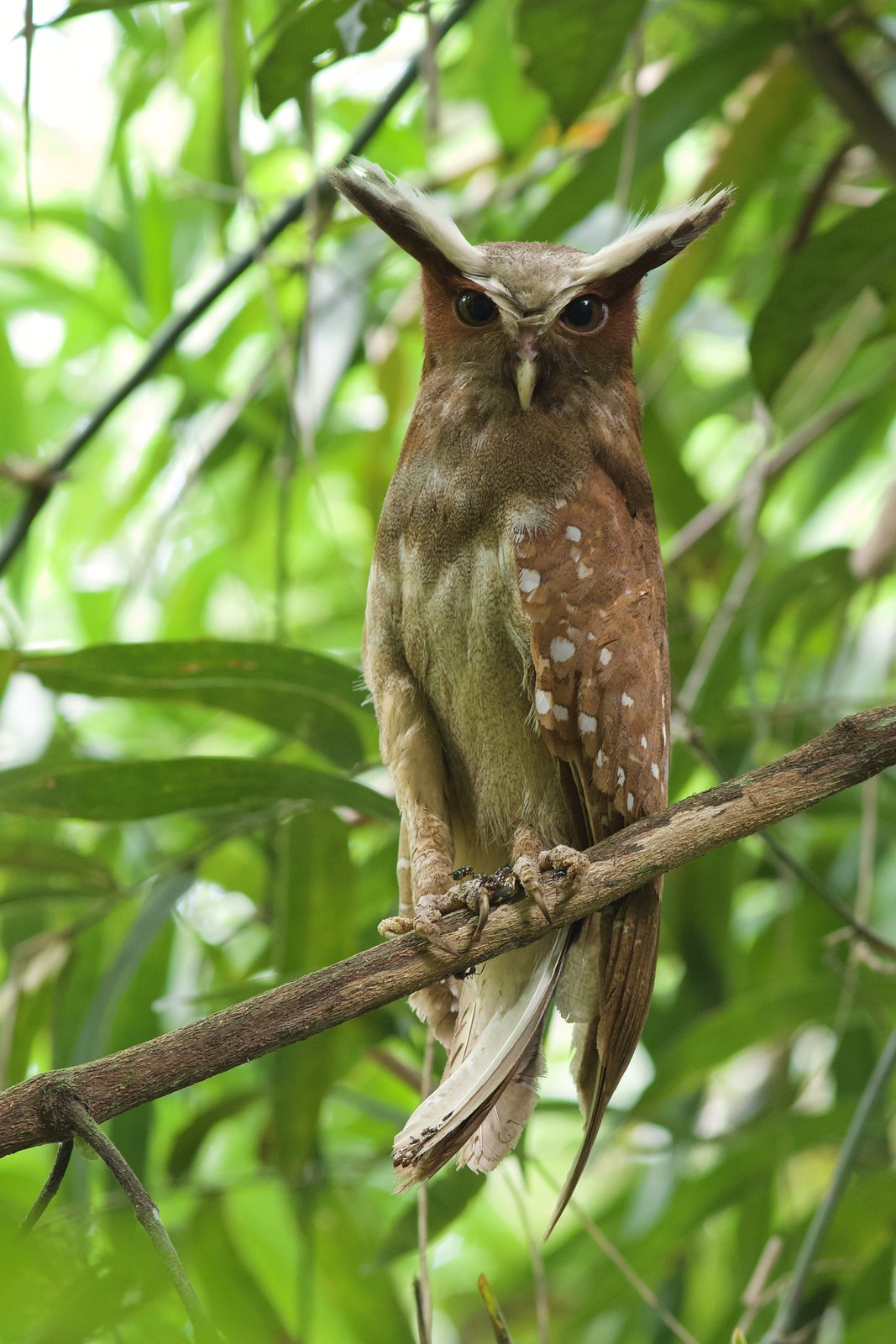
The Crested Owl is a medium-sized forest owl with long white ear tufts that continue into white eyebrows. It lives in humid lowland and foothill forest on both sides of the Andes and roosts by day, often in pairs, in dense foliage. It is the only species of the genus Lophostrix.
Voice
A low, frog-like, rolling growl, k-k-grrrrrrr, beginning with a few short stuttering notes, lasting about a second and repeated at intervals. Calls mainly in the first part of the night.
Recording: Jacob Wijpkema — CC BY-NC-SA 4.0 · xeno-canto
Identification
38–43 cm, with long white to whitish ear tufts that rise at an angle from the white eyebrows. The facial disc is rufous to dark brown, the eyes are orange-yellow to orange-brown and the bill is pale horn. The upperparts are dark chocolate brown with fine vermiculation and white spots on the wing coverts. The underparts are paler buff to brown with fine dark vermiculation. There are dark and paler, more rufous birds. The sexes are alike; young birds are whitish with a darker face.
Confusion species
Spectacled Owl Pulsatrix perspicillata lacks ear tufts and has a broad dark breast band, a yellowish belly and yellow eyes. Stygian Owl Asio stygius is blackish brown, with close-set ear tufts and streaked underparts, and lives mainly in montane forest and semi-open country. Striped Owl Asio clamator has pale, heavily streaked underparts and lives in open country.
Habitat
Humid lowland and foothill forest, also várzea and older secondary forest, often near streams and rivers, up to about 1500 m. By day it roosts in the lower and middle strata in dense foliage or vine tangles. It feeds mainly on large insects such as katydids, and sometimes small vertebrates. It nests in a tree cavity.
Where the bird is most at home, classified by the vegetation units of the Andes and the west coast.


Range and movements
In Colombia in the Pacific lowlands, the Magdalena valley and Amazonia. In Ecuador both in the west and in the eastern lowlands. In Peru in the eastern lowlands and foothills. In Bolivia in the lowlands of the north and east. Absent from the Galápagos. Outside the guide area from southern Mexico to Brazilian Amazonia.
- Resident
- dark = core range, pale = thinly spread
How and when to look
Guides at lodges in the Amazonian lowlands often know regular roost sites, usually in dense thickets along a stream, where a pair sits by day. At night the growl can be heard along streams in tall forest.
Conservation status
Least Concern. The species depends on forest and disappears where forest is cleared.
Scientific name
Lophostrix cristata | (Daudin, 1800)
Daudin described the species in 1800 as Strix cristata; because it was later moved to another genus, the author and year stand in brackets. The genus Lophostrix was introduced in 1836 by Lesson. The genus name comes from Greek lophos, 'crest', and strix, 'owl'. The species name comes from Latin cristatus, 'crested'. The specimen the first description was based on came from The Guianas.