All species › Passerines › Cotingas › White-tipped Plantcutter
White-tipped Plantcutter | Phytotoma rutila
Rosse zaagvink | Cortarramas argentino | Corta-ramos-de-rabo-branco
The White-tipped Plantcutter is a stocky, finch-like cotinga of dry scrub and open woodland in the south of the guide area. With its short, thick bill with finely serrated edges it clips off leaves, buds and fruit. It is one of the three plantcutters, a small group of dry, open landscapes in southern South America.
Voice
The usual call is a mechanical, drawn-out errrr, often repeated, recalling a door creaking on rusty hinges. Also short, nasal notes.
Recording: GABRIEL LEITE — CC BY-NC-SA 4.0 · xeno-canto
Identification
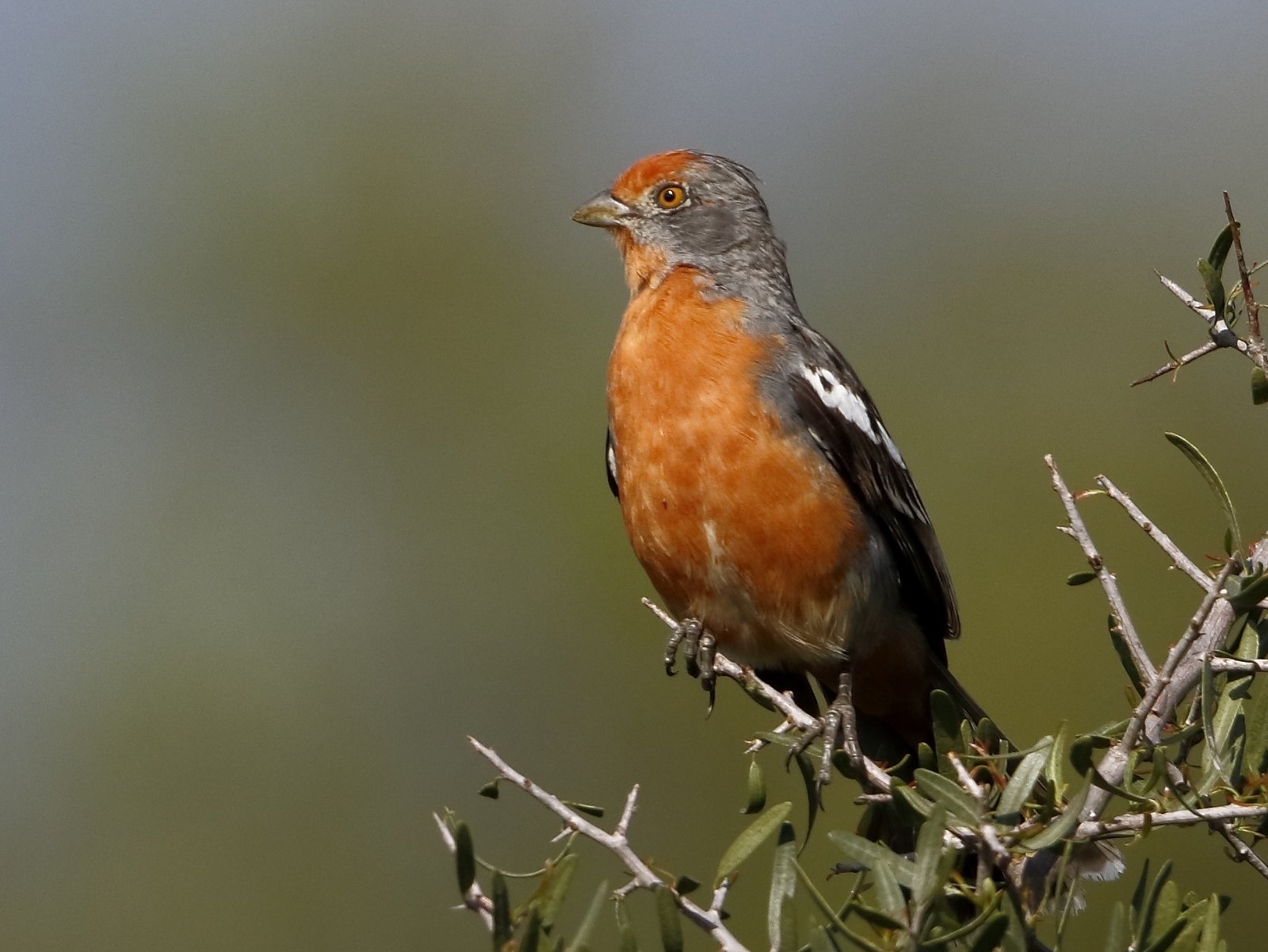
18–19 cm, with a short, conical bill, a short crest and a fairly long tail. The male has a rufous forehead, a dark grey crown and cheeks, and grey upperparts with a few dark streaks. The wings are blackish, with two white wing bars; the tail feathers have white tips. The throat and underparts are mostly rufous, with grey-brown flanks. The female is brown, with pale streaks on the head and back and heavy dark streaks on the buff underparts. The iris is pale yellow to hazel.
Confusion species
Peruvian Plantcutter Phytotoma raimondii lives only on the coastal plain of north-western Peru, far from the range of this species; the male is greyer, with rufous only on the belly. Golden-billed Saltator Saltator aurantiirostris shares the dry scrub, but has an orange or black bill, a pale eyebrow and a dark breast band. The streaked female may recall a female sparrow or finch, but is larger, with a small crest, a thick bill and white tail tips.
Habitat
Dry scrub, open dry woodland, chaco woodland, thickets along streams, hedges, orchards and gardens. In the Andes roughly from 600 to 3600 m, east of the Andes in the lowlands up to 1800 m. It feeds mainly on leaves, buds, shoots and fruit, which it clips off with its serrated bill. The nest is a loose platform of twigs in a shrub or low tree.
Where the bird is most at home, classified by the vegetation units of the Andes and the west coast.


Range and movements
In Bolivia in the dry Andean valleys and on the eastern slope, from Cochabamba south through Chuquisaca and Tarija, and in the Chaco lowlands; after the breeding season birds from the south reach south-eastern Bolivia. Absent from Colombia, Ecuador, Peru and the Galápagos. Outside the guide area in Paraguay, Argentina and Uruguay.
- Resident
- dark = core range, pale = thinly spread
How and when to look
Look in the dry valleys of Cochabamba, Chuquisaca and Tarija for birds perched on top of shrubs or on wires. The creaking errrr often gives the species away before the plumage does.
Conservation status
Least Concern. The species also lives in farmland with hedges and orchards, where it is locally regarded as harmful to buds and fruit.
Scientific name
Phytotoma rutila | Vieillot, 1818
Vieillot described the species in 1818 and placed it straight away in the genus where it still stands. The genus Phytotoma was introduced in 1782 by Molina. The genus name comes from Greek phuton, 'plant', and -tomos, 'cutting', after the serrated bill used to clip plant material. The species name is Latin rutilus, 'reddish, ruddy', after the rufous plumage. The specimen the first description was based on came from Paraguay.