All species › Passerines › Cotingas › Peruvian Plantcutter
Peruvian Plantcutter | Phytotoma raimondii
Peruaanse zaagvink | Cortarramas peruano | Corta-ramos-peruano
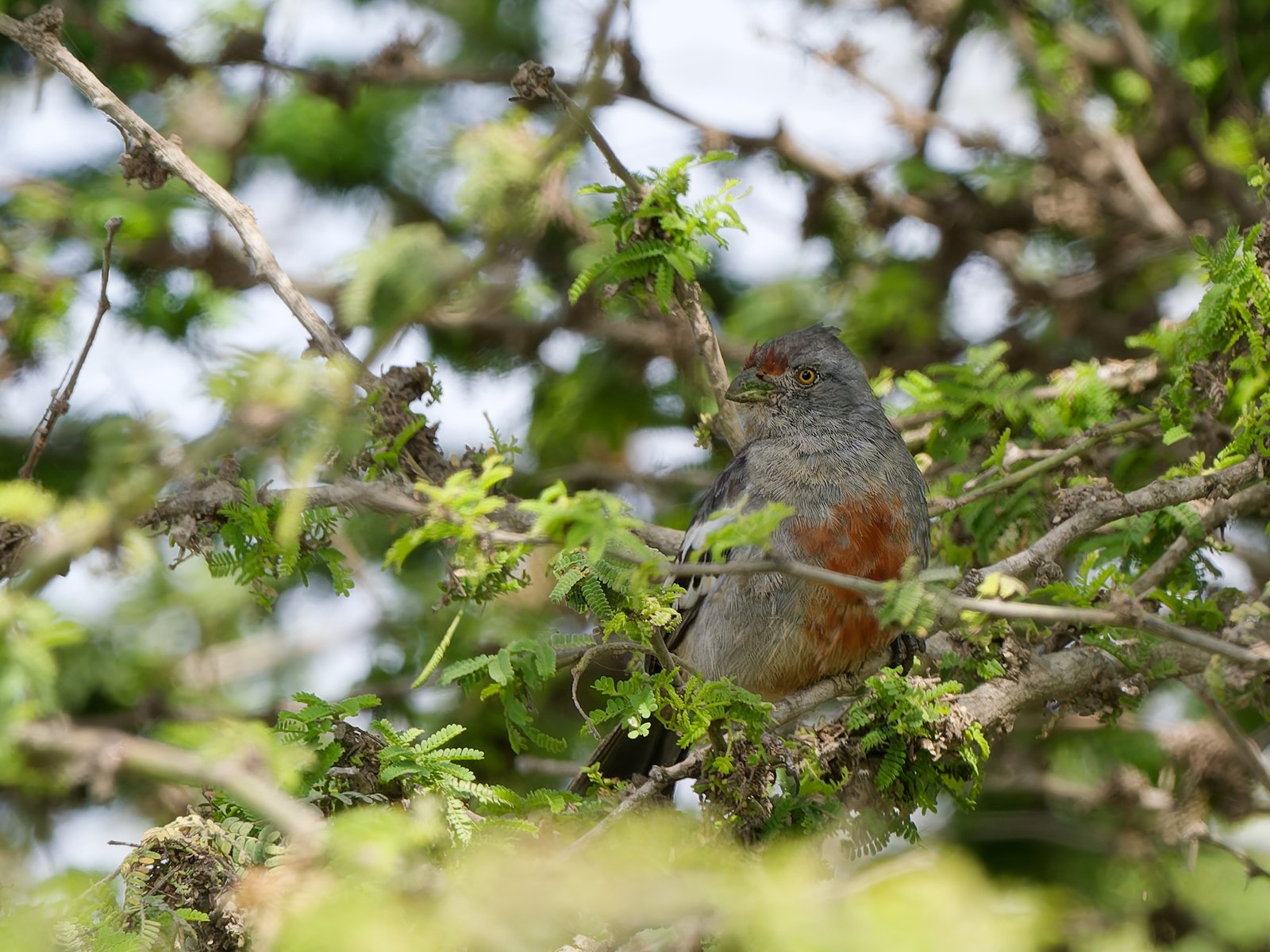
The Peruvian Plantcutter is an endemic cotinga of the dry coastal region of north-western Peru. With its short, thick, serrated bill it snips off leaves, buds and shoots, which is unusual for a songbird. It is closely tied to dry forest and scrub with algarrobo (Prosopis).
Voice
A strange, nasal, bleating or creaking call, often from a prominent branch. Otherwise not very vocal.
Recording: Alex Lees — CC BY-NC-SA 3.0 · xeno-canto
Identification
18–19 cm, a stocky, finch-like bird with a short, thick bill with finely serrated edges. The male is grey, with a rufous forehead and rufous belly and undertail coverts; the wings and tail are blackish, with a white wing bar and white spots in the tail. The iris is yellowish. The female is sandy brown, streaked dark above and below, with pale wing bars.
Confusion species
White-tipped Plantcutter Phytotoma rutila has more rufous underparts in the male and lives in the dry valleys of Bolivia, outside the range of this species. Streaked Saltator Saltator striatipectus resembles the female, but has a greenish back, a pale supercilium and a heavier bill. Females of some finches and sparrows are also streaked, but lack the short, thick bill and upright posture.
Habitat
Dry forest and scrub with algarrobo and other thorny shrubs on the coastal plain and in dry river valleys, also riparian woodland and the edges of fields, roughly from sea level to 550 m, locally higher. It feeds on leaves, buds, shoots, flowers and fruit. The nest is a cup in a thorny shrub or tree.
Where the bird is most at home, classified by the vegetation units of the Andes and the west coast.


Range and movements
Only in Peru, on the coastal plain and in the western foothills from Tumbes south to Ancash and northern Lima. Not known with certainty from Ecuador. Absent from Colombia, Bolivia and the Galápagos. Does not occur outside the guide area.
- Resident
- dark = core range, pale = thinly spread
How and when to look
Search the algarrobo forest of Bosque de Pómac in Lambayeque or dry scrub near Talara in Piura. Birds often perch in the morning on a prominent branch at the top of a shrub.
Conservation status
Vulnerable. The population is small and fragmented. Dry forest is cleared for agriculture and charcoal, and grazing by goats damages the shrub layer.
Scientific name
Phytotoma raimondii | Taczanowski, 1883
Taczanowski described the species in 1883 and placed it straight away in the genus where it still stands. The genus Phytotoma was introduced in 1782 by Molina. The genus name comes from Greek phuton, 'plant', and -tomos, 'cutting', after the serrated bill used to clip plant material. The species name honours Antonio Raimondi (1826–1890), an Italian-born naturalist and geographer who worked in Peru. The specimen the first description was based on came from Tumbes, Peru.