All species › Passerines › Cotingas › Swallow-tailed Cotinga
Swallow-tailed Cotinga | Phibalura flavirostris
Zwaluwstaartcotinga | Cotinga tijereta | Tesourinha-da-mata
The Swallow-tailed Cotinga is a small cotinga with a long, deeply forked tail. In the guide area only the Bolivian form boliviana occurs, solely around Apolo in La Paz; this form is often treated as a separate species (Palkachupa Cotinga). The nominate form lives far outside the guide area, in south-eastern Brazil and adjacent countries.
Voice
Richer than in the nominate form, with a song and several calls, but poorly described; mainly thin, high call notes.
Recording: Ricardo Gagliardi — CC BY-NC-SA 4.0 · xeno-canto
Identification
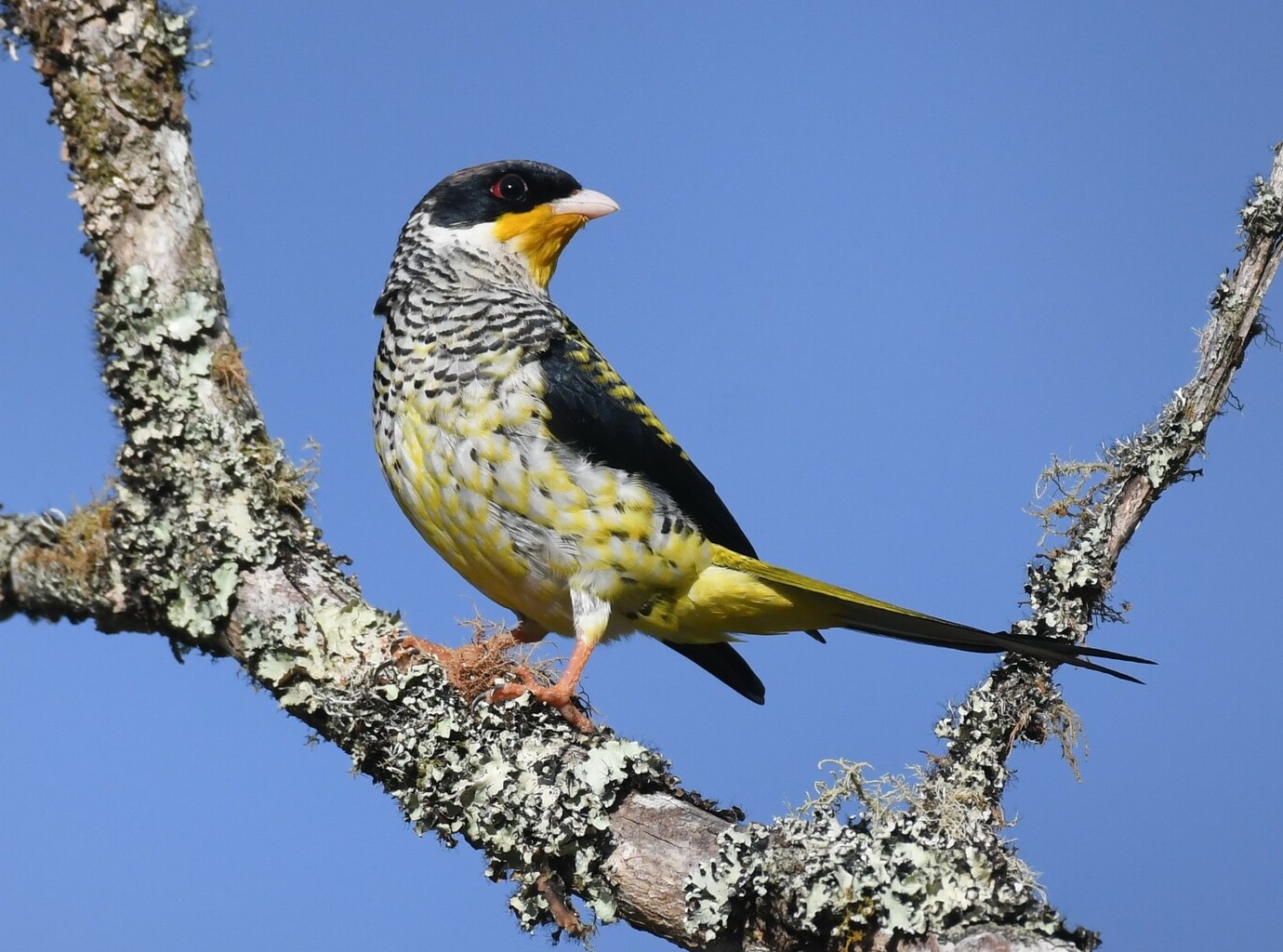
18–22 cm, including the long, deeply forked black tail; the outer tail feathers are longer and more curved in the male. The male has a dark blue crown with a largely concealed crimson patch and a blue-black mask. The upperparts are yellow with dark barring, and the wings blue-black. The underparts are bright yellow with dark bars. The female is duller, with olive, scaly upperparts and a pale yellow throat spotted greyish brown. Both sexes have a yellowish iris, red bare skin around the eye, a short, broad, pale bill and orange legs.
Confusion species
Practically unmistakable in the guide area thanks to the long forked tail and barred yellow underparts. Scaled Fruiteater Ampelioides tschudii is also scaled yellow and black, but has a short tail and lives in humid montane forest.
Habitat
Semi-humid forest, forest fragments and forest edges interspersed with savanna and grassland in the eastern Andean foothills, roughly between 1300 and 2000 m. It feeds mainly on fruit and also catches insects, often in small groups in the canopy. Both parents build a shallow, lichen-covered cup nest in a branch fork; the clutch is two eggs.
Where the bird is most at home, classified by the vegetation units of the Andes and the west coast.


Range and movements
In the guide area only in Bolivia, around Apolo in northern La Paz. Not known from Colombia, Ecuador, Peru or the Galápagos. Outside the guide area the nominate form lives in south-eastern Brazil and adjacent parts of Paraguay and Argentina.
- Resident
- dark = core range, pale = thinly spread
How and when to look
Only in the forest fragments and savannas around Apolo, on the edge of the Madidi area; small groups often perch in the tops of trees at the forest edge.
Conservation status
Not Evaluated in this species concept. The Bolivian form, treated as a separate species, is classed as Endangered: there are an estimated few hundred mature birds, and forest around Apolo is shrinking through burning, clearing and cattle ranching.
Scientific name
Phibalura flavirostris | Vieillot, 1816
Vieillot described the species in 1816 and placed it straight away in the genus where it still stands. He introduced the genus Phibalura in that same work. The genus name comes from a supposed Greek phibalōs, 'slender', and oura, 'tail', after the long forked tail. The species name comes from Latin flavus, 'yellow', and -rostris, 'billed', after the yellow bill. The specimen the first description was based on came from Rio de Janeiro, Brazil.