All species › Passerines › Cotingas › White-cheeked Cotinga
White-cheeked Cotinga | Zaratornis stresemanni
Witwangcotinga | Cotinga cariblanca | Anambé-de-bochecha-branca
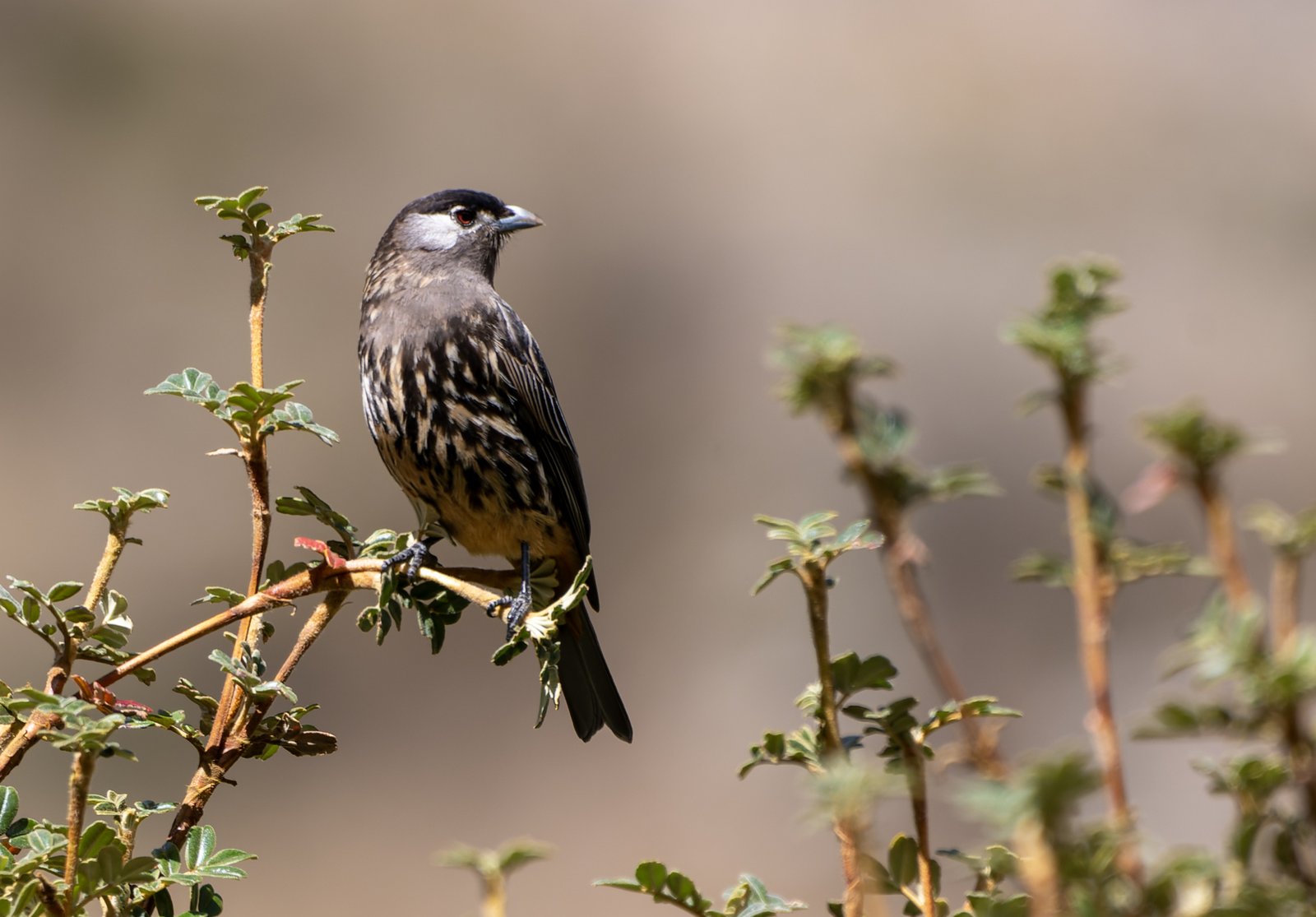
The White-cheeked Cotinga is an endemic cotinga of the high Andes of Peru, closely tied to Polylepis woodland. It lives largely on the berries of mistletoes (Tristerix) growing on trees and shrubs. It is the only species in the genus Zaratornis.
Voice
Usually silent. Occasionally gives a low, croaking or rasping call.
Recording: Niels Krabbe — CC BY-NC-SA 3.0 · xeno-canto
Identification
21 cm, a fairly slender cotinga with a short, broad bill. The crown and side of the head are black, with a distinct white patch on the cheek. The upperparts are dark brown with paler, ochre streaks and scales. The throat is blackish; the breast and belly are pale ochre-yellow to brownish, with dark streaks on the breast. The iris is red. The sexes are alike.
Confusion species
Red-crested Cotinga Ampelion rubrocristatus is grey, with a red crest and a white band across the tail, and lacks a white cheek patch. Chestnut-crested Cotinga Ampelion rufaxilla has a chestnut head and crest and lives in more humid forest on the east slope. Bay-vented Cotinga Doliornis sclateri is uniform greyish brown with chestnut undertail and lives in cloud forest on the east slope.
Habitat
Polylepis woodland and other high-elevation woodland and scrub rich in mistletoe, mainly on dry, rocky slopes, roughly between 2700 and 4500 m. It feeds mainly on mistletoe berries and also on other fruit. Outside the breeding season it may wander within the mountains to places where berries are ripe. The nest is a cup in a tree.
Where the bird is most at home, classified by the vegetation units of the Andes and the west coast.


Range and movements
Only in Peru, mainly on the western slope and the high slopes of the western Andes, from Ancash south to about Ayacucho and Apurímac. Absent from Colombia, Ecuador, Bolivia and the Galápagos. Does not occur outside the guide area.
- Resident
- dark = core range, pale = thinly spread
How and when to look
Search Polylepis woodland in the Cordillera Blanca in Ancash or in the high valleys above Lima, and check mistletoes with ripe berries. Birds often sit quietly at the top of a tree.
Conservation status
Near Threatened. The population is small and fragmented. Polylepis woodland is cut for firewood and charcoal and lost to fire and grazing.
Scientific name
Zaratornis stresemanni | Koepcke, 1954
Koepcke described the species in 1954 and placed it straight away in the genus where it still stands. He introduced the genus Zaratornis in that same work. The genus name refers to the Zárate forest in Lima department, Peru, where the species was discovered, with Greek ornis, 'bird'. The species name honours the German ornithologist Erwin Stresemann (1889–1972), curator at the Berlin museum. The specimen the first description was based on came from Zárate, San Bartolomé, Lima, Peru.