All species › Passerines › Cotingas › Andean Cock-of-the-Rock
Andean Cock-of-the-Rock | Rupicola peruvianus
Rode rotshaan | Gallito de las rocas andino | Galo-da-serra-andino
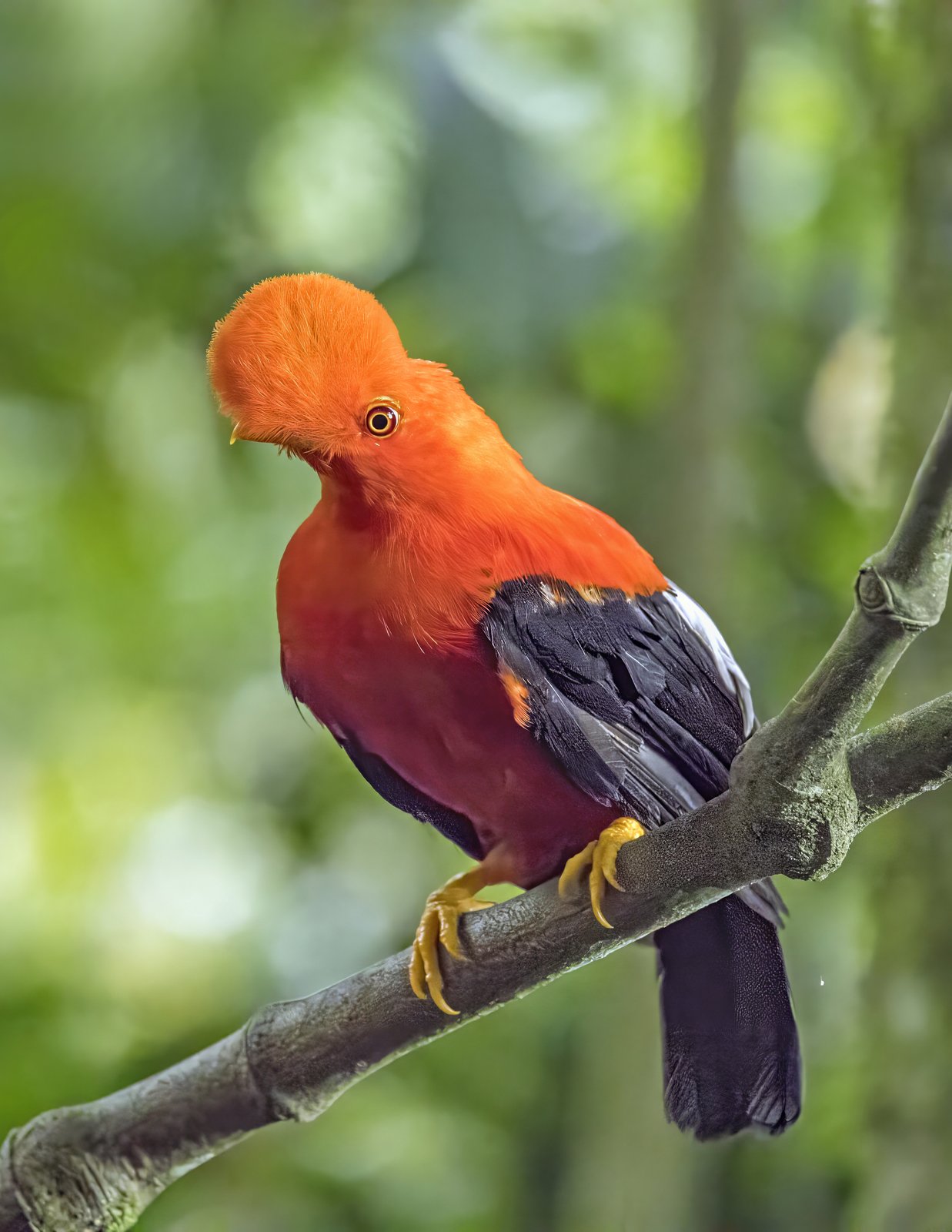
The Andean Cock-of-the-Rock is one of the most striking birds of the Andes: the male is fiery red with a crest that covers the bill. Males display in groups at traditional sites in forested ravines along streams, where they jump up and down, calling loudly. The species is the national bird of Peru.
Voice
At the display site males give loud, screeching and grunting, pig-like cries, often in chorus. Usually silent elsewhere.
Recording: Juan Freile — CC BY-NC-SA 4.0 · xeno-canto
Identification
30–32 cm, a stocky, pigeon-like bird. The male is bright red to orange-red, with a tall, disc-shaped crest that falls forward from the forehead over the bill; the wings and tail are black, the large inner secondaries pale silvery grey. The shade varies by region, from orange-red to deep blood-red. The female is dark rusty brown with a smaller crest and no silvery grey in the wing. Young males are brown at first and gradually turn red.
Confusion species
The male is unmistakable in the Andes. Guianan Cock-of-the-Rock Rupicola rupicola is brighter orange and lives only in the lowlands east of the Andes in the far east of Colombia, outside the range of Andean Cock-of-the-Rock. Red-ruffed Fruitcrow Pyroderus scutatus is black with only an orange-red throat and breast. In dark forest the female may recall a fruitcrow or another large, dark forest bird, but can be told by the crest.
Habitat
Humid montane and foothill forest, especially in steep ravines with rock faces and fast-flowing streams, at roughly 500 to 2400 m. It eats mainly fruit and also takes large insects and sometimes small vertebrates. The female builds a cup-shaped nest of mud and plant material against a rock face or in a cave, often above or close to running water.
Where the bird is most at home, classified by the vegetation units of the Andes and the west coast.


Range and movements
Along the Andes in Colombia, on the slopes of all three cordilleras; in Ecuador on the western and eastern slopes; in Peru and Bolivia on the eastern slope. Absent from the Galápagos. Outside the guide area in the Andes of western Venezuela.
- Resident
- dark = core range, pale = thinly spread
How and when to look
Well-known display sites are near Jardín in Antioquia in Colombia, near Mindo in Ecuador and along the road to Manu in Peru. Males are most active early in the morning and late in the afternoon.
Conservation status
Least Concern, but numbers are declining through deforestation on the Andean slopes. The species is also trapped for the cage-bird trade.
Scientific name
Rupicola peruvianus | (Latham, 1790)
Latham described the species in 1790 as [Pipra] peruviana; because it was later moved to another genus, the author and year stand in brackets. The genus Rupicola was introduced in 1760 by Brisson. The genus name is New Latin for 'cliff-dweller', from Latin rupes, 'rock', and -cola, 'dweller'. The species name refers to Peru. The specimen the first description was based on came from Chanchamayo, Junín, Peru.