All species › Passerines › Cotingas › Guianan Cock-of-the-Rock
Guianan Cock-of-the-Rock | Rupicola rupicola
Oranje rotshaan | Gallito de las rocas guayanés | Galo-da-serra
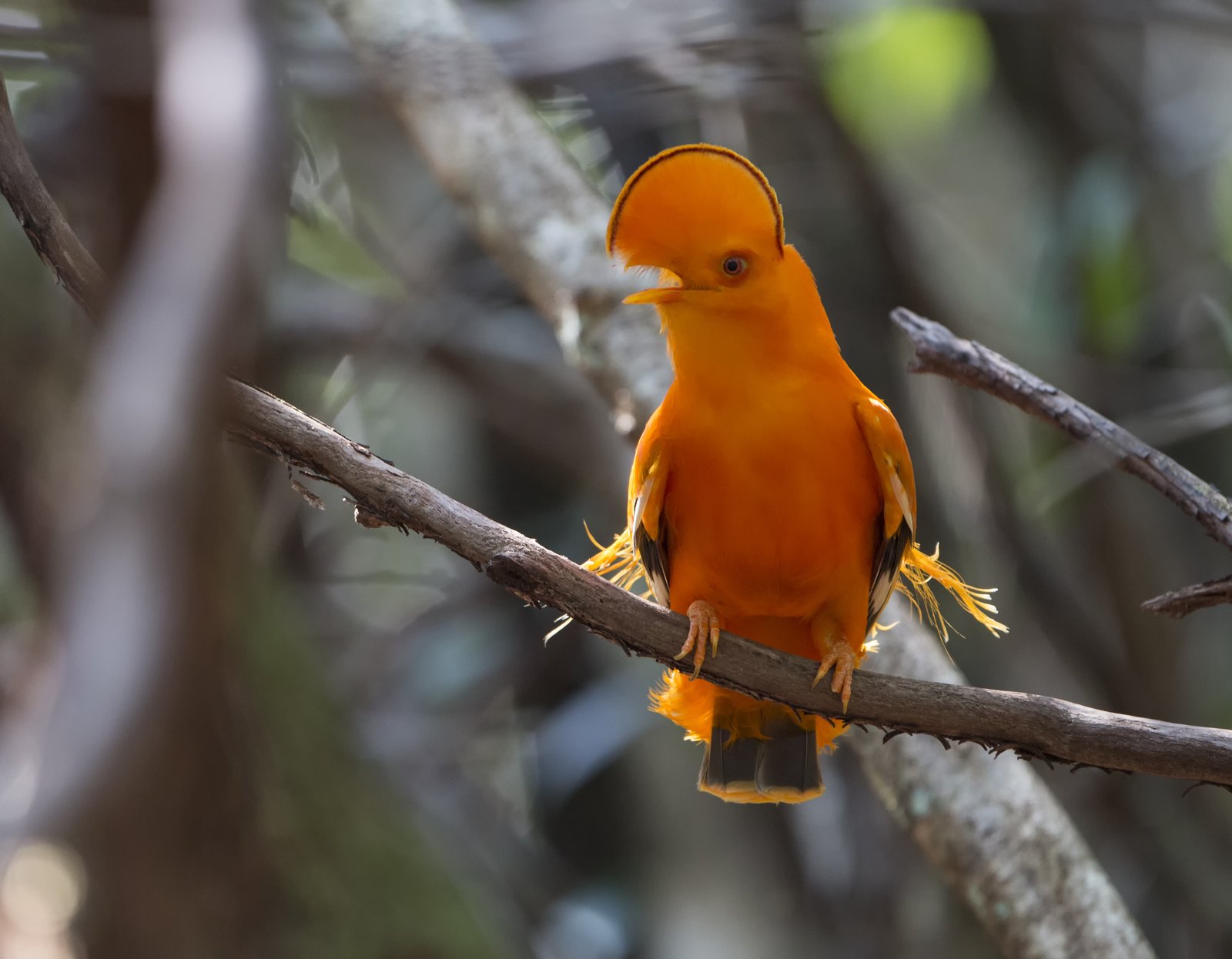
The Guianan Cock-of-the-rock is a stocky, bright orange cotinga of the Guiana Shield. In the guide area it occurs only in the far east of Colombia, around granite outcrops and hills in lowland forest. Males display in groups on the forest floor, each on its own cleared patch.
Voice
At the lek loud, crowing and squawking calls, roughly kaa-wow, and softer clucking sounds. Usually silent elsewhere.
Recording: Alexandre GRAVE — CC BY-NC-SA 4.0 · xeno-canto
Identification
30–32 cm, a stocky bird with a short tail. The male is bright orange, with a tall, semicircular crest that covers the bill and has a narrow dark margin. The wings are blackish brown with white patches on the primaries and long, frayed orange inner secondaries; the tail is brown with an orange tip. The female is dark olive-brown, with a smaller crest and a yellow bill tip. Young males are brown at first and gradually turn orange.
Confusion species
Andean Cock-of-the-rock Rupicola peruvianus is red to orange-red, with silvery grey inner secondaries, and lives in montane forest in the Andes; the ranges do not overlap. The female may recall other large, dark forest birds, but is identified by the crest.
Habitat
Humid terra firme lowland forest, especially around granite outcrops, cliffs, caves and boulder-strewn hills, roughly up to 1500 m. It feeds mainly on fruit. Leks are on the forest floor. The female builds a nest of mud and plant material against a rock face or in a cave.
Where the bird is most at home, classified by the vegetation units of the Andes and the west coast.


Range and movements
In the guide area only in the far east of Colombia, in Guainía and Vaupés, around granite outcrops and hills. Absent from Ecuador, Peru, Bolivia and the Galápagos. Outside the guide area in southern Venezuela, the Guianas and northern Brazil.
- Resident
- dark = core range, pale = thinly spread
How and when to look
In Colombia best known from the granite outcrops around Inírida in Guainía, such as the Cerros de Mavecure. Displaying males are most active in the morning; females are often found near rock faces.
Conservation status
Least Concern. The species is trapped locally for the cage-bird trade; its habitat in eastern Colombia is largely intact.
Scientific name
Rupicola rupicola | (Linnaeus, 1766)
Linnaeus described the species in 1766 as [Pipra] rupicola; because it was later moved to another genus, the author and year stand in brackets. The genus Rupicola was introduced in 1760 by Brisson. The genus name is New Latin for 'cliff-dweller', from Latin rupes, 'rock', and -cola, 'dweller'. The species name repeats the genus name: 'rock-dweller', from Latin rupes, 'rock', and -cola, 'dweller'. The specimen the first description was based on came from Cayenne, French Guiana.