All species › Tubenoses › Southern storm petrels › Wilson's Storm Petrel
Wilson's Storm Petrel | Oceanites oceanicus
Wilsons stormvogeltje | Paíño de Wilson | Alma-de-mestre
Wilson's Storm Petrel is a small, dark storm petrel with a white rump that breeds around Antarctica and on the islands of the southern oceans. It is counted among the most numerous seabirds in the world. After breeding it moves north; in the guide area it is mainly the smaller subspecies chilensis that occurs, living at sea in the Humboldt Current off Peru and Ecuador.
Voice
Usually silent at sea; when feeding sometimes a soft chattering sound. At the breeding sites scratchy and rattling calls from the nest burrows.
Recording: Fabrice Schmitt — CC BY-NC-SA 4.0 · xeno-canto
Identification
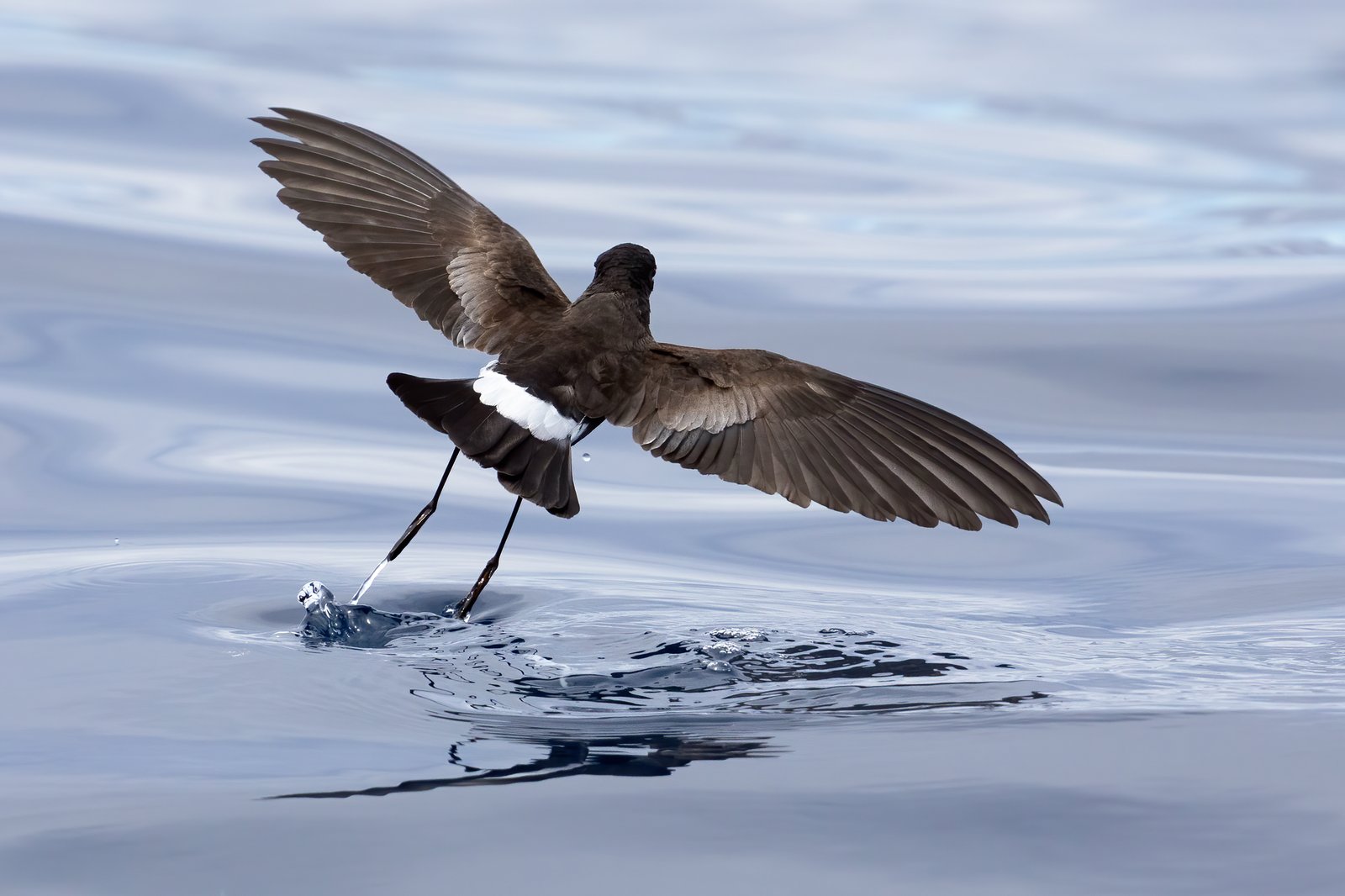
16–18 cm, with fairly short, rounded wings, a square tail and long legs that project beyond the tail in flight; the webs of the feet are yellow but rarely visible. The plumage is sooty black to blackish brown, with a pale diagonal bar across the upperwing. The white rump band is broad and extends onto the flanks and undertail coverts. Birds of the subspecies chilensis are smaller and often have pale marks on the underwing and sometimes some white on the belly. Flight is fluttering, with short glides; when feeding the bird hovers with raised wings over the water and patters the surface with its feet. The sexes are alike.
Confusion species
Elliot's Storm-Petrel Oceanites gracilis is smaller, with a white patch in the centre of the belly; birds of the subspecies chilensis with white on the belly should therefore be seen well before they are identified. Wedge-rumped Storm Petrel Hydrobates tethys has longer, more pointed wings, a larger, triangular white rump and feet that do not project beyond the tail. Band-rumped Storm Petrel Hydrobates castro is larger, with a narrower rump band, a slightly forked tail, short legs and a shearing flight. Markham's Storm Petrel Hydrobates markhami is larger and all dark, with a forked tail.
Habitat
Open sea and especially the cool, productive waters of the Humboldt Current over the continental shelf, often in flocks and regularly within sight of land. It picks small crustaceans such as krill, small fish and oil droplets from the surface and follows fishing boats and cetaceans. It does not breed in the guide area; outside it, it nests in rock crevices and burrows on the coasts and islands of Antarctica, the subantarctic islands and Tierra del Fuego.
Where the bird is most at home, classified by the vegetation units of the Andes and the west coast.


Range and movements
In Peru a common visitor at sea along the whole coast, mainly in the austral winter, with birds present throughout the year. In Ecuador offshore and in smaller numbers around the Galápagos. In Colombia at sea off the Pacific coast, and off the Caribbean coast as a passage migrant of the nominate form in the northern summer. Absent from Bolivia. Breeds around Antarctica, on the islands of the southern oceans and in Tierra del Fuego, and outside the breeding season moves north into the Pacific, Atlantic and Indian Oceans.
- Resident
- Summer visitor (c. Apr–Sep)
- Winter visitor (c. Oct–Mar)
- Passage (Mar–Apr, Oct–Nov)
- dark = core range, pale = thinly spread
How and when to look
Join a pelagic trip from, for example, Pucusana, Callao or Lima in Peru; the species is attracted to fish oil and fish scraps thrown into the water behind the boat. From shore birds can sometimes be seen over the surf and in bays, especially in strong winds.
Conservation status
Least Concern; the world population numbers many millions of birds. At the breeding sites introduced predators and snowfall blocking the nest burrows can reduce breeding success.
Scientific name
Oceanites oceanicus | (Kuhl, 1820)
Kuhl described the species in 1820 as Procellaria oceanica; because it was later moved to another genus, the author and year stand in brackets. The genus Oceanites was introduced in 1840 by Keyserling & Blasius. The genus name comes from Greek Ōkeanitēs, after the Oceanids, the sea nymphs who were daughters of Oceanus. The species name is Latin oceanicus, 'of the ocean'. The specimen the first description was based on came from South Georgia.