All species › Tubenoses › Southern storm petrels › Elliot's Storm-Petrel
Elliot's Storm-Petrel | Oceanites gracilis
Sierlijk stormvogeltje | Paíño de Elliot | Painho-de-elliot
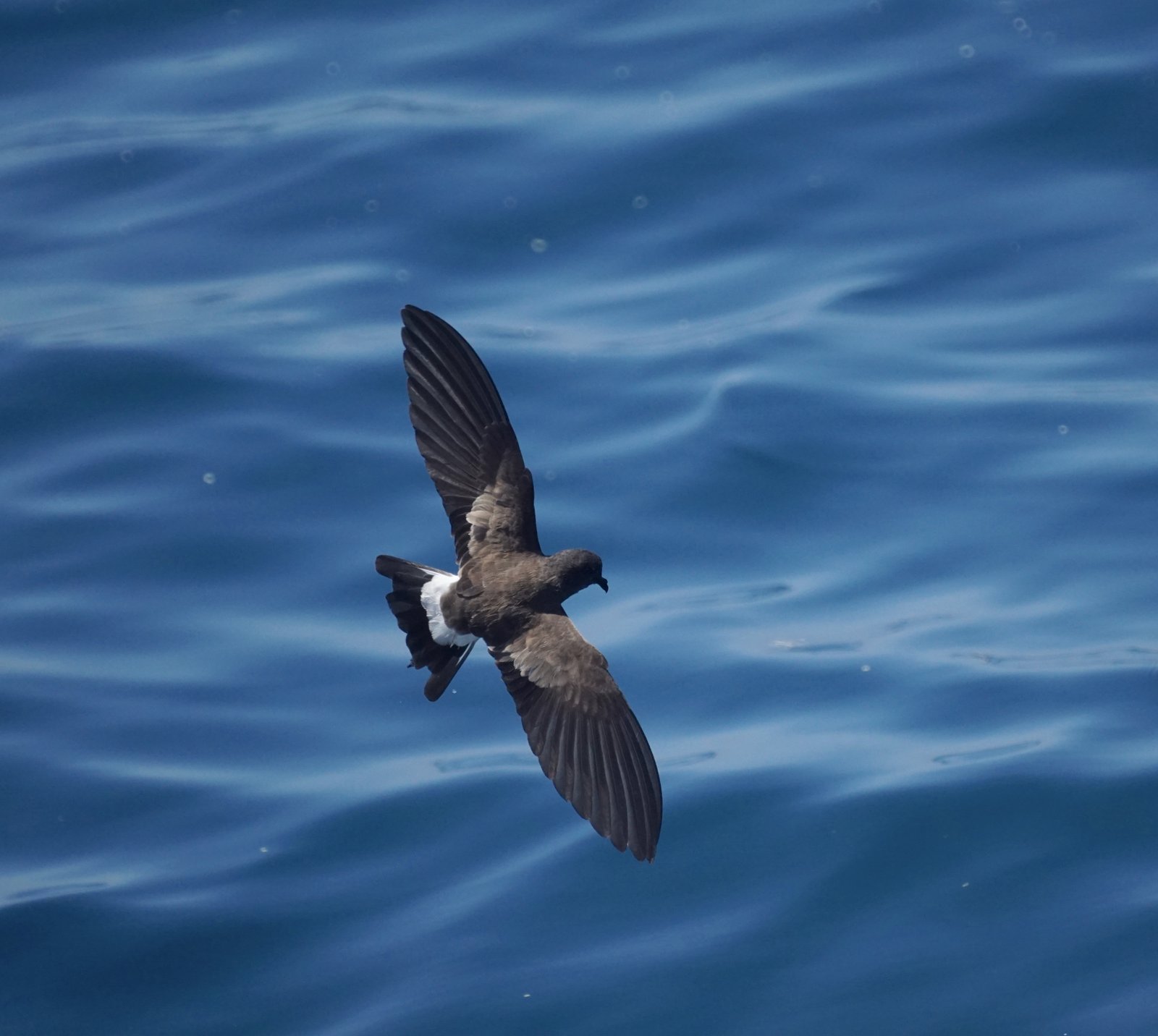
Elliot's Storm-Petrel is the smallest storm petrel of the guide area, a dark bird with a white rump and a white patch on the belly. It occurs only in the eastern Pacific, in the Humboldt Current and around the Galápagos. Although at sea it is often seen close inshore, there is hardly any information on its breeding sites.
Voice
Usually silent at sea. Little is known about the calls at the breeding sites.
Recording: Rodrigo Silva — CC BY-NC-SA 4.0 · xeno-canto
Identification
15–16 cm, with rounded wings, a square tail and long legs that project beyond the tail in flight. The plumage is blackish brown, with a pale diagonal bar across the upperwing and a white rump band that extends onto the flanks. In the centre of the belly there is a white patch of variable size, and the underwing often has a pale central stripe. Birds from the Galápagos, subspecies galapagoensis, are slightly larger. Flight is fluttering, low over the water; when feeding the bird patters the surface with its feet. The sexes are alike.
Confusion species
Wilson's Storm Petrel Oceanites oceanicus is larger and usually has a dark belly; birds of the subspecies chilensis, however, can also show some white on the belly. Wedge-rumped Storm Petrel Hydrobates tethys has a dark belly, a larger, triangular white rump, longer, more pointed wings and feet that do not project beyond the tail. White-bellied Storm Petrel Fregetta grallaria, a vagrant, is much larger, with an entirely white belly and white underwing coverts.
Habitat
Cool inshore waters of the Humboldt Current, often close to the coast, in bays and harbours, and open sea around the Galápagos. It feeds in flocks, picking small crustaceans, fish eggs and oil droplets from the surface; it follows boats and is attracted to fish waste. Only a few nests have been found, in rock crevices on an islet off the coast of Chile; it probably also breeds on the Galápagos, but nests have not been described there.
Where the bird is most at home, classified by the vegetation units of the Andes and the west coast.


Range and movements
In Peru common year-round at sea along the whole coast. In Ecuador offshore and around the Galápagos, where the subspecies galapagoensis lives. Scarce and little recorded off the Pacific coast of Colombia. Absent from Bolivia. Outside the guide area off the coast of Chile, south to about the middle of the country.
- Resident
- dark = core range, pale = thinly spread
How and when to look
From the quay in harbours such as Pucusana, Paracas or Mollendo in Peru and from piers they are often seen fluttering low over the water; on pelagic trips they follow the boat. Around the Galápagos they can be seen from boats between the islands.
Conservation status
Data Deficient: because the breeding sites and population size are almost unknown, its threat status cannot be assessed. At sea the species appears common. Possible threats are introduced predators at the breeding sites and artificial light on the coast, which can cause young birds to come down on land.
Scientific name
Oceanites gracilis | (Elliot, 1859)
Elliot described the species in 1859 as Thalassidroma gracilis; because it was later moved to another genus, the author and year stand in brackets. The genus Oceanites was introduced in 1840 by Keyserling & Blasius. The genus name comes from Greek Ōkeanitēs, after the Oceanids, the sea nymphs who were daughters of Oceanus. The species name is Latin gracilis, 'slender'. The specimen the first description was based on came from West coast of South America.