All species › Tubenoses › Southern storm petrels › White-faced Storm-Petrel
White-faced Storm-Petrel | Pelagodroma marina
Bont stormvogeltje | Paíño pechialbo | Painho-de-face-branca
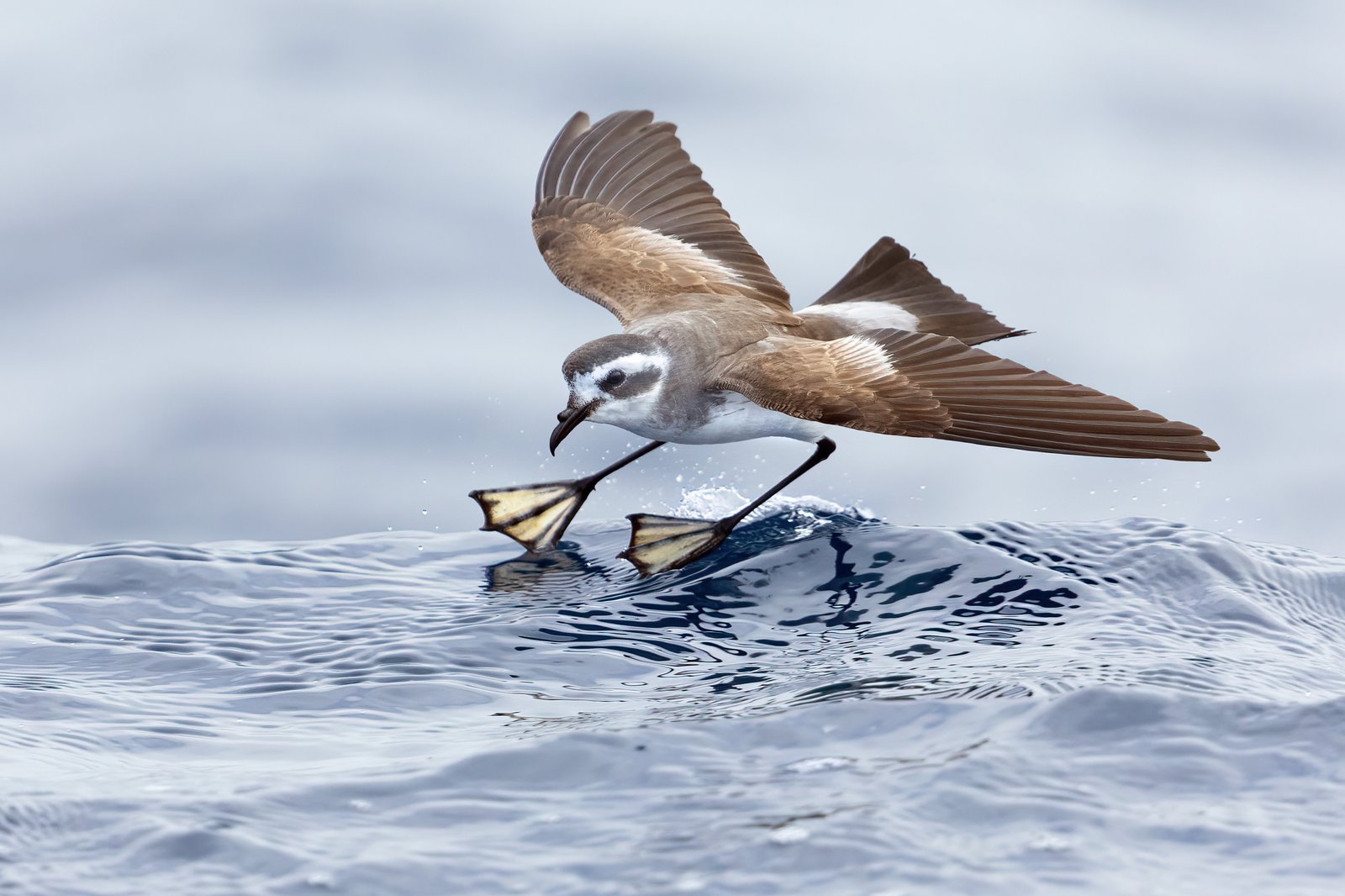
The White-faced Storm-Petrel is a grey-and-white storm petrel with a white face pattern and very long legs, breeding on islands in the Atlantic Ocean and around Australia and New Zealand. Birds from the Pacific disperse outside the breeding season to the tropical eastern Pacific. In the guide area it is a scarce visitor far out at sea, seen only on trips well offshore.
Voice
Silent at sea. At the breeding sites soft, moaning calls from the burrows at night.
Recording: Rinse van der Vliet — CC BY-NC-SA 4.0 · xeno-canto
Identification
19–21 cm, with broad, rounded wings, a square tail and very long legs that project well beyond the tail. The upperparts are greyish brown, with a paler, grey rump and a pale bar across the upperwing. The head has a dark crown, a white supercilium and a dark eye patch that extends onto the ear coverts. The throat, breast and belly are white, with grey patches on the sides of the breast. The underwing has white coverts and dark flight feathers. In flight the bird swings from side to side and bounces off the water with both feet together. The sexes are alike.
Confusion species
White-bellied Storm Petrel Fregetta grallaria has a black head and breast without a white face pattern, a white rump and feet that do not project beyond the tail. Elliot's Storm-Petrel Oceanites gracilis and Wilson's Storm Petrel Oceanites oceanicus are much darker, with a dark head and breast and a white rump. Phalaropes Phalaropus in non-breeding plumage also have white underparts and a dark eye patch, but they are shorebirds with a thin bill and pointed wings that sit on the water in flocks.
Habitat
Open ocean, in the guide area almost only well beyond the continental shelf over deep, warm water. It picks small crustaceans and small fish from the surface while pushing off the water with its feet; it rarely follows boats. It does not breed in the guide area; outside it, it nests in colonies in self-dug burrows on small islands.
Where the bird is most at home, classified by the vegetation units of the Andes and the west coast.

Range and movements
A scarce and little-recorded visitor far offshore off Ecuador and Peru and in the ocean around the Galápagos; these are birds that disperse eastward from the western Pacific outside the breeding season. Hardly recorded from Colombia. Absent from Bolivia. Breeds on islands in the Atlantic Ocean, such as the Canary Islands, the Selvagens, Cape Verde and Tristan da Cunha, and around Australia and New Zealand.
- Summer visitor (c. Apr–Sep)
- dark = core range, pale = thinly spread
How and when to look
Join a long pelagic trip that reaches well beyond the continental shelf, or watch during a crossing to the Galápagos. Look for a pale storm petrel bouncing over the water on long legs.
Conservation status
Least Concern. Locally, colonies have been affected by introduced rats, cats and mice; these predators have been eradicated on several islands.
Scientific name
Pelagodroma marina | (Latham, 1790)
Latham described the species in 1790 as Procellaria marina; because it was later moved to another genus, the author and year stand in brackets. The genus Pelagodroma was introduced in 1853 by Reichenbach. The genus name comes from Greek pelagos, 'open sea', and dromos, 'runner'. The species name is Latin marinus, 'of the sea'. The specimen the first description was based on came from Sea off the mouth of the Río de la Plata.