All species › Tubenoses › Southern storm petrels › White-bellied Storm Petrel
White-bellied Storm Petrel | Fregetta grallaria
Witbuikstormvogeltje | Paíño Ventriblanco | Painho-de-barriga-branca
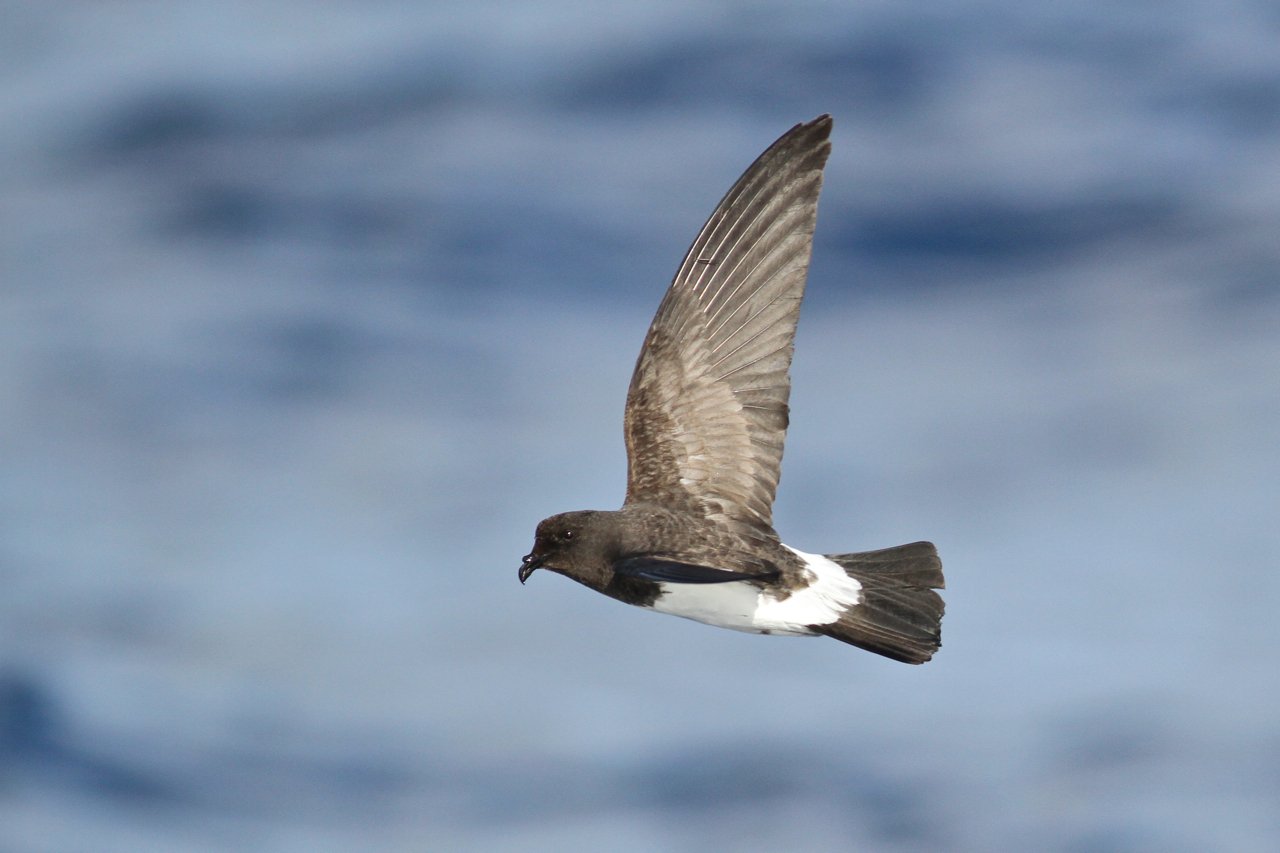
The White-bellied Storm Petrel is a fairly large, black-and-white storm petrel of the subtropical parts of the Pacific, Atlantic and Indian Oceans. The nearest breeding sites are on the Juan Fernández Islands and the Desventuradas off Chile. In the guide area it is a very rare vagrant, known from only a few records at sea.
Voice
Silent at sea. At the breeding sites squeaking and whistling calls at night.
No recording with a suitable Creative Commons licence is available for this species yet.
Identification
20 cm, with broad wings, a square tail and feet that do not or barely project beyond the tail. The head, neck, breast and upperparts are blackish, the back and wing coverts with pale fringes. The rump is white, the belly sharply demarcated white, and the underwing has white coverts with a broad dark border. Dark birds also occur, especially on the Juan Fernández Islands. Flight is fast and swinging; when feeding the bird bounds over the water, touching the surface with its breast or feet. The sexes are alike.
Confusion species
Black-bellied Storm Petrel Fregetta tropica has a dark stripe down the centre of the white belly and toes that just project beyond the tail; it is not known from the guide area but occurs off Chile. White-faced Storm-Petrel Pelagodroma marina has a white face pattern, a grey rump and very long legs. Elliot's Storm-Petrel Oceanites gracilis is much smaller, with only a small white belly patch and long legs that project beyond the tail.
Habitat
Open ocean over deep, warm water, far offshore. It picks small crustaceans, squid and small fish from the surface. It does not breed in the guide area; outside it, it nests in rock crevices and burrows on remote islands.
Where the bird is most at home, classified by the vegetation units of the Andes and the west coast.

Range and movements
In the guide area a very rare vagrant; there are only a few records far offshore. Not a regular species in Colombia, Ecuador, Peru or the Galápagos; absent from Bolivia. Breeds on the Juan Fernández Islands and the Desventuradas off Chile, on Lord Howe, the Kermadec Islands and the Austral Islands in the Pacific, and on Tristan da Cunha and Gough in the Atlantic.
How and when to look
A black-and-white storm petrel with a white belly on a pelagic trip far offshore is worth checking; document a sighting with photographs of the belly, underwing and feet to rule out Black-bellied Storm Petrel.
Conservation status
Least Concern. On several breeding islands introduced rats and cats are a threat to the colonies.
Scientific name
Fregetta grallaria | (Vieillot, 1818)
Vieillot described the species in 1818 as Procellaria grallaria; because it was later moved to another genus, the author and year stand in brackets. The genus Fregetta was introduced in 1855 by Bonaparte. The genus name is Bonaparte's own coinage, linked to French frégate, 'frigate'; it is not a misspelling of Fregata, as Bonaparte knew that genus. The species name comes from Latin grallarius, 'stilt-walker', after the long legs with which the bird appears to walk on the water. The specimen the first description was based on came from Australia.