All species › Tubenoses › Northern storm petrels › Band-rumped Storm Petrel
Band-rumped Storm Petrel | Hydrobates castro
Madeirastormvogeltje | Paíño de Madeira | Painho-de-castro
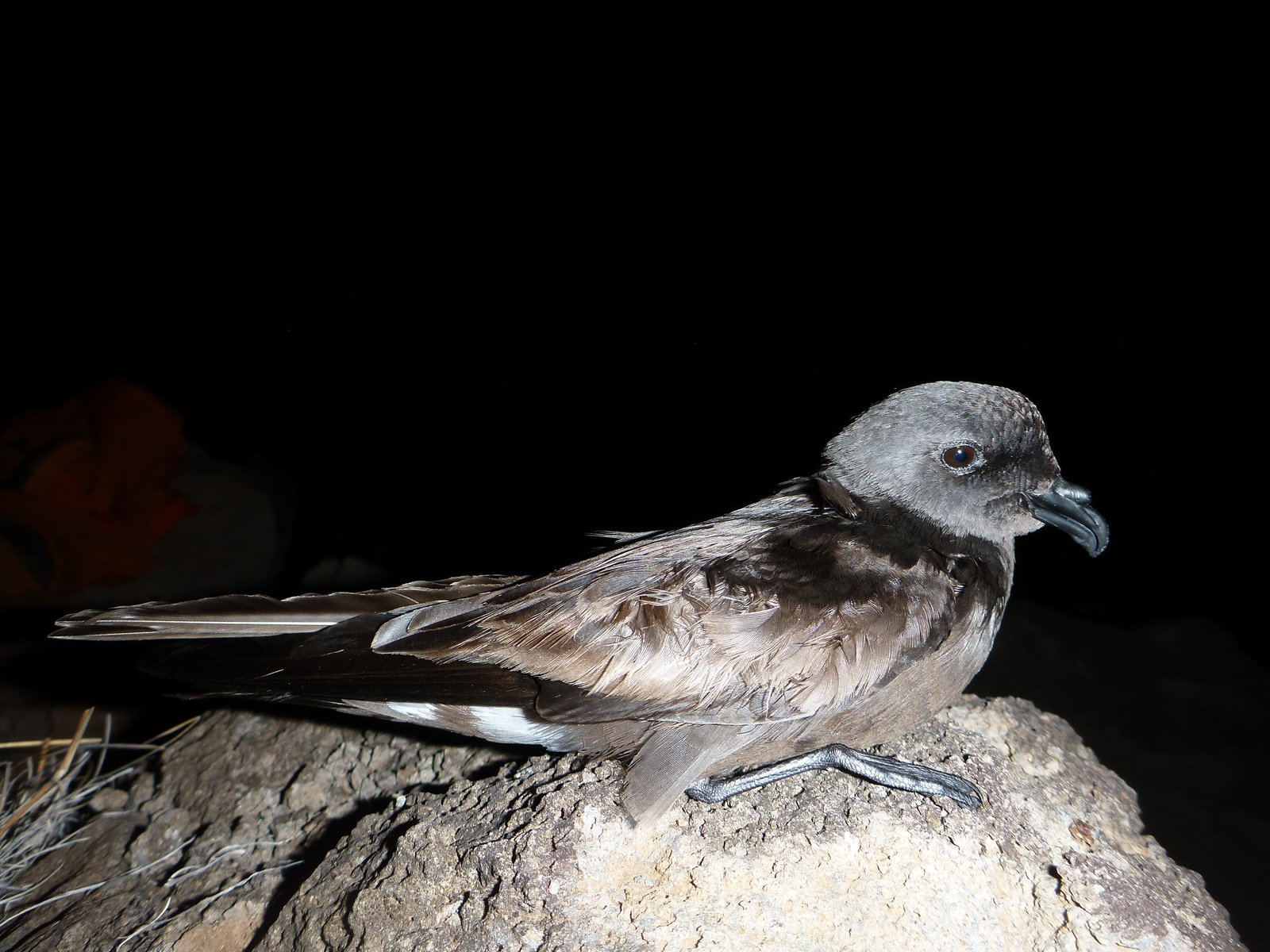
The Band-rumped Storm Petrel is a medium-sized, dark storm petrel with a narrow white rump band, breeding on subtropical and tropical islands in the Atlantic and Pacific Oceans. In the guide area it breeds on the Galápagos, in two groups that breed at different times of the year. These seasonal groups differ genetically and are being studied as possible separate species.
Voice
Silent at sea. At the colonies a hoarse, chattering and purring sound comes from the nest cavities at night.
Recording: Ben Porter — CC BY-NC-SA 4.0 · xeno-canto
Identification
19–21 cm, a medium-sized storm petrel with fairly long wings and a short, square to slightly forked tail. The plumage is dark blackish brown, with a faint pale bar across the upperwing that reaches less far forward than on Leach's Storm-Petrel. The white rump band is narrow and straight, extends onto the sides of the undertail coverts and is not divided in the centre. The feet do not project beyond the tail. Flight is calm and shearing, with short glides. The sexes are alike.
Confusion species
Wedge-rumped Storm Petrel Hydrobates tethys is smaller, with a much larger, triangular white rump and a faster, erratic flight. Leach's Storm-Petrel Hydrobates leucorhous has a more clearly forked tail, a longer pale wing bar and a rump patch often divided in the centre, and flies with nightjar-like bounding. Wilson's Storm Petrel Oceanites oceanicus and Elliot's Storm-Petrel Oceanites gracilis are smaller, with rounder wings and feet that project beyond the tail.
Habitat
Open ocean, especially warm, deep water far offshore; rare over the cold Humboldt Current. It picks small fish, squid and crustaceans from the surface in flight, often fluttering. It breeds in colonies in rock crevices, cavities in lava rock and under stones on islands; birds come ashore mainly at night, but on the Galápagos they also fly over the colonies by day.
Where the bird is most at home, classified by the vegetation units of the Andes and the west coast.


Range and movements
Breeds on several islands of the Galápagos, including Genovesa, and is found year-round in the waters around the archipelago. Scarce off the coasts of Ecuador and Colombia, mainly far offshore; rare off Peru. Absent from Bolivia. Outside the guide area it breeds in Hawaii, Japan and on islands in the Atlantic, among other places.
- Passage (Mar–Apr, Oct–Nov)
- dark = core range, pale = thinly spread
How and when to look
On Genovesa, Band-rumped Storm Petrels fly over the lava fields by day among the many Wedge-rumped Storm Petrels. On boat trips between the islands the species is often seen alongside Wedge-rumped Storm Petrel; look for the narrower rump band and the calmer, shearing flight.
Conservation status
Least Concern, though some breeding groups are small. Introduced rats and cats threaten the colonies, and on the Galápagos Short-eared Owl Asio flammeus hunts the birds at their nests. Artificial light on ships and ashore can disorient young birds.
Scientific name
Hydrobates castro | (Harcourt, 1851) (GBIF: Oceanodroma castro)
Harcourt described the species in 1851 as Thalassidroma castro; because it was later moved to another genus, the author and year stand in brackets. The genus Hydrobates was introduced in 1822 by Boie. The genus name comes from Greek hudro-, 'water-', and batēs, 'walker', for the pattering over the water surface while feeding. The species name comes from Roque de Castro, the local name for this bird on Madeira; in Old Portuguese it means 'rock of the castle', but the name is probably an onomatopoeia for one of the birds' calls at the nest. The specimen the first description was based on came from Ilhas Desertas, Madeira, Portugal.