All species › Tubenoses › Northern storm petrels › Black Storm Petrel
Black Storm Petrel | Hydrobates melania
Zwart stormvogeltje | Paíño negro | Painho-negro
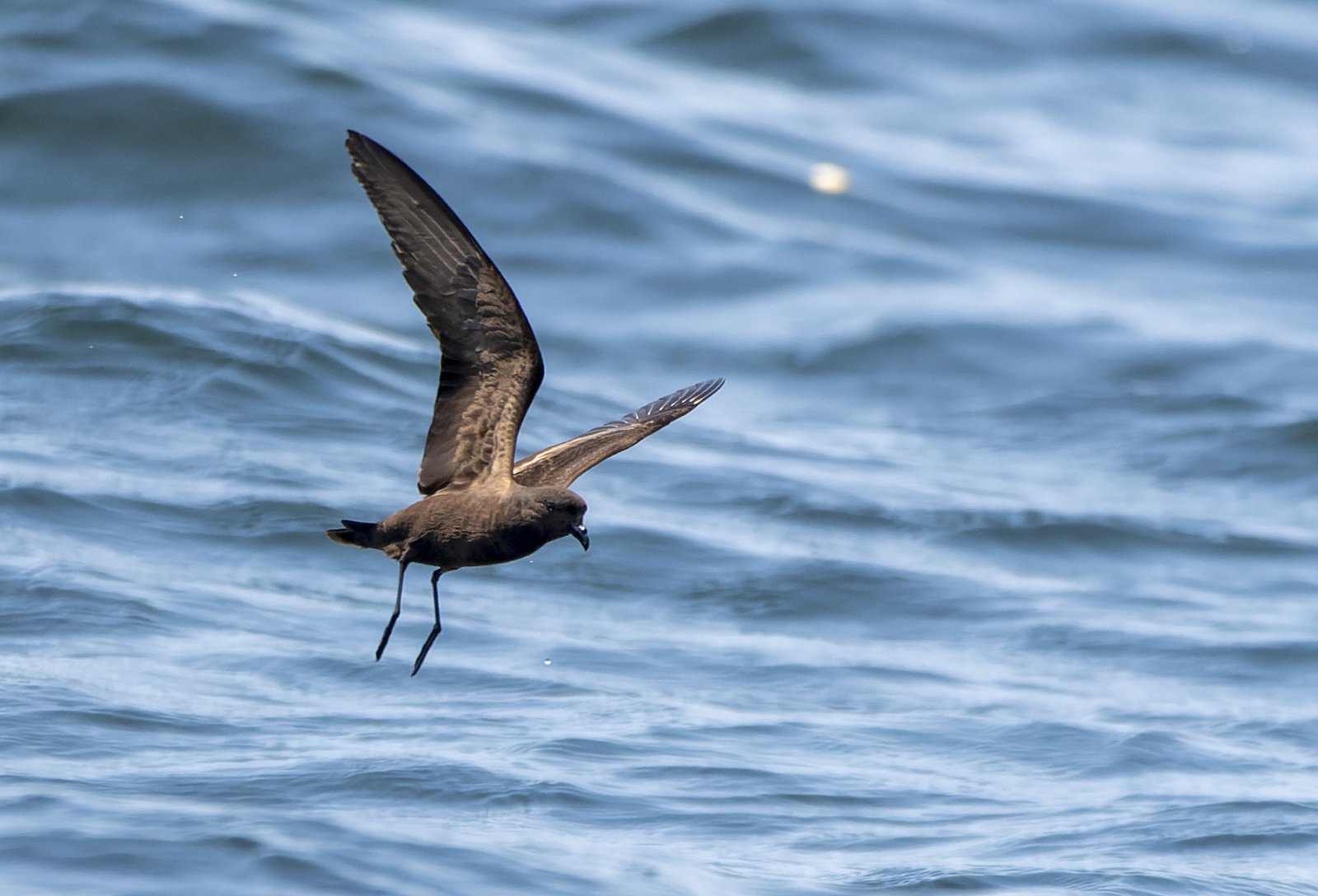
The Black Storm Petrel is the largest all-dark storm petrel of the eastern Pacific. It breeds on islands off Baja California and in the Gulf of California and moves south outside the breeding season, as far as the cool waters off Peru. There it is among the most numerous storm petrels over the continental shelf.
Voice
Silent at sea. At the breeding colonies a rhythmic series of hoarse, hiccupping notes is given at night.
No recording with a suitable Creative Commons licence is available for this species yet.
Identification
21–23 cm, a large, all blackish-brown storm petrel with long wings and a long, deeply forked tail. A brownish bar crosses the upperwing but does not reach the leading edge. Bill and legs are black. Flight is calm and purposeful, with deep, slow wingbeats and short glides. The sexes are alike.
Confusion species
Markham's Storm Petrel Hydrobates markhami is slightly browner, with a more prominent pale wing bar reaching close to the leading edge, and flies with shallower, stiffer wingbeats. Least Storm Petrel Hydrobates microsoma is much smaller, with a short, wedge-shaped tail. Dark-rumped Leach's Storm-Petrels Hydrobates leucorhous are smaller, with a shorter tail and a bounding, erratic flight.
Habitat
At sea over the continental shelf and its edge, often a few tens of kilometres offshore, but also farther out. It picks small fish, fish larvae and crustaceans from the surface in flight, often in mixed flocks with other storm petrels. It breeds in rock crevices and cavities on small islands outside the guide area.
Where the bird is most at home, classified by the vegetation units of the Andes and the west coast.


Range and movements
At sea along the Pacific coast of Colombia, Ecuador and Peru and in the waters around the Galápagos. Off Peru numerous over the Humboldt Current, often together with Markham's Storm Petrels. Does not breed in the guide area and is absent from Bolivia. Outside the guide area it breeds on islands off southern California and Baja California and in the Gulf of California.
- Resident
- Winter visitor (c. Oct–Mar)
- Passage (Mar–Apr, Oct–Nov)
- dark = core range, pale = thinly spread
How and when to look
On pelagic trips from Peruvian ports such as Callao and off the coast of Ecuador, flocks can be seen over the continental shelf, mainly from October to April. Note the slow, deep wingbeat and the long forked tail.
Conservation status
Least Concern. Introduced rats and cats on the breeding islands and artificial light that attracts birds at night are the main threats.
Scientific name
Hydrobates melania | (Bonaparte, 1854)
Bonaparte described the species in 1854 as Procellaria melania; because it was later moved to another genus, the author and year stand in brackets. The genus Hydrobates was introduced in 1822 by Boie. The genus name comes from Greek hudro-, 'water-', and batēs, 'walker', for the pattering over the water surface while feeding. The species name comes from Greek melania, 'blackness', for the all-dark plumage. The specimen the first description was based on came from Coast of California, United States.