All species › Passerines › Tyrant flycatchers and allies › Yellow-bellied Elaenia
Yellow-bellied Elaenia | Elaenia flavogaster
Geelbuikelenia | Elenia vientre amarillo | Guaracava-de-barriga-amarela
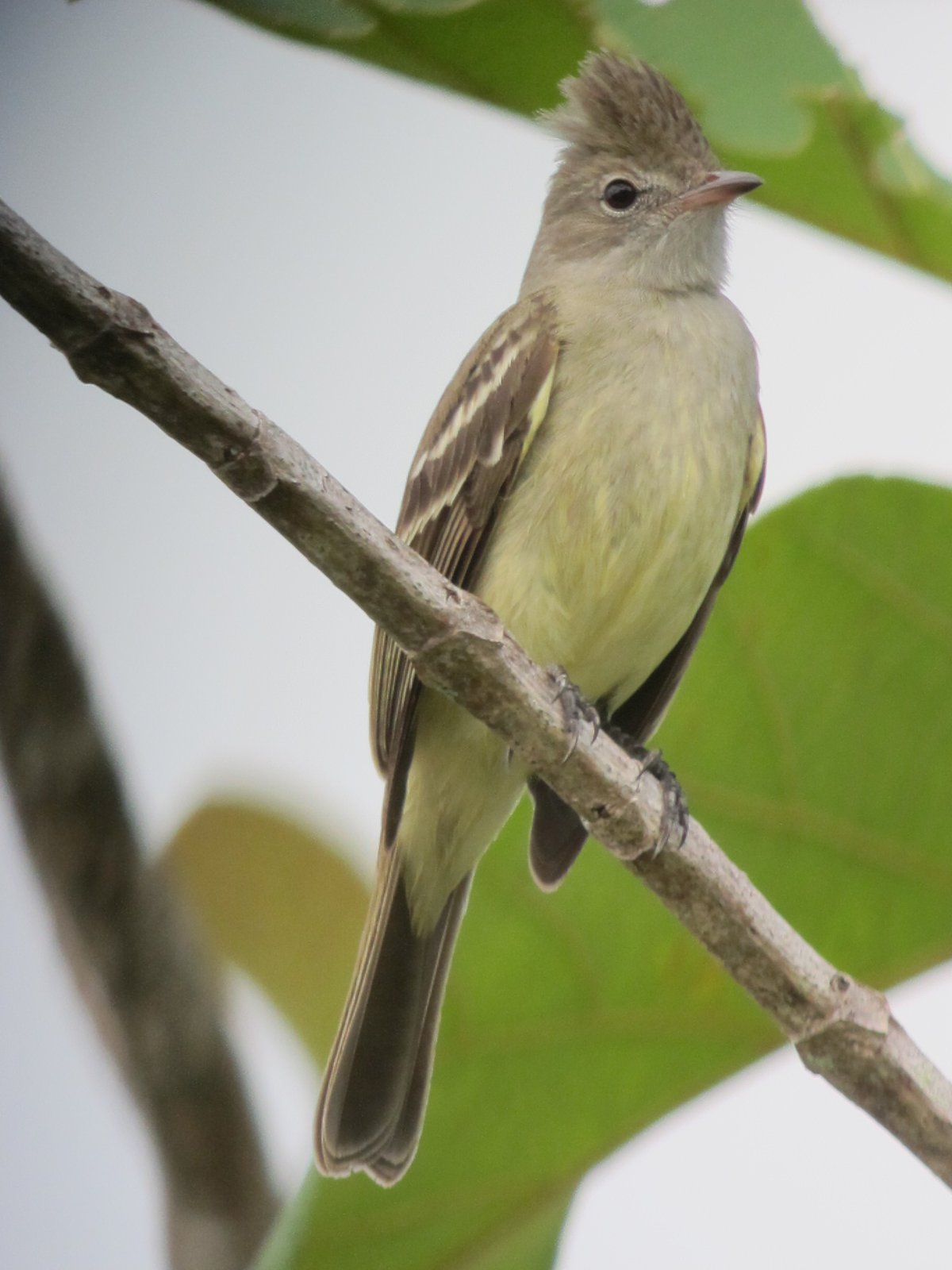
The Yellow-bellied Elaenia is the most widespread elaenia of open lowlands, from Mexico to Argentina. With its shaggy, often raised crest with a white core and its loud, harsh call, it is a regular inhabitant of gardens, pastures with trees and forest edges. It benefits from deforestation.
Voice
A loud, harsh, downslurred creeeer; at dawn repeated series such as wreeyer-wreeyer-wree, often in duet.
Recording: JAYRSON ARAUJO DE OLIVEIRA — CC BY-NC-SA 4.0 · xeno-canto
Identification
16 cm, with a short black bill with a pale base to the lower mandible. The crest is shaggy and often raised, revealing a white crown patch. The upperparts are olive-brown, with a narrow white eye-ring. The wings are dark with two white wing bars. The throat and breast are grey, the belly pale yellow. The sexes are alike. Juveniles have a shorter crest without a white patch.
Confusion species
Large Elaenia Elaenia spectabilis has hardly any crest, a darker grey breast and often three wing bars. Lesser Elaenia Elaenia chiriquensis is smaller and paler, with a smaller crest and a less grey breast. Small-billed Elaenia Elaenia parvirostris has a round head and a whitish belly. Mottle-backed Elaenia Elaenia gigas has a divided crest and a mottled back.
Habitat
Semi-open country with trees and shrubs, gardens, parks, pastures, plantations, secondary forest and forest edges, mainly in the lowlands and lower montane zones up to about 1800 m. It eats fruit and insects. The nest is a small, shallow cup of moss and fibres in a tree fork.
Where the bird is most at home, classified by the vegetation units of the Andes and the west coast.


Range and movements
Colombia: widespread in the lowlands and on lower slopes, also in the inter-Andean valleys. Ecuador: widespread in the west; in the east locally in cleared areas. Peru: in the far north-west and locally in the east, mainly in cleared areas. Bolivia: widespread in the lowlands. Absent from the Galápagos. Outside the guide area from Mexico to northern Argentina.
- Resident
- dark = core range, pale = thinly spread
How and when to look
Listen in the early morning in gardens and pastures with scattered trees for the harsh calls; birds often perch in the open at the top of a shrub or tree.
Conservation status
Least Concern. Common and benefits from open, human-made landscapes.
Scientific name
Elaenia flavogaster | (Thunberg, 1822)
Thunberg described the species in 1822 as P[ipra] flavogaster; because it was later moved to another genus, the author and year stand in brackets. The genus Elaenia was introduced in 1836 by Sundevall. The genus name comes from Ancient Greek elaineos, 'of olive oil' or 'oleaginous'. From Latin flavus, 'yellow', and Ancient Greek gastēr, 'belly': 'yellow-bellied'. The specimen the first description was based on came from Rio de Janeiro (presumably), Brazil.