All species › Passerines › Tyrant flycatchers and allies › Highland Elaenia
Highland Elaenia | Elaenia obscura
Hooglandelenia | Fiofío oscuro | Guaracava-das-terras-altas
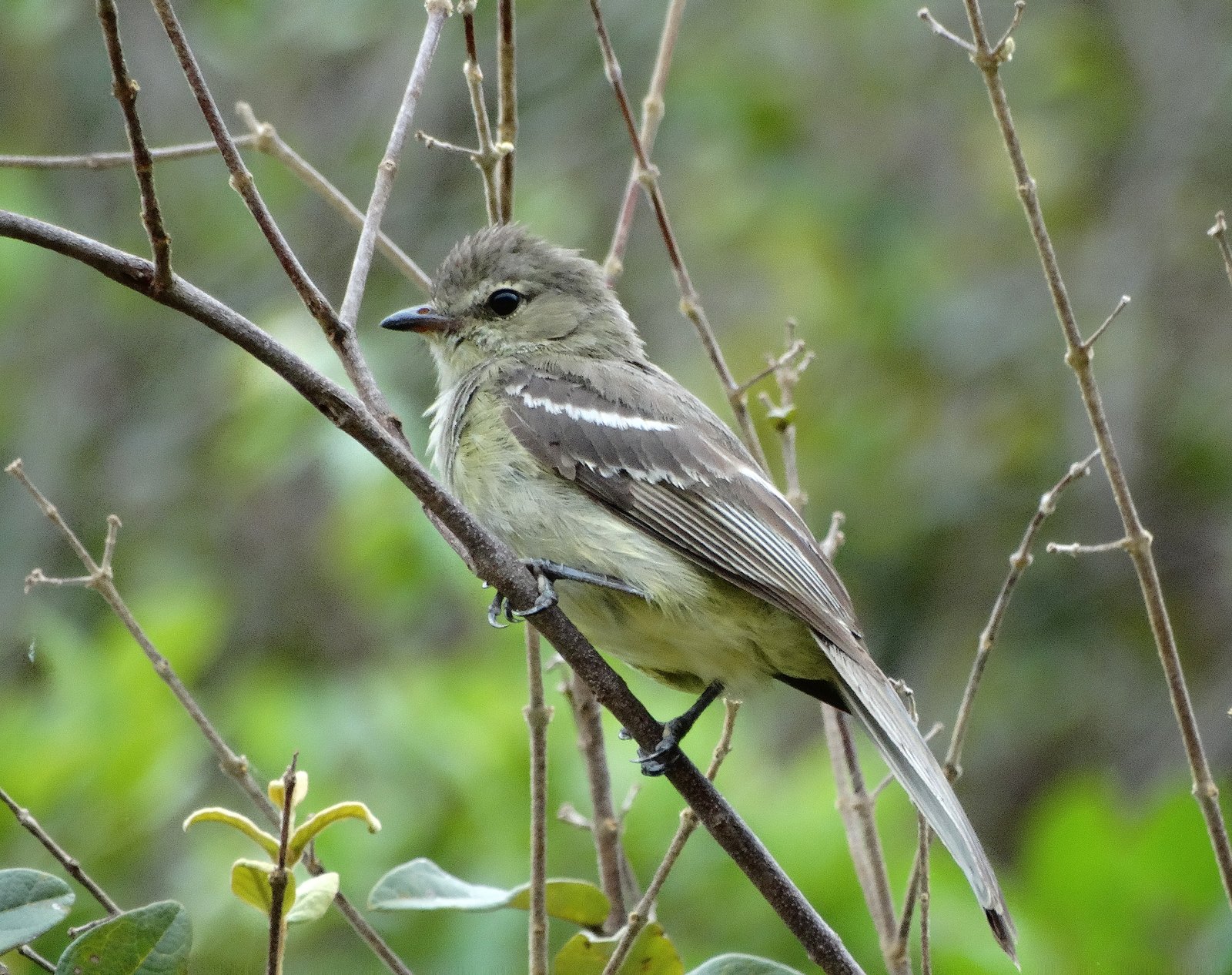
The Highland Elaenia is a large, dark elaenia of montane forest edges in the Andes, from southern Ecuador to Bolivia. It has a round head without an obvious crest and without a white crown patch, which separates it from most other elaenias. It often stays hidden in dense scrub.
Voice
Harsh, rolling calls and a repeated, whistled wheew; the song is a series of low, broken notes.
Recording: alvaro riccetto — CC BY-NC-SA 4.0 · xeno-canto
Identification
18 cm, with a round head, a short, broad bill and a fairly long tail. The upperparts are dark olive-green, with a narrow yellowish eye-ring. The crown lacks a white patch. The wings are dark with two yellowish-white wing bars. The throat and breast are olive-grey, the belly yellow. The sexes are alike.
Confusion species
Sierran Elaenia Elaenia pallatangae is smaller, with a small white crown patch and a smaller bill. White-crested Elaenia Elaenia albiceps is greyer, with a distinct white crown stripe and a white belly. Yellow-bellied Elaenia Elaenia flavogaster lives lower, has a shaggy crest and a white crown patch.
Habitat
Edges of cloud forest and upper montane forest, scrub, open woodland with Polylepis and Alnus and rough ground in the highlands, roughly between 1500 and 3200 m. It takes fruit and insects in dense shrubs and low trees, often hidden.
Where the bird is most at home, classified by the vegetation units of the Andes and the west coast.


Range and movements
Ecuador: locally in the south, on the eastern slope in Loja and Zamora-Chinchipe. Peru: along the eastern slope of the Andes from Amazonas and Cajamarca south to Puno. Bolivia: in the Yungas and the higher valleys from La Paz to Tarija. Absent from Colombia and the Galápagos. Outside the guide area in north-western Argentina.
- Resident
- dark = core range, pale = thinly spread
How and when to look
Watch for round-headed, dark elaenias along cloud-forest edges and in scrub above the treeline, for example along the roads through the Yungas of La Paz; the bird often sits deep in cover and is mainly heard.
Conservation status
Least Concern. The species also lives in degraded forest and scrub.
Scientific name
Elaenia obscura | (d'Orbigny, ACVMD & de Lafresnaye, 1837)
D'Orbigny, ACVMD & de Lafresnaye described the species in 1837 as M[uscipeta] obscura; because it was later moved to another genus, the author and year stand in brackets. The genus Elaenia was introduced in 1836 by Sundevall. The genus name comes from Ancient Greek elaineos, 'of olive oil' or 'oleaginous'. Latin obscurus, 'dark', after the dark plumage. The specimen the first description was based on came from Yungas, Bolivia.