All species › Passerines › Tyrant flycatchers and allies › Mottle-backed Elaenia
Mottle-backed Elaenia | Elaenia gigas
Geschubde elenia | Fiofío gigante | Guaracava-gigante
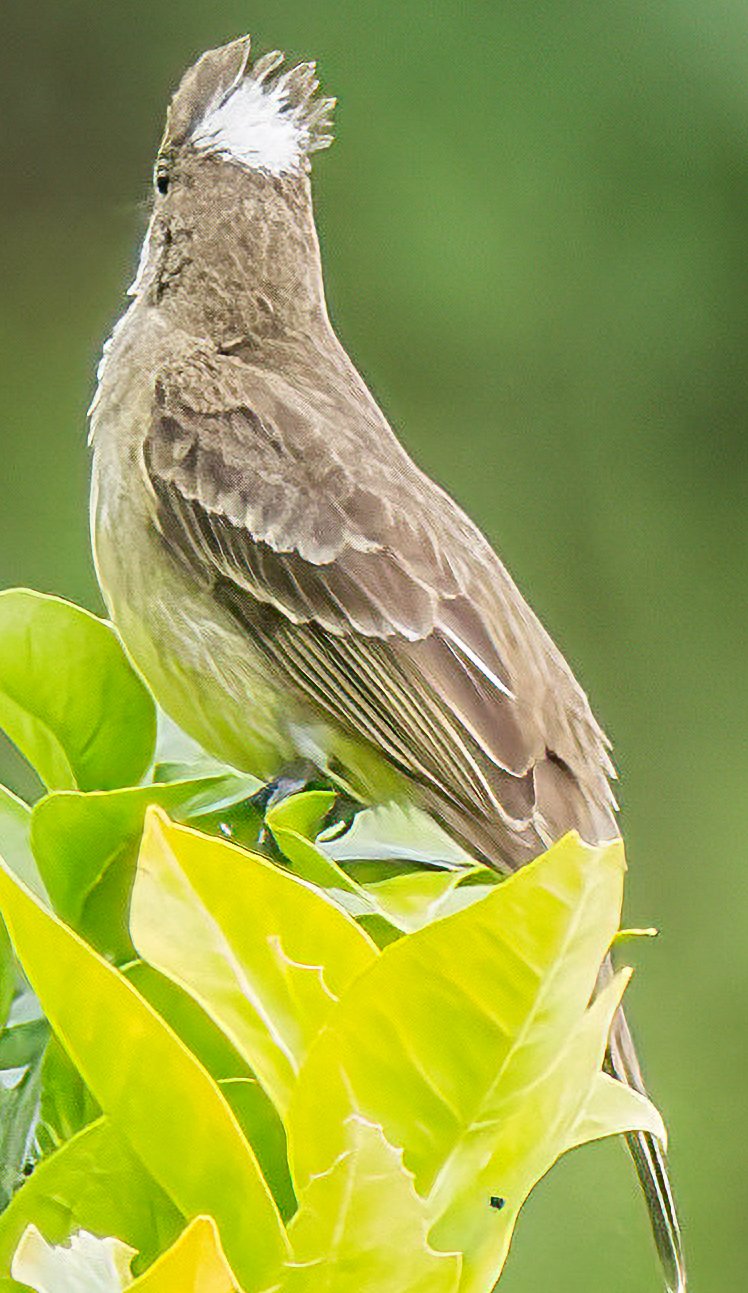
The Mottle-backed Elaenia is a large elaenia of the eastern Andean foothills, with a divided crest that stands out like two small horns. It lives in young scrub on gravel bars and river islands along fast-flowing rivers. It occurs only from Colombia to Bolivia.
Voice
Loud, harsh, downslurred calls, roughly brreeew, and short rattling series.
Recording: Leonardo Ordóñez-Delgado — CC BY-NC-SA 4.0 · xeno-canto
Identification
18 cm, with a short black bill and a clearly divided crest with a white centre. The upperparts are dark olive-brown, mottled on the back because the feathers have dark centres and paler edges. The wings are dark with two whitish wing bars. The throat and breast are greyish with faint dark streaks, the belly pale yellow. The sexes are alike.
Confusion species
Yellow-bellied Elaenia Elaenia flavogaster has a shaggy, undivided crest, a plain back and an unstreaked breast. Large Elaenia Elaenia spectabilis has hardly any crest and a plain back. Small-billed Elaenia Elaenia parvirostris is smaller, with a round head and a distinct white eye-ring.
Habitat
Young scrub with Cecropia, cane and low trees on gravel bars, river islands and riverbanks in the Andean foothills, also rough pastures and forest edges, roughly between 250 and 1250 m. It eats insects and fruit, often from an exposed branch.
Where the bird is most at home, classified by the vegetation units of the Andes and the west coast.


Range and movements
Colombia: at the foot of the eastern slope of the Andes, from Meta south to Putumayo. Ecuador: in the foothills of the eastern slope. Peru: at the foot of the eastern slope throughout the length of the country. Bolivia: in the Andean foothills in the west (La Paz, Cochabamba). Absent from the Galápagos. Does not occur outside the guide area.
- Resident
- dark = core range, pale = thinly spread
How and when to look
Search the gravel bars of rivers at the foot of the eastern Andes, for example near Tena in Ecuador or in the Alto Madre de Dios valley in Peru. The bird often perches in the open on a shrub above the low growth.
Conservation status
Least Concern. It benefits locally from young scrub, but depends on the natural dynamics of rivers.
Scientific name
Elaenia gigas | Sclater, 1871
Sclater described the species in 1871 and placed it straight away in the genus where it still stands. The genus Elaenia was introduced in 1836 by Sundevall. The genus name comes from Ancient Greek elaineos, 'of olive oil' or 'oleaginous'. Latin gigas, 'giant', after its large size within the genus. The specimen the first description was based on came from Río Napo, Ecuador.