All species › Passerines › Tyrant flycatchers and allies › Slaty Elaenia
Slaty Elaenia | Elaenia strepera
Leigrijze elenia | Fiofío plomizo | Guaracava-cinzenta
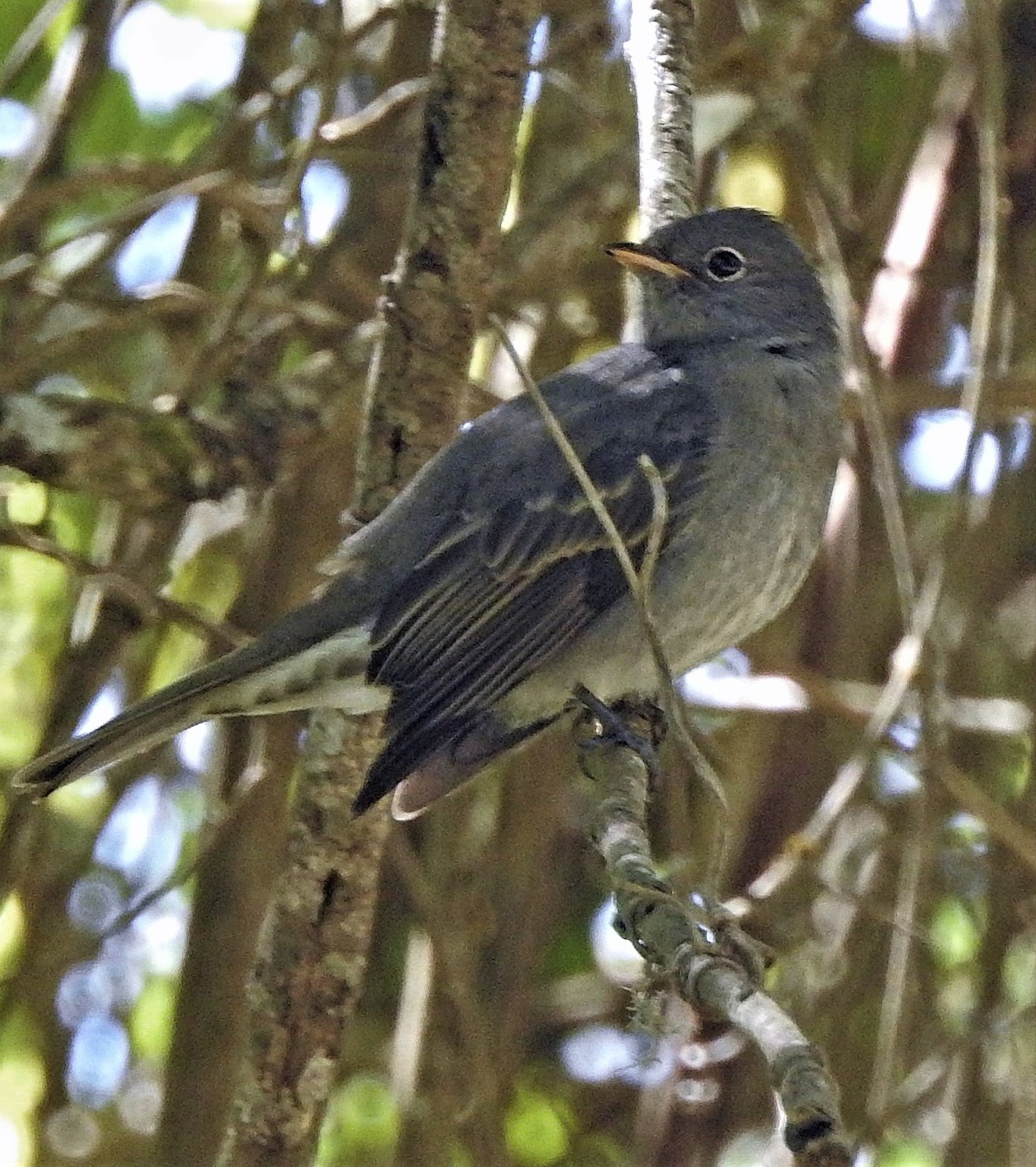
The Slaty Elaenia is the only grey elaenia. It breeds in the montane forests of southern Bolivia and north-western Argentina and moves to the western Amazon Basin in the austral winter. The male has a croaking, frog-like song.
Voice
The male's song is a low, croaking, frog-like rattle. Also short, harsh calls.
Recording: Sjoerd Mayer — CC BY-NC-SA 3.0 · xeno-canto
Identification
15 cm, with a round head, a small crest and a short black bill. The male is mostly slate-grey, with a white crown patch, faint grey wing bars and a whitish centre to the belly. The female is browner grey, with pale brown wing bars and a pale yellowish lower belly. Juveniles resemble the female, with rusty wing bars.
Confusion species
Small-billed Elaenia Elaenia parvirostris and White-crested Elaenia Elaenia albiceps are olive rather than grey, with distinctly white wing bars. Large Elaenia Elaenia spectabilis is larger, with a yellow belly. Plumbeous-crowned Tyrannulet Phyllomyias plumbeiceps is smaller and greener.
Habitat
Breeds in lower and upper Yungas forest, forest edges and open woodland with shrubs, roughly between 1000 and 2500 m. In winter in forest edges, riverside scrub and on river islands in the Amazonian lowlands. It eats insects and fruit.
Where the bird is most at home, classified by the vegetation units of the Andes and the west coast.


Range and movements
Bolivia: breeds in the Andes of the south (mainly Chuquisaca and Tarija); in winter further north in the lowlands. Peru, Ecuador and Colombia: winter visitor in the eastern lowlands, scarce and scattered. Absent from the Galápagos. Outside the guide area it breeds in north-western Argentina and winters north to Venezuela.
- Winter visitor (c. Oct–Mar)
- dark = core range, pale = thinly spread
How and when to look
In the breeding season (October–March) search forest edges in the Yungas of southern Bolivia, where the male's croaking song gives the bird away. In winter look in riverside scrub along Amazonian rivers among other elaenias.
Conservation status
Least Concern. The breeding range lies largely in montane forest that is locally being cleared.
Scientific name
Elaenia strepera | Cabanis, 1883
Cabanis described the species in 1883 and placed it straight away in the genus where it still stands. The genus Elaenia was introduced in 1836 by Sundevall. The genus name comes from Ancient Greek elaineos, 'of olive oil' or 'oleaginous'. Latin streperus, 'noisy', after its calls. The specimen the first description was based on came from Tucumán, Argentina.