All species › Passerines › Tyrant flycatchers and allies › Yellow-billed Tit-Tyrant
Yellow-billed Tit-Tyrant | Anairetes flavirostris
Geelsnavelmeestiran | Cachudito piquiamarillo | Tiranete-chapim-de-bico-amarelo
The Yellow-billed Tit-Tyrant is a small, streaked tyrant of dry scrub in the central and southern Andes, from northern Peru to Patagonia. The name refers to the yellow lower mandible. In Peru and Bolivia it is one of the most widespread tit-tyrants of dry mountain slopes.
Voice
The dawn song is a rising trill followed by a stuttered burst; calls are a rising and falling musical trill and a rising and falling chatter.
Recording: Cristian Pinto — CC BY-NC-SA 4.0 · xeno-canto
Identification
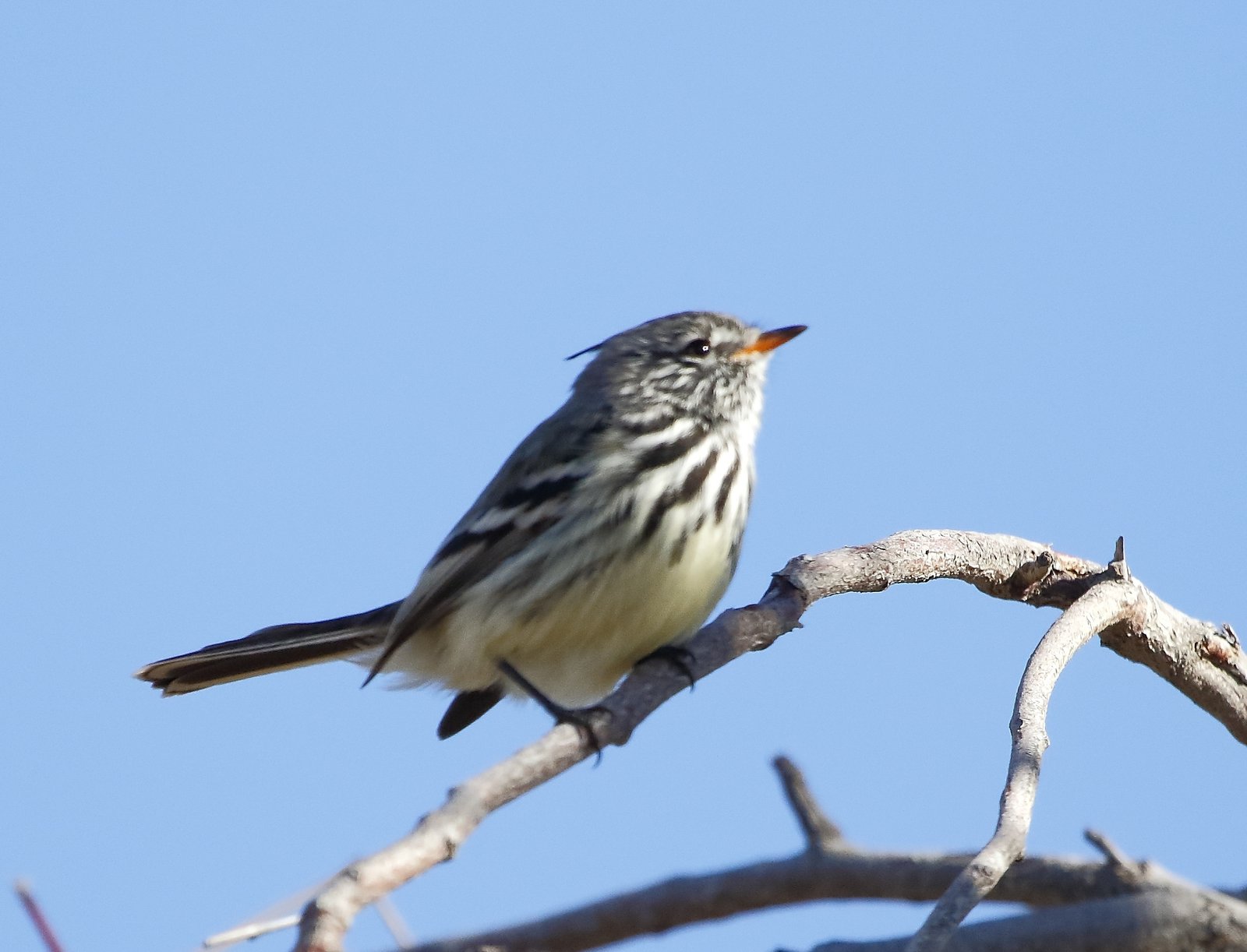
11 cm. Blackish, split crest above a white crown and supercilium; face white with bold black streaks. Upperparts grey-brown; wings with pale edgings and two cinnamon-buff wing bars. Throat, breast and upper belly white with black streaks, flanks and lower belly unmarked yellowish. Upper mandible black, lower mandible yellow with a black tip; iris dark brown. Sexes alike. Juveniles have a shorter crest and are duller and less streaked. The subspecies differ in the amount of white on the crown and the strength of the streaking.
Confusion species
Tufted Tit-Tyrant Anairetes parulus has an all-black bill, a pale iris, a long, curled crest and whitish wing bars. Pied-crested Tit-Tyrant Anairetes reguloides has a black, white-streaked back, a yellow to orange-red bill and a whitish belly. Ash-breasted Tit-Tyrant Anairetes alpinus is larger and grey, with an unstreaked breast.
Habitat
Dry, semi-open to open country: dry montane and desert scrub, thorn scrub and also groves of Polylepis and Gynoxys; west of the Andes locally down to near sea level in the lomas. Mostly between 1900 and 4100 m. It searches for insects in shrubs, alone or in pairs.
Where the bird is most at home, classified by the vegetation units of the Andes and the west coast.


Range and movements
Peru: in the northern Andes from Piura and Cajamarca to Áncash and Huánuco, on the west slope from Lima southwards, and in Cusco. Bolivia: in the Andes. Colombia and Ecuador: absent. Absent from the Galápagos. Outside the guide area in northern Chile and in Argentina south to Chubut; southern birds move north in winter, a few reaching Uruguay.
- Resident
- dark = core range, pale = thinly spread
How and when to look
Search dry scrub along roads in the inter-Andean valleys of Peru and Bolivia and listen for the musical trill.
Conservation status
Least Concern. The population is believed to be stable; fairly common in the Peruvian Andes, rare to fairly common elsewhere.
Scientific name
Anairetes flavirostris | Sclater & Salvin, 1876
Sclater & Salvin described the species in 1876 and placed it straight away in the genus where it still stands. The genus Anairetes was introduced in 1850 by Reichenbach. The genus name comes from Greek anairetēs, 'destroyer, slayer'. The species name comes from Latin flavus, 'yellow', and rostrum, 'bill'. The specimen the first description was based on came from Tilotilo, Yungas, La Paz, Bolivia.