All species › Passerines › Tyrant flycatchers and allies › Tufted Tit-Tyrant
Tufted Tit-Tyrant | Anairetes parulus
Pluimmeestiran | Cachudito piquinegro | Tiranete-chapim-de-topete
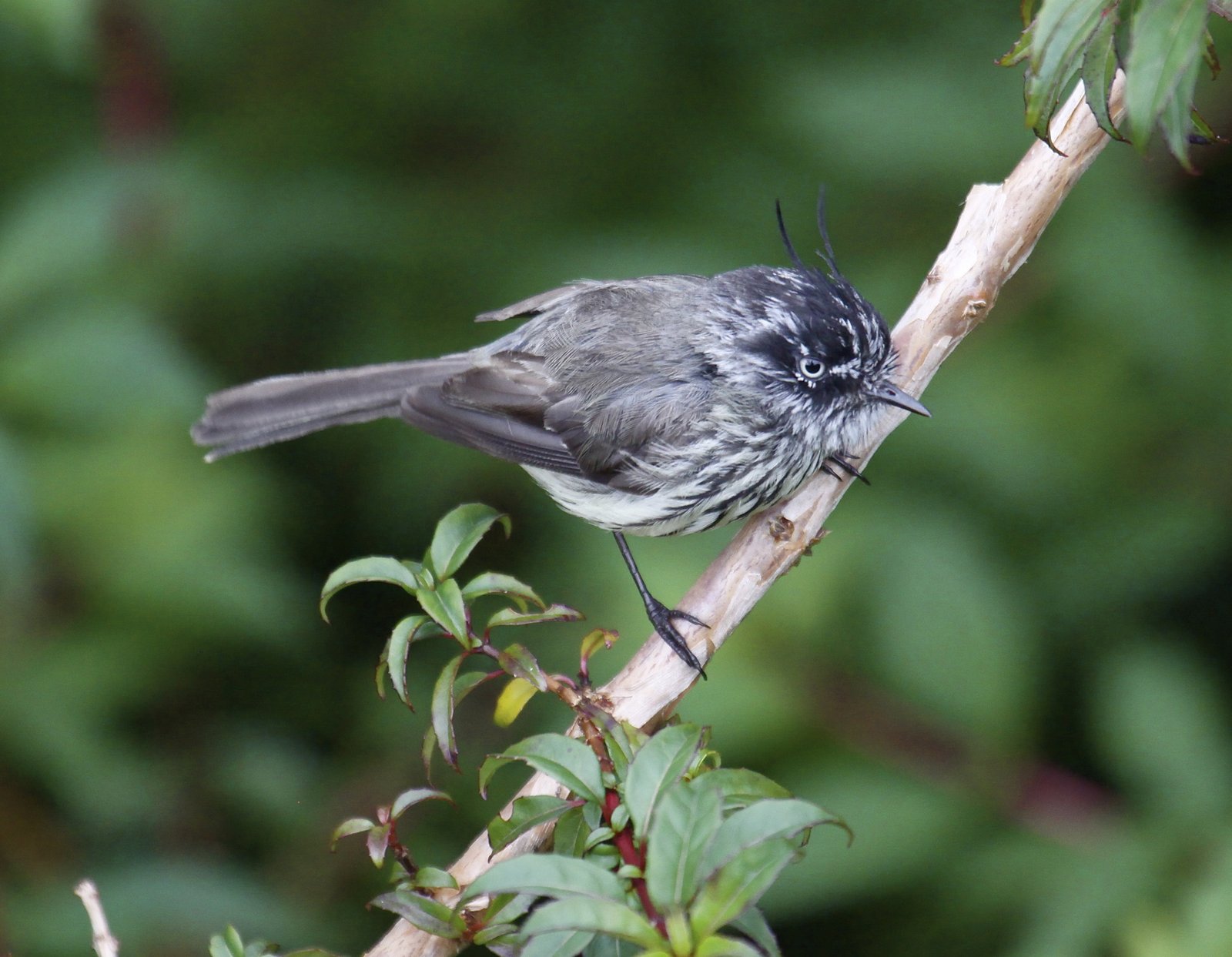
The Tufted Tit-Tyrant is a small tyrant with a long, thin, forward-curling crest. It is the most widespread tit-tyrant and occurs along almost the entire Andes, from Colombia to Tierra del Fuego. In the guide area it lives in scrub and forest edges high in the mountains.
Voice
A fast, dry trill and high, short calls pit or tsee, often in series that run into a trill.
Recording: Cristian Pinto Fernandez — CC BY-NC-SA 4.0 · xeno-canto
Identification
11 cm. Long, thin black crest that curls forward; head streaked black and white with a white supercilium. Iris white to pale yellow; bill black. Upperparts grey-brown; wings dark with two narrow whitish wing bars. Throat and breast white with black streaks, belly pale yellow. Sexes alike; juveniles have a shorter crest and duller plumage.
Confusion species
Yellow-billed Tit-Tyrant Anairetes flavirostris has a yellow lower mandible, a dark iris, a shorter, split crest and cinnamon-buff wing bars. Agile Tit-Tyrant Uromyias agilis has a longer tail, a dark iris, a flat crest and a heavily streaked brown back. White-banded Tyrannulet Mecocerculus stictopterus has no crest and no streaks on the breast.
Habitat
Scrub and forest edges near the treeline, Polylepis woodland, shrubby páramo and dry montane scrub; in the guide area mostly between 2000 and 4000 m, further south in its range down to sea level. It actively searches for insects in shrubs and low trees, in pairs and often in mixed flocks. The nest is a small, deep cup of moss and plant fibres in a shrub.
Where the bird is most at home, classified by the vegetation units of the Andes and the west coast.


Range and movements
Colombia: in the Andes, mainly in the south. Ecuador: throughout the Andes. Peru: along the entire length of the Andes. Bolivia: in the highlands. Absent from the Galápagos. Outside the guide area in Chile and Argentina to Tierra del Fuego.
- Resident
- dark = core range, pale = thinly spread
How and when to look
Search shrubbery along mountain roads and the edges of Polylepis groves; look for the upturned crest and the pale iris.
Conservation status
Least Concern. Widespread and common in large parts of its range.
Scientific name
Anairetes parulus | (Kittlitz, 1830)
Kittlitz described the species in 1830 as Muscicapa Parulus; because it was later moved to another genus, the author and year stand in brackets. The genus Anairetes was introduced in 1850 by Reichenbach. The genus name comes from Greek anairetēs, 'destroyer, slayer'. The species name is a diminutive of Latin parus, 'tit': 'little tit'. The specimen the first description was based on came from Valparaíso, Chile.