All species › Passerines › Tyrant flycatchers and allies › Yellow-olive Flatbill
Yellow-olive Flatbill | Tolmomyias sulphurescens
Groenkapbreedbektiran | Mosquero ojo blanco | Bico-chato-de-orelha-preta
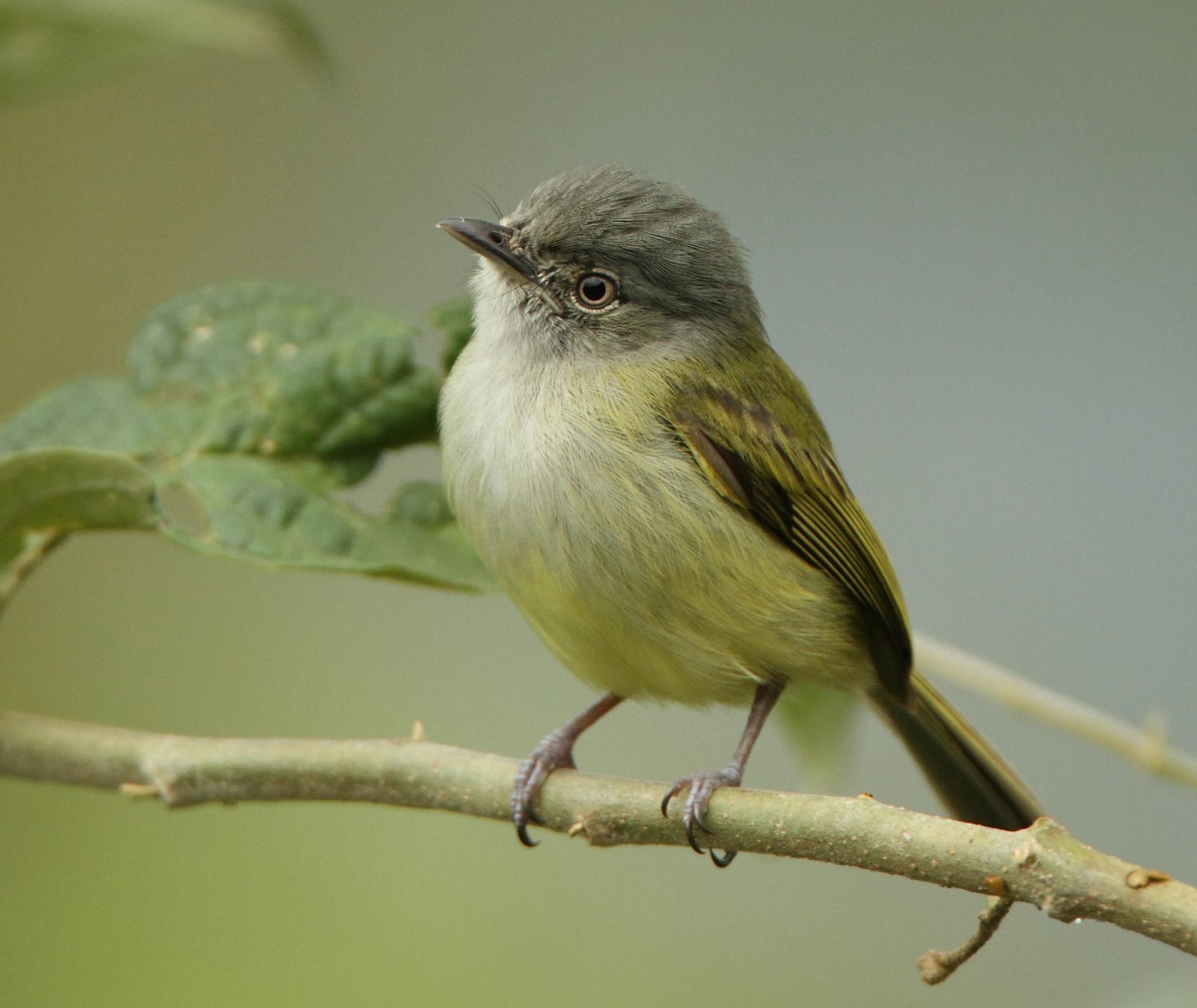
The Yellow-olive Flatbill is the most widespread flatbill of the guide area, from dry forest on the Pacific side to forest edge on the east slope. It is a small, olive-green flycatcher with a grey head and, in most forms, a pale iris. It builds a hanging pouch with a downward entrance tube, often close to a wasp nest.
Voice
A high, thin, sibilant tsweeip, often repeated two or three times, and a high, sharp tsip.
Recording: JAYRSON ARAUJO DE OLIVEIRA — CC BY-NC-SA 4.0 · xeno-canto
Identification
13–14 cm, with a broad, flat bill with a pale lower mandible. The crown and nape are grey to olive-grey, the back olive-green. The lores and eye-ring are pale grey; the iris is greyish white in most forms, darker in some. The wings are dark, with two narrow yellowish-green wing bars and yellow edges to the flight feathers. The throat is pale grey, the breast olive-yellow and the belly pale yellow. The sexes are alike. The species varies considerably from region to region.
Confusion species
Yellow-margined Flatbill Tolmomyias assimilis has a dark iris and a pale patch at the base of the primaries, and lives higher in the canopy of lowland forest. Grey-crowned Flatbill Tolmomyias poliocephalus is smaller, with a shorter bill and a more clearly grey crown. Ochre-lored Flatbill Tolmomyias flaviventris is yellower below and lacks a grey crown. Orange-eyed Flatbill Tolmomyias traylori has an ochre face and an orangey iris.
Habitat
Forest edge, secondary forest, dry forest, gallery forest and semi-open country with trees, from sea level to roughly 2000 m. It forages in the middle and upper storeys, taking insects from the undersides of leaves with short sallies; often in mixed flocks. The nest is a hanging pouch with a long entrance tube at the bottom, often on a thin branch over an open space.
Where the bird is most at home, classified by the vegetation units of the Andes and the west coast.


Range and movements
Colombia: over most of the country, on both sides of the Andes and in the valleys. Ecuador: in the west, mainly in drier forest, and on the east slope. Peru: in the north-west (Tumbes, Piura), in the valleys of the east slope and at the edge of the Amazonian lowlands. Bolivia: in the Yungas, the dry valleys and the eastern lowlands. Absent from the Galápagos. Outside the guide area from Mexico to Argentina.
- Resident
- dark = core range, pale = thinly spread
How and when to look
Listen at forest edge and in dry forest for the high, sibilant call, then search the foliage for a small green flycatcher with a broad bill and pale eyes. The hanging nests are sometimes found before the bird.
Conservation status
Least Concern. The species tolerates disturbed and secondary forest. The group probably includes more than one species; its classification may change.
Scientific name
Tolmomyias sulphurescens | (Spix, 1825)
Spix described the species in 1825 as Platyrhynchus sulphurescens; because it was later moved to another genus, the author and year stand in brackets. The genus Tolmomyias was introduced in 1927 by Hellmayr. The genus name combines Greek tolma, 'courage, boldness', with New Latin myias, 'flycatcher'. The species name is New Latin sulphurescens, 'becoming sulphur-coloured', from sulphur, 'sulphur', after the yellow underparts. The specimen the first description was based on came from Rio de Janeiro, Brazil.