All species › Passerines › Tyrant flycatchers and allies › Orange-eyed Flatbill
Orange-eyed Flatbill | Tolmomyias traylori
Oranjeoogbreedbektiran | Picoplano ojinaranja | Bico-chato-de-olho-laranja
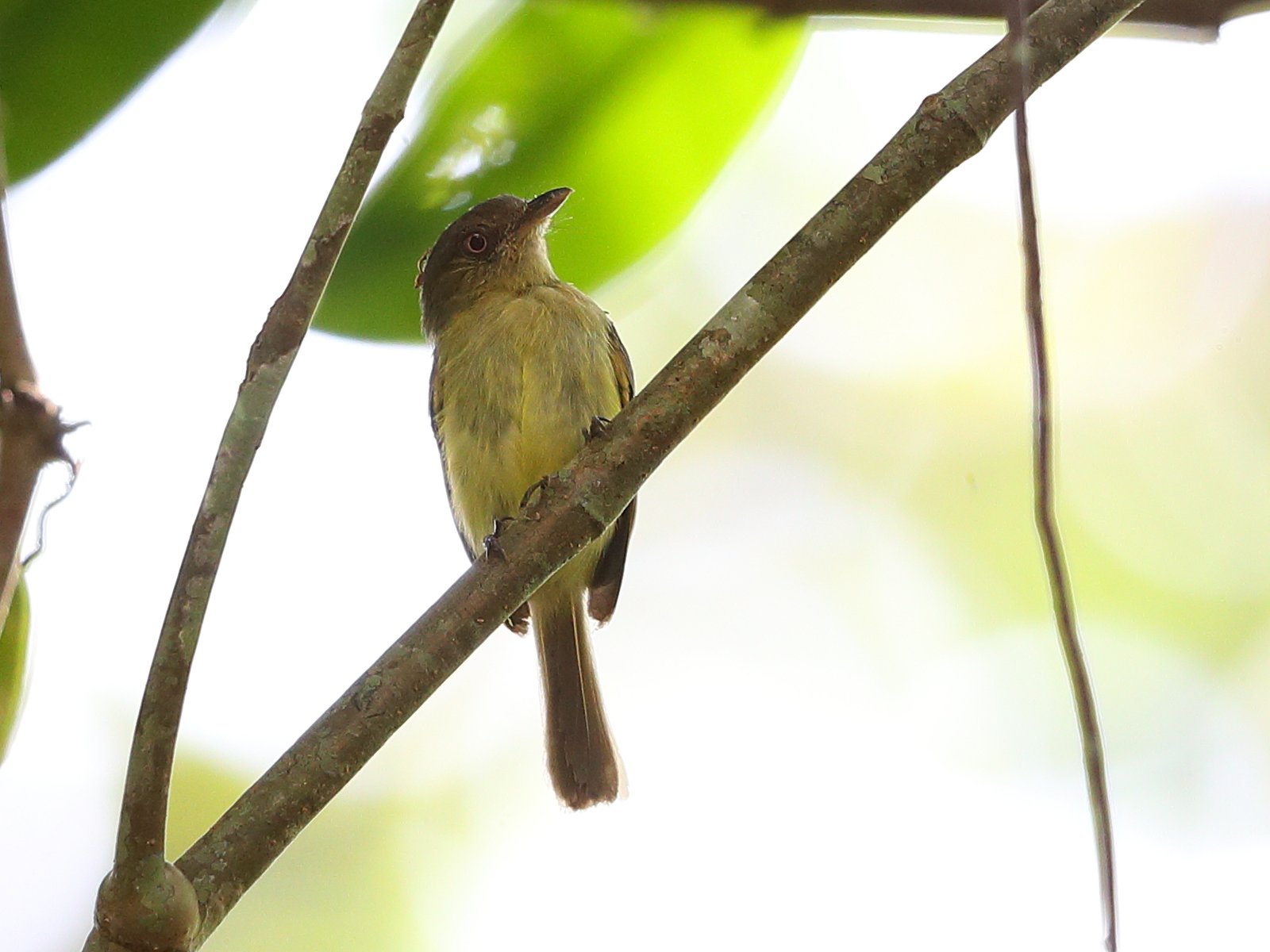
The Orange-eyed Flatbill was described only in 1997 and is a flatbill of western Amazonia. It lives mainly in forest along rivers and on river islands. Its ochre face and orangey iris are characteristic.
Voice
A series of three to five high, thin, slightly buzzy whistles, rising in pitch.
Recording: Juan Freile — CC BY-NC-SA 4.0 · xeno-canto
Identification
12–13 cm, with a broad, flat bill. The crown and upperparts are olive-green, the crown sometimes with a grey tinge. The lores, eye-ring and cheeks are ochre-yellow; the iris is pale orange to orange-brown. The wings are dark, with two narrow yellow wing bars and yellow edges to the flight feathers. The throat and breast are tinged ochre-yellow, the belly yellow. The sexes are alike.
Confusion species
Ochre-lored Flatbill Tolmomyias flaviventris is very similar, but the western Amazonian forms have a greener face with little ochre and a dark iris. Yellow-olive Flatbill Tolmomyias sulphurescens has a grey crown, a greyish-white iris and a greyish throat. Grey-crowned Flatbill Tolmomyias poliocephalus has a clearly grey crown and no ochre face.
Habitat
Várzea, river-island forest, riverine forest and forest edge along rivers and oxbow lakes in the lowlands, mostly below 300 m. It forages in the middle and upper storeys, taking insects from leaves with short sallies, often with mixed flocks. Little is known of the nest; presumably a hanging pouch as in related species.
Where the bird is most at home, classified by the vegetation units of the Andes and the west coast.


Range and movements
Colombia: in the far south, in the Amazonian lowlands along the Putumayo and the Amazon. Ecuador: in the eastern lowlands, mainly along the large rivers. Peru: in the north-east, in Loreto, mainly north of the Amazon. Absent from Bolivia and the Galápagos. Outside the guide area locally in adjacent western Brazil.
- Resident
- dark = core range, pale = thinly spread
How and when to look
Search forest along the large rivers and on river islands near Iquitos or in eastern Ecuador; listen for the rising whistled series in the canopy and look for the ochre face.
Conservation status
Least Concern. The species has a limited range in the riverine forest of western Amazonia, a habitat that is cleared locally along the rivers.
Scientific name
Tolmomyias traylori | Schulenberg & Parker, 1997
Schulenberg & Parker described the species in 1997 and placed it straight away in the genus where it still stands. The genus Tolmomyias was introduced in 1927 by Hellmayr. The genus name combines Greek tolma, 'courage, boldness', with New Latin myias, 'flycatcher'. The species name honours Melvin Alvah Traylor Jr. (1915–2008), American ornithologist at the Field Museum in Chicago, who had long before singled out the museum's two specimens as unusual. The specimen the first description was based on came from North bank of the Amazon near Orán, Loreto, Peru.