All species › Passerines › Tyrant flycatchers and allies › Yellow-margined Flatbill
Yellow-margined Flatbill | Tolmomyias assimilis
Spiegelbreedbektiran | Picoplano aliamarillo | Bico-chato-da-copa
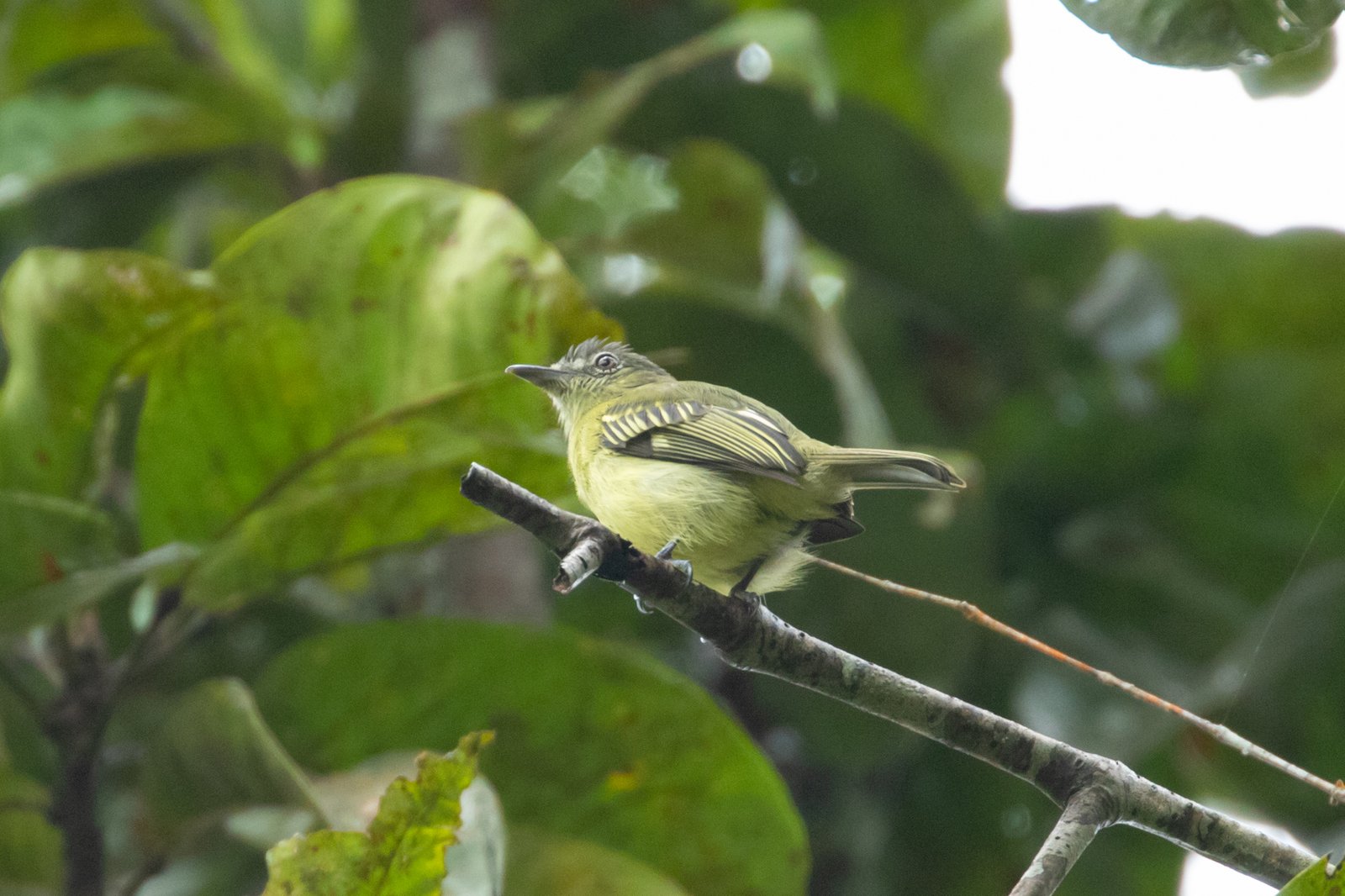
The Yellow-margined Flatbill is a flatbill of the canopy of humid lowland forest. It travels with mixed flocks high in the trees and is mostly noticed by its buzzy call series. The Dutch name refers to the pale patch at the base of the primaries.
Voice
A series of three to six buzzy, hoarse notes, zrrip zrrip zrrip, first rising and then falling slightly; also a single sharp zip.
Recording: Juan Freile — CC BY-NC-SA 4.0 · xeno-canto
Identification
13–14 cm, with a broad, flat bill with a pale lower mandible. The head is grey, with a narrow, pale eye-ring; the iris is dark. The back is olive-green. The wings are dark, with yellow edges to the coverts and flight feathers and a small pale patch at the base of the primaries. The throat is pale grey, the breast greyish green and the belly pale yellow. The sexes are alike.
Confusion species
Yellow-olive Flatbill Tolmomyias sulphurescens usually has a pale iris, no pale patch on the primaries, and lives more often at forest edge and lower in the trees. Grey-crowned Flatbill Tolmomyias poliocephalus is smaller, with a shorter bill and a pale iris. Ochre-lored Flatbill Tolmomyias flaviventris lacks the grey head and is yellower below.
Habitat
The canopy and upper storey of humid terra firme lowland forest and, less often, várzea and foothill forest, up to roughly 1200 m. It takes insects from leaves with short sallies, mostly with mixed flocks in the treetops. The nest is a hanging pouch with an entrance tube at the bottom.
Where the bird is most at home, classified by the vegetation units of the Andes and the west coast.


Range and movements
Colombia: in the lowlands east of the Andes. Ecuador: in the eastern lowlands and foothills. Peru: in the Amazonian lowlands and the foothills of the east slope. Bolivia: in the northern and eastern lowlands and in the foothills. Absent from the Galápagos. Outside the guide area in Venezuela, the Guianas and Brazilian Amazonia.
- Resident
- dark = core range, pale = thinly spread
How and when to look
In lowland forest, follow the mixed flocks in the canopy and listen for the buzzy call series; a canopy tower or walkway gives the best view.
Conservation status
Least Concern. The species depends on large, continuous forest, which still remains over much of Amazonia. Populations west of the Andes are now usually treated as a separate species.
Scientific name
Tolmomyias assimilis | (Pelzeln, 1868)
Pelzeln described the species in 1868 as Rhynchocyclus assimilis; because it was later moved to another genus, the author and year stand in brackets. The genus Tolmomyias was introduced in 1927 by Hellmayr. The genus name combines Greek tolma, 'courage, boldness', with New Latin myias, 'flycatcher'. The species name is Latin assimilis, 'similar', after its resemblance to related flatbills. The specimen the first description was based on came from Borba, Amazonas, Brazil.