All species › Passerines › Tanagers and allies › Yellow-green Tanager
Yellow-green Tanager | Bangsia flavovirens
Zwartvoorhoofdtangare | Tangara verdiamarilla | Sanhaço-verde-amarelado
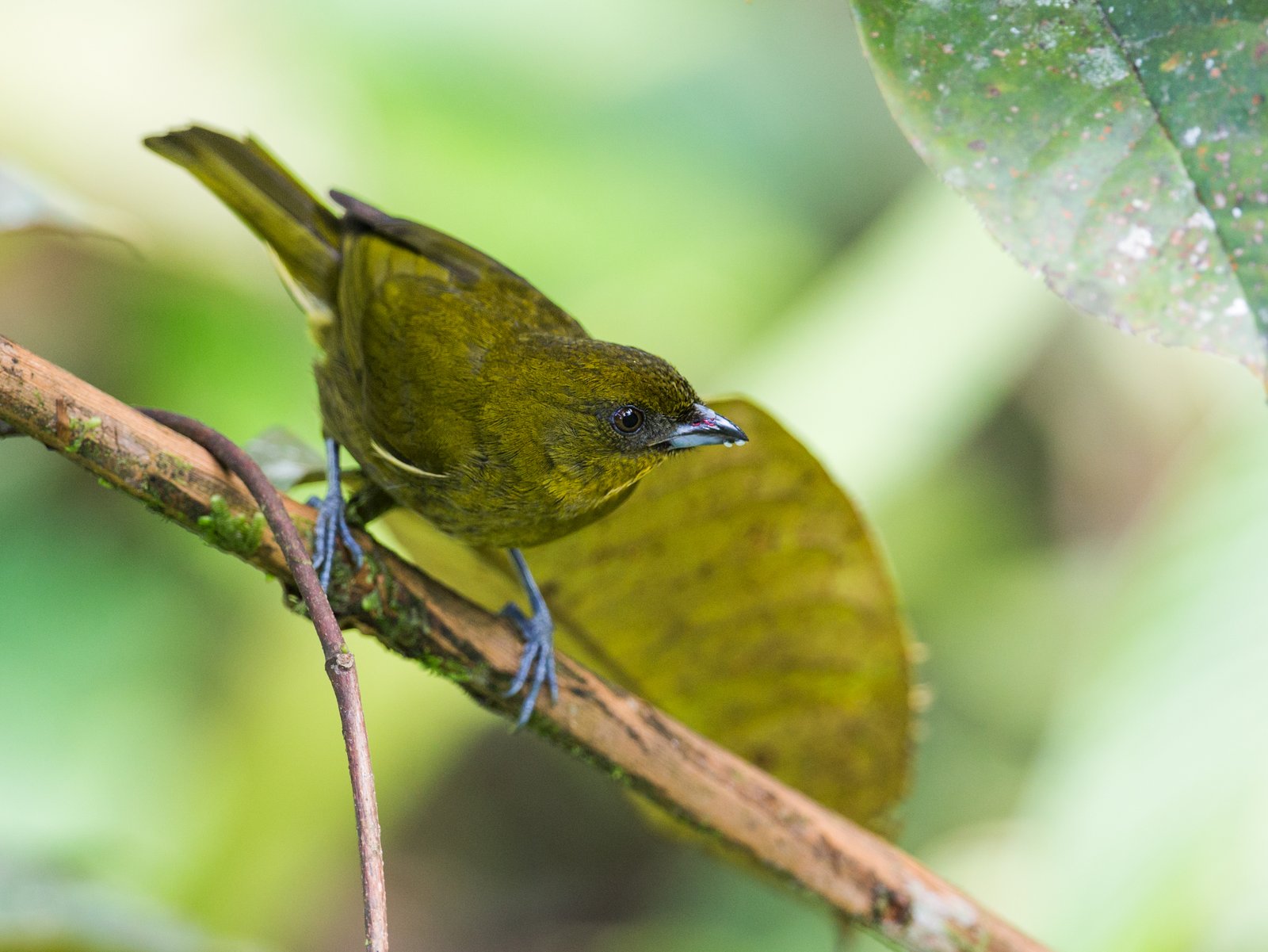
The Yellow-green Tanager is a small, plain yellowish-green tanager of wet foothill forest on the Pacific side of Colombia and Ecuador. It was long placed with the chlorospinguses and only recently moved to the Bangsia tanagers on the basis of DNA studies. It lives in small groups in the canopy, often with mixed flocks.
Voice
Short, dry chip calls and a rapid, high twittering series; poorly described.
Recording: Olaf Jahn — CC BY-NC-SA 4.0 · xeno-canto
Identification
15 cm, with a short, stout bill. The upperparts are bright olive green; the underparts are yellowish green, yellowest on the throat and breast and more olive towards the belly. The head has no obvious markings, at most slightly darker lores. The iris is dark. The sexes are alike.
Confusion species
Dusky Chlorospingus Chlorospingus semifuscus lives higher and is darker, with a grey breast and a pale iris. Yellow-throated Chlorospingus Chlorospingus flavigularis has a bright yellow throat contrasting sharply with a grey breast. Lemon-spectacled Tanager Chlorothraupis olivacea is larger and darker olive green, with yellow spectacles, and lives lower, in the lowlands. Moss-backed Tanager Bangsia edwardsi has a blue head.
Habitat
Wet foothill forest and the lowest montane forest on the Pacific side, mostly in the canopy and at forest edges, roughly between 400 and 1100 m. It searches moss and epiphytes for insects and also eats small fruits. Little is known about the nest.
Where the bird is most at home, classified by the vegetation units of the Andes and the west coast.


Range and movements
In Colombia on the Pacific slope of the Western Andes, locally from Chocó and Valle del Cauca south to Nariño. In Ecuador in the north-west, in Esmeraldas, Imbabura and north-western Pichincha. Absent from Peru, Bolivia and the Galápagos. Does not occur outside the guide area.
- Resident
- dark = core range, pale = thinly spread
How and when to look
In north-western Ecuador, search mixed flocks in the canopy of foothill forest, for example around Mashpi and along roads in north-western Pichincha; look for a small, plain green bird among the other tanagers.
Conservation status
Vulnerable. The range is small and fragmented, and foothill forest on the Pacific side is being cleared on a large scale for farming, cattle ranching and logging.
Scientific name
Bangsia flavovirens | (Lawrence, 1867)
Lawrence described the species in 1867 as Buarremon flavovirens; because it was later moved to another genus, the author and year stand in brackets. The genus Bangsia was introduced in 1919 by Penard. The genus name honours Outram Bangs (1863–1932), an American zoologist and from 1900 curator of mammals at Harvard's Museum of Comparative Zoology. The species name comes from Latin flavus, 'yellow', and virens, 'green'. The specimen the first description was based on came from Ecuador.