All species › Passerines › Shrike-babblers, Erpornis and vireos › Yellow-throated Vireo
Yellow-throated Vireo | Vireo flavifrons
Geelborstvireo | Vireo gorjiamarillo | Juruviara-de-garganta-amarela
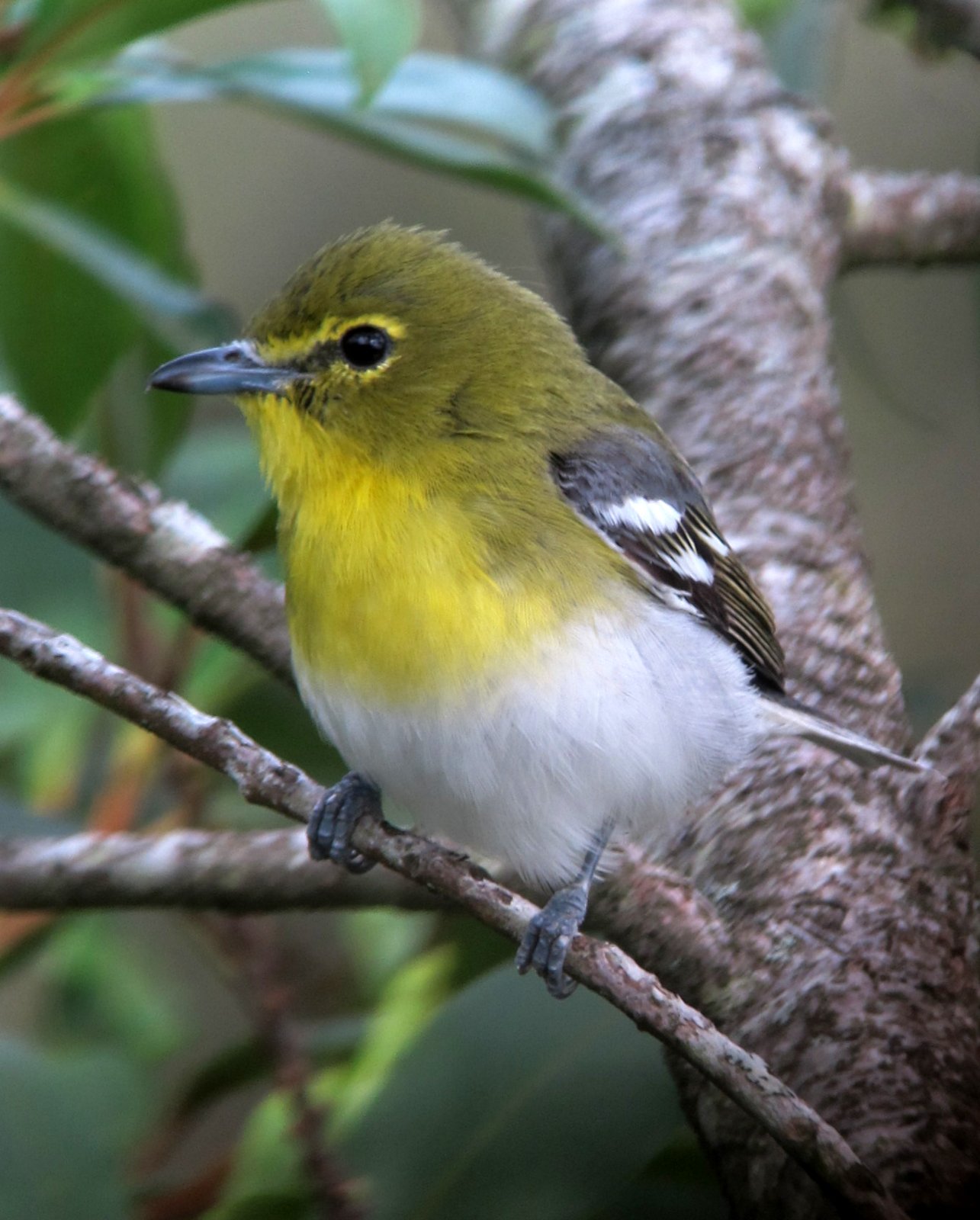
The Yellow-throated Vireo is a stocky vireo with a bright yellow throat and breast, yellow spectacles and two white wing bars. It breeds in the deciduous forests of eastern North America and winters from Mexico to northern South America. In the guide area it is a winter visitor, mainly in Colombia.
Voice
The song is a slow series of husky, burry phrases of two or three notes with long pauses, often rendered as three-eight ... three-oh. The call is a harsh, descending rattle shey-shey-shey. In the winter quarters mainly the call.
Recording: Scott Gravette — CC BY-NC-SA 4.0 · xeno-canto
Identification
13–14 cm, with a thick, grey bill. The head, back and breast are olive-green to yellow: the throat and breast are bright yellow, with yellow spectacles from the bill around the eye. The rump is grey, the belly and undertail coverts pure white. The wings are dark grey with two bold white wing bars. The iris is dark. The sexes are alike; young birds are slightly duller.
Confusion species
Red-eyed Vireo Vireo olivaceus and Black-whiskered Vireo Vireo altiloquus lack wing bars and the yellow throat. Some Nearctic warblers with yellow throats and wing bars, such as Black-throated Green Warbler Setophaga virens, have a thinner bill and a different head pattern. White-eyed Vireo Vireo griseus is smaller, with a white throat and, in adults, a white iris.
Habitat
In winter in the canopy of forest edges, open woodland, shade coffee and gardens with tall trees, from the lowlands to about 2000 m, most often in the foothills and on lower slopes. It forages slowly and deliberately for insects and spiders among branches and leaves, often in mixed flocks. It does not breed in the guide area.
Where the bird is most at home, classified by the vegetation units of the Andes and the west coast.


Range and movements
Colombia: winter visitor, mainly in the north and in the Andes and their foothills. Ecuador: rare winter visitor in the north, with few records. Peru and Bolivia: absent. Absent from the Galápagos. Outside the guide area it breeds in the eastern United States and south-eastern Canada and winters from Mexico to Venezuela.
- Winter visitor (c. Oct–Mar)
- dark = core range, pale = thinly spread
How and when to look
Look between November and March in mixed flocks in the canopy of forest edges and shade-coffee plantations in the Colombian Andes. Listen for the harsh rattle call.
Conservation status
Least Concern. The breeding population is stable to increasing.
Scientific name
Vireo flavifrons | Vieillot, 1808
Vieillot described the species in 1808 and placed it straight away in the genus where it still stands. He introduced the genus Vireo in that same work. The genus name is Latin vireo, a green migratory bird, perhaps the female golden oriole or the greenfinch; related to virere, 'to be green'. The species name comes from Latin flavus, 'yellow', and frons, 'forehead': 'yellow-fronted'. The specimen the first description was based on came from eastern United States.