All species › Passerines › New World sparrows › Yellow-whiskered Chlorospingus
Yellow-whiskered Chlorospingus | Chlorospingus parvirostris
Kortsnaveltangare | Clorospingo bigotudo | Clorospingo-de-bigode-amarelo
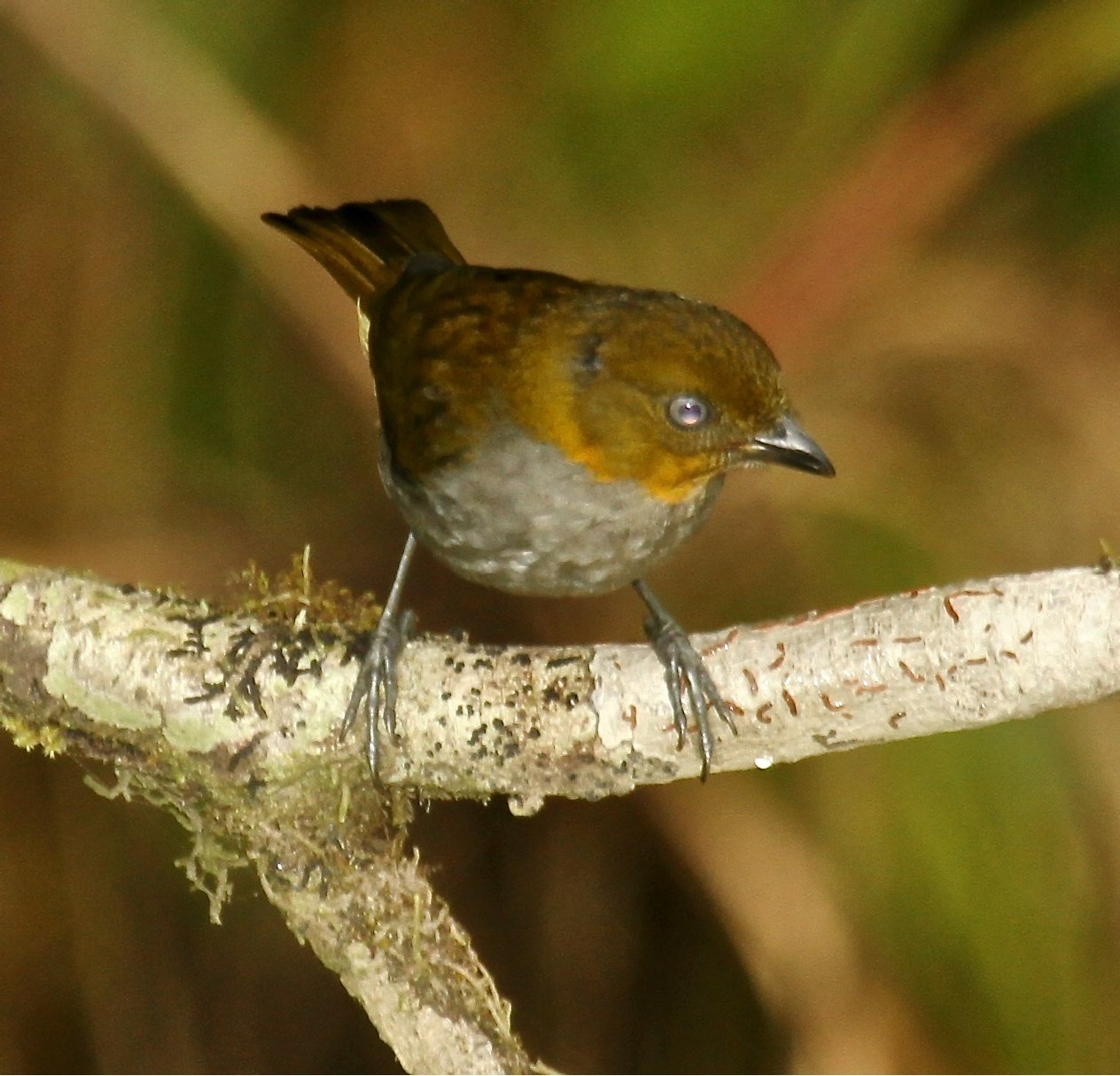
The Yellow-whiskered Chlorospingus is an olive chlorospingus of the eastern slope of the Andes, from Colombia to Bolivia. Its hallmark is a yellow to orange-yellow malar stripe on an otherwise grey throat, which the name refers to. It lives in pairs or small groups in the middle levels of montane forest, often near streams and ravines.
Voice
Dry, sharp chip calls, and as song a harsh, hurried series of chip notes, similar to those of related species.
Recording: Niels Krabbe — CC BY-NC-SA 4.0 · xeno-canto
Identification
14–15 cm, with a rather short, conical, dark bill. The upperparts are olive-green, the head greyish olive, without a white spot behind the eye. The throat is whitish to grey, bordered by a broad yellow to orange-yellow malar stripe. The breast is grey with an olive-yellow wash on the sides, the belly greyish white, the flanks olive. The iris is usually pale, yellowish to light brown. The sexes are alike. Juveniles are duller.
Confusion species
Yellow-throated Chlorospingus Chlorospingus flavigularis has the whole throat bright yellow and a darker iris, and often lives somewhat lower. Common Chlorospingus Chlorospingus flavopectus usually has a white spot behind the eye, a speckled whitish throat and a yellow breast band. Ashy-throated Chlorospingus Chlorospingus canigularis lacks a yellow malar stripe and has a clear yellow breast band.
Habitat
Humid montane forest, cloud forest and forest edges, especially along streams, ravines and steep slopes, roughly between 900 and 2200 m. It searches the middle levels of the forest among leaves and epiphytes for insects and small fruits, alone, in pairs or with mixed flocks. The nest is a cup of moss and fibres.
Where the bird is most at home, classified by the vegetation units of the Andes and the west coast.


Range and movements
In Colombia locally on the eastern slope of the Central and Eastern Andes in the south. In Ecuador along the eastern slope. In Peru along the eastern slope over almost the whole length of the country. In Bolivia on the eastern slope in La Paz and Cochabamba, south into Santa Cruz. Absent from the Galápagos. Does not occur outside the guide area.
- Resident
- dark = core range, pale = thinly spread
How and when to look
Look near streams and ravines along mountain roads on the eastern slope, in the middle levels of the forest. In mixed flocks watch for a chlorospingus with a grey throat and yellow whisker.
Conservation status
Least Concern. The species is widespread and tolerates forest edges, but depends on forested slopes.
Scientific name
Chlorospingus parvirostris | Chapman, 1901
Chapman described the species in 1901 and placed it straight away in the genus where it still stands. The genus Chlorospingus was introduced in 1851 by Cabanis. The genus name combines Greek khlōros, 'green', with spingos, a small bird, perhaps the chaffinch. The species name comes from Latin parvus, 'small', and rostrum, 'bill': small-billed. The specimen the first description was based on came from Inca Mine (Santo Domingo), southeastern Peru.