All species › Passerines › Wagtails and pipits › American Pipit
American Pipit | Anthus rubescens
Pacifische waterpieper | Bisbita norteamericano
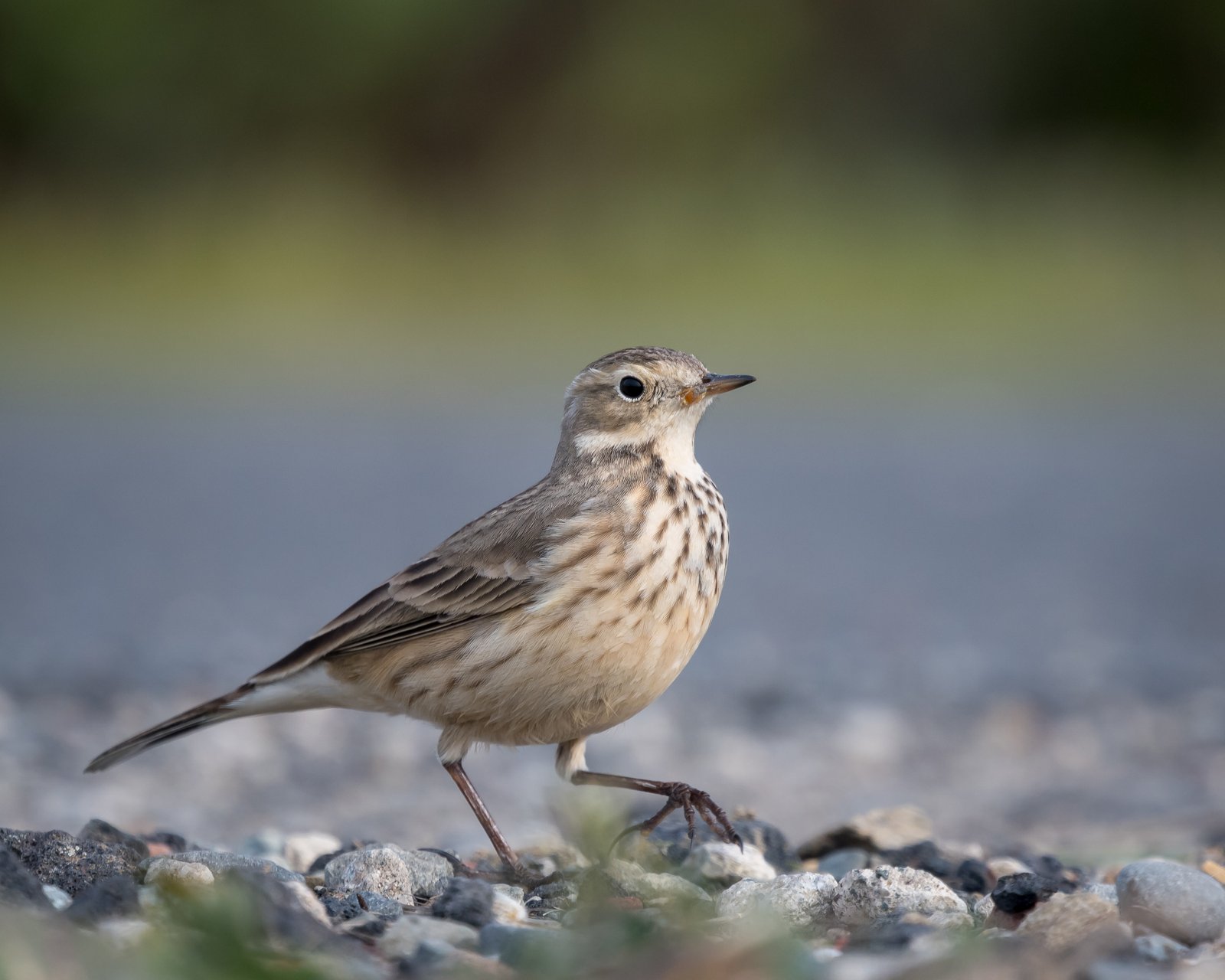
The American Pipit breeds on tundra and in high mountains of North America and north-eastern Siberia and winters from the southern United States to Guatemala. The Caribbean lies at the edge of its wintering range: only in the Bahamas and Cuba is it seen with any regularity, and elsewhere it is a vagrant. It was formerly treated as one species with Water Pipit Anthus spinoletta.
Voice
The call, often given on take-off, is a high, thin pi-pit or sip-it, usually repeated. Song is not to be expected in the winter months.
Recording: Manuel Grosselet — CC BY-NC-SA 4.0 · converted to mono · xeno-canto
Identification
15–17 cm, slim, with a thin, pointed bill, long dark legs and a fairly long tail with white outer tail feathers. In non-breeding plumage the upperparts are grey-brown and faintly streaked and the underparts pale buff, with dark streaks on breast and flanks. A pale supercilium, a pale eye-ring and a dark malar stripe mark the head; two narrow pale wing bars are often visible. In breeding plumage, seen in the region at most on late spring birds, the underparts are warmer buff and less streaked. It pumps its tail almost constantly.
Confusion species
Savannah Sparrow Passerculus sandwichensis also lives in open country and is streaked, but has a short conical bill, often a yellow wash above the eye, and does not pump its tail. Northern Waterthrush Parkesia noveboracensis and Louisiana Waterthrush Parkesia motacilla also bob, but are dark olive-brown above, have a distinctive supercilium and live in mangroves and woodland near water. Grasshopper Sparrow Ammodramus savannarum is compact, with a short tail and a thick bill.
Habitat
Open ground with short or sparse vegetation: drying lagoons and mudflats, the edges of salt pans, sandy beaches, short-mown grassland and golf courses, fields and rice paddies. It walks on the ground, picking up insects, small crustaceans and seeds.
Where the bird is most at home, classified by the vegetation types of the Caribbean.






Range and movements
Rare winter visitor in the Bahamas. On Cuba first recorded in December 2014 on the Guanahacabibes Peninsula, and seen a few times since. Also reported as a rare visitor or vagrant from Jamaica, Hispaniola, San Andrés and Providencia. Breeds from north-eastern Siberia, Alaska and northern Canada to Greenland, and south in the Rocky Mountains; winters along the Pacific coast and in the southern United States, Mexico and Guatemala.
- Winter visitor (c. Apr–Sep)
- dark = core range, pale = thinly spread
How and when to look
Most likely in the Bahamas and western Cuba, on drying lagoons, salt pans and golf courses. The bird is usually noticed only when it flushes and gives its high call; on the ground its tail-pumping gives it away.
Conservation status
Not threatened; the global population is large. In the Caribbean too scarce for a trend to be determined.
Scientific name
Anthus rubescens | (Tunstall, 1771)
Tunstall described the species in 1771 as Alauda Rubescens; because it was later moved to another genus, the author and year stand in brackets. The genus Anthus was introduced in 1805 by Bechstein. Anthus is the Latin word for a small bird of grasslands mentioned by Pliny the Elder. rubescens is Latin for 'reddish', from ruber 'red'. The specimen the first description was based on came from Pennsylvania.