The habitats of the Caribbean
Every species in this guide is linked to the habitats where it most occurs in the Caribbean. The classification was made for this guide: the land types follow A Guide to Caribbean Vegetation Types (Areces-Mallea et al., 1999), supplemented with types that birdwatchers distinguish on the islands; for coast and sea, CMECS was used. It has ten main groups, from open sea to built-up land, and beneath them a series of more specific formations. Each bird carries a few of those: not everywhere it has ever turned up, but where it truly belongs.
Select a habitat to read its description.
Open sea and reefs A
Every habitat governed by sea water, from the deep Caribbean Sea and the Atlantic Ocean to the clear shallows around the islands. The subdivision follows depth and seabed: the open ocean beyond the shelf edge, the coastal water above the shelf, and two bottom-bound formations, coral reef and seagrass beds. For birds the range runs from petrels that come ashore only in darkness to terns and pelicans fishing close inshore.
-
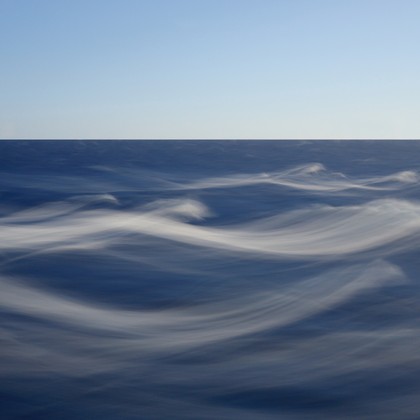 Open ocean A1
Caribbean Sea
32 species
Open ocean A1
Caribbean Sea
32 species
The deep water beyond the edge of the continental shelf, where the seabed drops away to hundreds or thousands of metres. That edge is the boundary with Coastal waters and shelf; reef and seagrass always lie inside it. The water is warm, clear and poor in food; drifting sargassum weed and places where predators drive fish to the surface are the oases. Black-capped Petrel forages here, far from its breeding grounds in the mountains of Hispaniola, alongside Sargasso Shearwater, Wilson's Storm Petrel, Sooty Tern, Bridled Tern, Masked Booby and Red-billed Tropicbird.
-
 Coastal waters and shelf A2
Cuba from space (satellite image)
39 species
Coastal waters and shelf A2
Cuba from space (satellite image)
39 species
The open water above the continental shelf, from the surf to the edge where Open ocean begins. Where the seabed becomes decisive, with reef or seagrass, the place belongs to Coral reef or to Seagrass beds and shallow bays; whatever dries out belongs to the coast. Broad shelves lie around Cuba and Trinidad, where river water makes the sea turbid and rich in food. Here hunt the birds seen from any quayside: Brown Pelican plunges onto shoals of sardines, Magnificent Frigatebird snatches fish from the surface, and Royal Tern, Sandwich Tern and Laughing Gull fish close inshore.
-
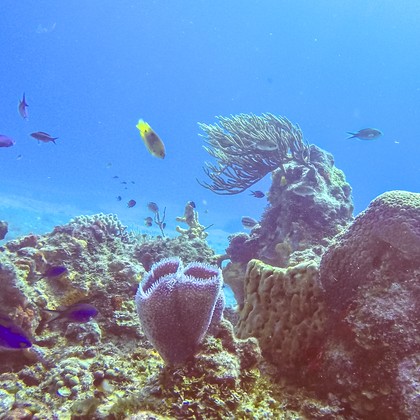 Coral reef A3
Arrecifes de Cozumel National Park, Mexico
4 species
Coral reef A3
Arrecifes de Cozumel National Park, Mexico
4 species
Shallow, clear sea water over a bottom built up by corals, from the reef flat behind the surf to the fore-reef slope dropping into the depths. Where the bottom is sand with seagrass, Seagrass beds and shallow bays begins; water over bare sand or silt belongs to Coastal waters and shelf. Reefs fringe much of the islands, with long barrier reefs along Andros and the Cuban cays and fringing reefs around Bonaire and the Lesser Antilles. Birds use the reef as a fishing ground: Brown Noddy, Bridled Tern and Roseate Tern pick small fish from the surf, Brown Booby dives into the channels and Osprey hunts over the clear water.
-
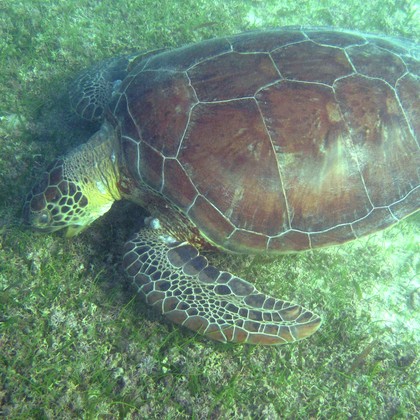 Seagrass beds and shallow bays A4
Turtle Beach, Akumal, Mexico
26 species
Seagrass beds and shallow bays A4
Turtle Beach, Akumal, Mexico
26 species
Shallow, sheltered sea with a sandy bottom covered in seagrass, above all turtle grass, Thalassia testudinum, in bays, behind reefs and on the extensive banks. The tidal range in the Caribbean is small; whatever does dry out belongs to Tidal flats and mudbanks and the reef structure itself to Coral reef. The Great Bahama Bank and the Gulf of Batabanó south of Cuba are the largest examples. Here birds wade and dive: Reddish Egret stands in the shallows, Red-breasted Merganser winters here, and Least Tern and Osprey fish over the beds.
Coast B
The narrow belt where sea and land meet, from beaches and rocky shores to mangroves and salt pans, and the smallest islets barely above water. The subdivision follows substrate and water: loose sand, bare rock, mud exposed by the tide, forest standing in salt water, evaporating lagoons and isolated cays. For birds the coast is the busiest habitat on the islands: here the shorebirds from the north spend the winter and the seabirds breed.
-
 Sandy beach and dunes B1
Sandy shore with dune vegetation
40 species
Sandy beach and dunes B1
Sandy shore with dune vegetation
40 species
Beaches of coral or volcanic sand with the beach ridge and low dunes behind, up to where scrub or forest forms a closed canopy. Bare rock and limestone terraces belong to Rocky shore and limestone cliffs, muddy sand exposed at low tide to Tidal flats and mudbanks. On the ridge grow creeping salt-tolerant plants such as beach morning glory, Ipomoea pes-caprae, with seagrape, Coccoloba uvifera, behind. Sanderling and Ruddy Turnstone forage along the tideline, Wilson's Plover and Least Tern nest on open sand, and Piping Plover winters on quiet Bahamian beaches.
-
 Rocky shore and limestone cliffs B2
Watamula coastal cliffs, Curaçao
18 species
Rocky shore and limestone cliffs B2
Watamula coastal cliffs, Curaçao
18 species
Shores of bare rock, from low limestone terraces to sheer cliffs above the surf. Where sand covers the rock, Sandy beach and dunes begins, and small rocky islets offshore belong to Rocky islet and coral cay. Many coasts are lined with jagged coral limestone eaten away by salt and surf, the diente de perro of Cuba and the ironshore of the Bahamas and the Cayman Islands. On the volcanic Lesser Antilles and on Tobago the cliffs drop straight into the sea. Red-billed Tropicbird and White-tailed Tropicbird nest in holes and on ledges in the cliffs; on the rocks of the splash zone Ruddy Turnstone and Spotted Sandpiper forage.
-
 Tidal flats and mudbanks B3
Tidal flats at Long Island, Bahamas (ISS photo)
74 species
Tidal flats and mudbanks B3
Tidal flats at Long Island, Bahamas (ISS photo)
74 species
Bare flats of mud or silty sand that are exposed at low tide. Loose dry sand belongs to Sandy beach and dunes, where trees take hold Mangrove begins, and evaporated flats with a salt crust behind the shore belong to Saline lagoon and salt pan. Because the tide is small here, the flats are mostly narrow or lie in bays and river mouths, as in the Gulf of Paria along Trinidad and on the inner side of Andros. They are the main feeding ground for wintering and passage shorebirds: Short-billed Dowitcher, Semipalmated Sandpiper, Western Sandpiper and Willet. On Trinidad Scarlet Ibis also feeds here.
-
 Mangrove B4
Red mangrove, San Salvador, Bahamas
181 species
Mangrove B4
Red mangrove, San Salvador, Bahamas
181 species
Forest and thicket of salt-tolerant trees in the tidal zone. Bare mudflats without trees belong to Tidal flats and mudbanks, and where the water turns fresh inland, mangrove gives way to Swamp forest and palm swamp. On the seaward side stands red mangrove, Rhizophora mangle, on prop roots, and behind it black mangrove, Avicennia germinans, with breathing roots. Mangroves are extensive along the Cuban coast and cays, on Andros and in Caroni Swamp on Trinidad. Characteristic birds are Mangrove Cuckoo, Mangrove Warbler and Clapper Rail; White-crowned Pigeon nests in colonies and in Caroni Scarlet Ibis comes in to roost.
-
 Saline lagoon and salt pan B5
Pekelmeer salt pans, Bonaire
114 species
Saline lagoon and salt pan B5
Pekelmeer salt pans, Bonaire
114 species
Shallow coastal lagoons with brackish to hypersaline water and the salt pans that evaporate behind them. They connect with the sea through a channel or through the ground; isolated salt lakes inland belong to Inland brackish and saline lakes, and mud open to the tide to Tidal flats and mudbanks. They are typical of the dry islands: Bonaire, Curaçao, the Turks and Caicos, Inagua and Anguilla. American Flamingo breeds on the pans of Bonaire and Inagua; Black-necked Stilt, Lesser Yellowlegs, Stilt Sandpiper and Reddish Egret also forage here, and Snowy Plover and Least Tern nest on the dried-out margins.
-
 Rocky islet and coral cay B6
Exuma Islands, Bahamas
25 species
Rocky islet and coral cay B6
Exuma Islands, Bahamas
25 species
Small, uninhabited islets of rock or coral sand, bare or with low salt plants and shrubs. Cays covered by mangrove belong to Mangrove, larger islands with forest to the land formations, and bare rock on the shore of a large island to Rocky shore and limestone cliffs. Such islets lie scattered across the whole region, from the cays of the Bahamas and the Pedro Cays off Jamaica to Little Tobago. Free of rats, cats and people, they are where the seabirds breed: Sooty Tern and Brown Noddy in large colonies, along with Bridled Tern, Brown Booby, Masked Booby and Red-footed Booby, while Magnificent Frigatebird patrols above the colonies.
Inland waters C
The open fresh and brackish water of the interior. On the limestone islands rainwater quickly disappears into the ground, so natural lakes are scarce and reservoirs supply much of the open water. The subdivision follows current and salinity: lakes and ponds, rivers and streams, and the brackish and saline lakes inland with no link to the sea. Where marsh plants overgrow the water the wetlands group begins. For birds these are wintering places for ducks and the home of grebes and kingfishers.
-
 Lakes and ponds C1
Étang Saumâtre, Haiti
119 species
Lakes and ponds C1
Étang Saumâtre, Haiti
119 species
Still fresh water with an open surface: natural lakes, ponds, sinkholes, reservoirs and fish ponds. Where reeds, sedges or floating plants cover most of the water, Freshwater marsh with reeds and sedges begins; brackish or saline water inland belongs to Inland brackish and saline lakes. Large reservoirs lie on Cuba, Hispaniola and Puerto Rico; on the smaller islands these are mostly ponds and water catchments. Least Grebe and Pied-billed Grebe dive along the edges, American Coot and Ruddy Duck swim on open water, and in winter Ring-necked Duck, Lesser Scaup and Blue-winged Teal rest on the larger lakes.
-
 Rivers and streams C2
Chavón River, La Romana, Dominican Republic
56 species
Rivers and streams C2
Chavón River, La Romana, Dominican Republic
56 species
Flowing fresh water, from fast mountain streams to slow lower reaches. Where the tide pushes in and the water turns brackish the river passes into Mangrove or Tidal flats and mudbanks; still backwaters and reservoirs belong to Lakes and ponds, and the forest along the banks to the forest formations. True mountain streams flow in the high ranges of Hispaniola, Jamaica, Puerto Rico and the volcanic Lesser Antilles; the longest rivers are on Cuba and Hispaniola. In winter Louisiana Waterthrush and Spotted Sandpiper walk along the stones, Belted Kingfisher watches over the pools, and Green Heron hunts in the shade of the bank.
-
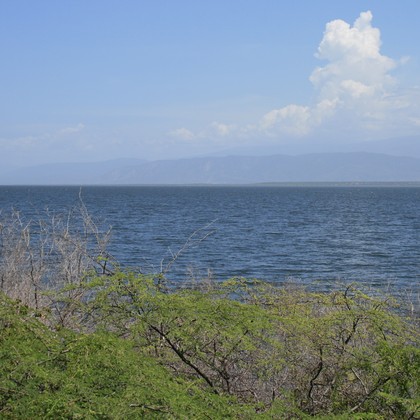 Inland brackish and saline lakes C3
Lake Enriquillo, Dominican Republic
22 species
Inland brackish and saline lakes C3
Lake Enriquillo, Dominican Republic
22 species
Brackish and saline lakes in the interior with no open link to the sea, fed by rain, springs and groundwater and concentrated by evaporation. Coastal lagoons and salt pans connected with the sea belong to Saline lagoon and salt pan; fresh lakes to Lakes and ponds. The best-known example is Lago Enriquillo in the Dominican Republic, which lies below sea level, with brackish Étang Saumâtre on the Haitian side; salt lakes also lie in the middle of islands in the Bahamas. American Flamingo filters the shallows, Roseate Spoonbill and Black-necked Stilt forage along the shore, and White-cheeked Pintail swims on the open water.
Wetlands D
Wet ground with fresh or at most slightly brackish water, where vegetation rather than open water sets the scene. Open lakes and rivers belong to inland waters, mangrove and saline lagoons to the coast. The subdivision follows the height of that vegetation: herbaceous marsh of sedge and reed, swamp forest and palm swamp with trees, and savanna that lies under water only in the rainy season. Rails, gallinules and herons live here, and with Zapata Wren and Zapata Rail two birds found nowhere else in the world.
-
 Freshwater marsh with reeds and sedges D1
Swamp (ciénaga)
138 species
Freshwater marsh with reeds and sedges D1
Swamp (ciénaga)
138 species
Open marsh of sedges, rushes, reeds and cattails on fresh water, with no trees to speak of. Where shrubs and trees take over, swamp forest and palm swamp begins; where the marsh dries out in the dry season and grass prevails, seasonally flooded savanna; where the water deepens and opens up, lakes and ponds. The largest marsh in the islands is the Ciénaga de Zapata in Cuba, with vast stands of sawgrass, Cladium jamaicense; in Trinidad the key site is Nariva. Zapata Wren and Zapata Rail live here, Red-shouldered Blackbird breeds in the reeds, and Purple Gallinule, Least Grebe and Snail Kite are common. In Trinidad, Yellow-hooded Blackbird, Pied Water Tyrant and White-headed Marsh Tyrant join them.
-
 Swamp forest and palm swamp D2
Pterocarpus forest, Puerto Rico
58 species
Swamp forest and palm swamp D2
Pterocarpus forest, Puerto Rico
58 species
Forest and palm stands on ground wet or flooded most of the year, with fresh to slightly brackish water. Where salt water feeds the trees it is mangrove, which belongs to the coast; where the trees drop out and reeds and sedges remain, freshwater marsh with reeds and sedges. In Puerto Rico and Guadeloupe Pterocarpus officinalis, with its plank buttresses, forms such forest behind the mangrove; in Trinidad, Nariva holds palm swamp of moriche, Mauritia flexuosa, and royal palm. At Zapata the marsh breaks up into islands of swamp forest. West Indian Whistling Duck rests in such woodland by day, Northern Waterthrush winters there, and Red-bellied Macaw, Sulphury Flycatcher and Fork-tailed Palm Swift live in the Nariva palms.
-
 Seasonally flooded savanna D3
Aripo savannas, Trinidad
60 species
Seasonally flooded savanna D3
Aripo savannas, Trinidad
60 species
Grassy plains that flood in the rainy season and dry out in the dry season. The difference from freshwater marsh with reeds and sedges is that water does not stand here all year and grasses and low sedges prevail instead of tall reeds; with savanna and open grassland it shares the openness, but that stays dry all year. In Cuba such savannas lie on low plains with poorly drained soils; in Trinidad the Aripo Savanna is the best-known example. In the wet season American White Ibis, Glossy Ibis, Fulvous Whistling Duck and Limpkin feed on the flooded grass, in the dry season Sandhill Crane and Eastern Meadowlark, and in Trinidad Savanna Hawk hunts overhead.
Grasslands E
Open land where grasses and herbs set the tone and trees stand scattered at most. Pasture laid out by people belongs to farmland and plantations, and grassland that floods every year to the wetlands. The subdivision follows altitude: savanna and open grassland in the lowlands, often on poor sandy or limestone soils, and montane meadow in the highlands, above all on Hispaniola. For birds these are places to search the ground for seeds and insects and to nest, and hunting grounds for raptors and owls.
-
 Savanna and open grassland E1
Aripo savannas, Trinidad
153 species
Savanna and open grassland E1
Aripo savannas, Trinidad
153 species
Lowland grassland with scattered palms, shrubs or trees, kept open naturally by poor soil, fire or drought. Where it floods in the rainy season it becomes seasonally flooded savanna; where shrubs close in, thorn scrub and cactus scrub; where people manage it as cattle pasture, pasture and small-scale farm mosaic. Cuba has the largest savannas, among them those on white sand in Pinar del Río and on the Isla de la Juventud, where the barrel palm, Colpothrinax wrightii, stands out; on Hispaniola and Trinidad they are smaller. Sandhill Crane and Eastern Meadowlark walk here, Burrowing Owl nests in the ground, and Killdeer, Grasshopper Sparrow and Cuban Grassquit forage. In Trinidad Fork-tailed Flycatcher is a conspicuous visitor.
-
 Montane meadow and highland grassland E2
La Piedra Letreada, Constanza, Dominican Republic
4 species
Montane meadow and highland grassland E2
La Piedra Letreada, Constanza, Dominican Republic
4 species
Grassland high in the mountains, where cold, wind and fire keep the trees at bay. Where shrubs gain the upper hand it passes into montane scrub; where the pines close into forest, into pine forest; lower down into savanna and open grassland. In the Caribbean this is above all a formation of the Cordillera Central of Hispaniola, with open grasslands around Valle Nuevo and on the summits near Pico Duarte, where nights can bring frost. The grass often grows among scattered pines, Pinus occidentalis. Rufous-collared Sparrow and Antillean Siskin pick seeds from the ground, Golden Swallow hawks low over the slopes, and Red-tailed Hawk and American Kestrel watch for prey.
Scrub F
Vegetation of shrubs and low trees without a closed canopy, lower and more open than forest. The subdivision follows what keeps the growth low: drought in thorn scrub and cactus scrub, salt and wind in coastal and beach scrub, altitude and exposure in montane scrub, and a poor, metal-rich soil in serpentine scrub. On the dry islands and along the coasts scrub is the main habitat on land, and many endemic songbirds, doves and hummingbirds are well suited to it.
-
 Thorn scrub and cactus scrub F1
Washington Slagbaai National Park, Bonaire
114 species
Thorn scrub and cactus scrub F1
Washington Slagbaai National Park, Bonaire
114 species
Dry scrub of thorny shrubs, agaves and columnar cacti where rain is scarce and the dry season long. Where trees close into a canopy it passes into dry deciduous forest; right by the sea, where salt wind shapes the growth, into coastal and beach scrub. It is characteristic of Aruba, Curaçao and Bonaire, with the divi-divi, Libidibia coriaria, bent over by the trade wind, and of southern Hispaniola around Lago Enriquillo and the south coast of eastern Cuba near Guantánamo. On the ABC islands Bare-eyed Pigeon, Brown-throated Parakeet, Tropical Mockingbird, Yellow Oriole and Crested Caracara live here; on Hispaniola Hispaniolan Lizard Cuckoo and Flat-billed Vireo, and near Guantánamo Cuban Gnatcatcher and Oriente Warbler.
-
 Coastal and beach scrub F2
Playa Sucia, Cabo Rojo, Puerto Rico
103 species
Coastal and beach scrub F2
Playa Sucia, Cabo Rojo, Puerto Rico
103 species
Low scrub sheared by salt wind just behind the beach and on coastal limestone, with sea grape, Coccoloba uvifera, buttonwood, Conocarpus erectus, and tough herbs. The bare sand in front belongs to sandy beach and dunes; where the growth rises and closes into a canopy, coastal woodland begins; inland, beyond the reach of salt, thorn scrub and cactus scrub. It is widespread in the Bahamas, the Turks and Caicos Islands and the cays off northern Cuba, such as Cayo Coco. There Cuban Gnatcatcher, Zapata Sparrow and Bahama Mockingbird live; Thick-billed Vireo, Bahama Woodstar, Black-faced Grassquit and Zenaida Dove are further typical residents.
-
 Montane scrub F3
Mount St. Catherine summit, Jamaica (840 m)
11 species
Montane scrub F3
Mount St. Catherine summit, Jamaica (840 m)
11 species
Dense, low growth of tough, small-leaved shrubs and young trees on high ridges and slopes, often after fire or where the wind is strong. The difference from cloud forest and elfin woodland is that those form a closed, mossy dwarf forest, whereas this is a more open and drier thicket; with montane meadow and highland grassland it shares the altitude, but there grass prevails. It is most extensive on Hispaniola, in the Cordillera Central and the Sierra de Bahoruco; on other high islands it occurs only in small patches. On Hispaniola dense mountain thickets are the domain of Eastern Chat-Tanager, Western Chat-Tanager and Green-tailed Warbler, and Rufous-collared Sparrow and Hispaniolan Spindalis occur regularly.
Forest G
Every habitat with a closed or nearly closed canopy of trees, from low dry forest behind the coast to the mossy dwarf forest on the highest summits. The subdivision follows rainfall and altitude: dry deciduous forest, semi-evergreen forest, lowland and montane rainforest, and cloud forest above them. Three formations are set by tree, ground or sea: pine forest, limestone karst forest and coastal woodland. Most of the islands' endemic birds live here: todies, trogons, amazons, quail-doves and lizard cuckoos.
-
 Dry deciduous forest G1
Guánica State Forest, Puerto Rico
256 species
Dry deciduous forest G1
Guánica State Forest, Puerto Rico
256 species
Low forest in which most trees stand bare through the dry winter months. Where more rain falls and the canopy stays largely green, semi-evergreen and moist forest takes over; where the trees break up into cacti and thorny shrubs, thorn scrub begins. Forest among cone hills and sinkholes counts as limestone karst forest. Dry forest grows in the rain shadow of the mountains: around Guánica in southern Puerto Rico, in Jamaica's Hellshire Hills, in south-western Hispaniola and on the low Lesser Antilles. Gumbo-limbo, Bursera simaruba, with its red, peeling bark, is typical. Puerto Rican Nightjar nests on the leaf litter; Adelaide's Warbler, Least Poorwill and Flat-billed Vireo are at home here.
-
 Semi-evergreen and moist forest G2
Cuchillas de Toa, Cuba
374 species
Semi-evergreen and moist forest G2
Cuchillas de Toa, Cuba
374 species
Taller, fuller forest than dry deciduous forest: some trees drop their leaves in the dry season, but the canopy stays largely green. Where rain falls all year and hardly anything stands bare, it passes into lowland rainforest. This was once the most widespread forest of the Greater Antilles and has largely been cleared; remnants survive on hills, around swamps such as the Ciénaga de Zapata in Cuba and in reserves. Mahogany, Swietenia mahagoni, grows among palms and lianas. It is core habitat for Cuban Trogon, Cuban Tody, Blue-headed Quail-Dove and Gundlach's Hawk; in winter Ovenbird and Black-and-white Warbler search the leaf litter and the trunks.
-
 Lowland rainforest G3
Tobago Forest Reserve, Tobago
150 species
Lowland rainforest G3
Tobago Forest Reserve, Tobago
150 species
Evergreen, tall and layered forest of the lowlands and lower slopes, with no dry season to speak of. Semi-evergreen and moist forest does have a dry spell with some trees bare; higher up, where trees grow shorter and tree ferns plentiful, montane rainforest begins. It is most extensive on Trinidad and Tobago, in the Northern Range and on the Main Ridge. It also grows on the wet windward side of the high Lesser Antilles, in eastern Cuba and, as tabonuco forest named after Dacryodes excelsa, at the foot of El Yunque in Puerto Rico. Trinidad has Crested Oropendola, Channel-billed Toucan and Golden-headed Manakin, Trinidad Motmot lives on Tobago too, and Puerto Rican Amazon belongs in the tabonuco forest.
-
 Montane rainforest G4
Rainforest on Dominica
208 species
Montane rainforest G4
Rainforest on Dominica
208 species
Wet forest on mountain slopes, lower and denser than the lowland rainforest below, rich in tree ferns, palms and epiphytes. The boundary with cloud forest and elfin woodland lies where trees grow gnarled and short in near-constant cloud and moss covers everything. It grows in Jamaica's Blue Mountains, the Cordillera Central and Bahoruco on Hispaniola, Haiti's Massif de la Hotte, Cuba's Sierra Maestra, the Luquillo Mountains of Puerto Rico, where the palm Prestoea montana clothes whole slopes, and the volcanoes of Dominica, St Lucia and St Vincent. Here live Hispaniolan Trogon, Ring-tailed Pigeon and Rufous-throated Solitaire, and, each on its own island, Imperial Amazon and St. Vincent Amazon.
-
 Cloud forest and elfin woodland G5
Blue Mountains, Jamaica
65 species
Cloud forest and elfin woodland G5
Blue Mountains, Jamaica
65 species
The forest of the highest ridges and summits, where cloud and wind prevail almost all year. Compared with montane rainforest below, it is lower, with gnarled, crowded stems and a canopy sometimes only a few metres high; mosses, bromeliads and orchids clothe everything. Where the growth becomes lower and more open still, it is montane scrub. Elfin woodland stands on the summits of the Luquillo Mountains and the Cordillera Central of Puerto Rico, on the highest ridges of the Blue Mountains and of Hispaniola, and on the volcanoes of the Lesser Antilles. Elfin Woods Warbler is named after it; on Hispaniola La Selle Thrush and Western Chat-Tanager live in cloud forest, and Bicknell's Thrush winters there.
-
 Pine forest G6
Hispaniolan pine forest, Haiti
91 species
Pine forest G6
Hispaniolan pine forest, Haiti
91 species
Forest of needle-leaved trees, often open, with grasses, ferns or shrubs beneath and maintained by fire. Not altitude but tree species defines this formation: pine forest at the same height as montane rainforest or dry deciduous forest belongs here, even where broadleaved trees grow up beneath. Caribbean pine, Pinus caribaea, grows on Grand Bahama, Abaco and Andros; in Cuba pine forest stands on poor sandy soil in the west and on the Isla de la Juventud, and Pinus cubensis on serpentine in the east; on Hispaniola Pinus occidentalis covers the higher mountains. Bahama Nuthatch and Bahama Warbler are tied to it, Olive-capped Warbler and Pine Warbler live here, and on Hispaniola Hispaniolan Crossbill feeds on pine seed.
-
 Limestone karst forest G7
Los Haitises National Park, Dominican Republic
88 species
Limestone karst forest G7
Los Haitises National Park, Dominican Republic
88 species
Forest on bare, weathered limestone, where sinkholes, cone hills and sheer-sided mogotes shape the land and soil lies only in cracks and hollows. That sets it apart from dry deciduous and semi-evergreen forest, which are defined by rainfall: here the rock decides, with dry forest on the ridges and tall forest in the moist sinkholes, often side by side. Major karst areas are Jamaica's Cockpit Country, the northern karst belt of Puerto Rico, Los Haitises in the Dominican Republic and the mogotes of Viñales in Cuba. Cockpit Country is a stronghold of Jamaican Crow, Black-billed Amazon and Yellow-billed Amazon; Los Haitises is a core area for Ridgway's Hawk, and Cuban Solitaire sings on the Cuban mogotes.
-
 Coastal woodland G8
Mona Island, Puerto Rico
138 species
Coastal woodland G8
Mona Island, Puerto Rico
138 species
Low to medium-height forest just behind the beach or on coral limestone by the sea, shaped by salt, wind and sand. Where the growth stays low and open it is coastal and beach scrub, where trees stand with their roots in tidal water it is mangrove; coastal woodland stands dry behind the high-water line under a closed canopy. Sea grape, Coccoloba uvifera, and the poisonous manchineel, Hippomane mancinella, set the scene on almost every island from the Bahamas to Tobago, though much has vanished under hotels and roads. White-crowned Pigeon eats fruit here, Zenaida Dove searches the ground for seeds, Mangrove Cuckoo and Black-whiskered Vireo breed, and for migrants it is often the first cover after the sea crossing.
Cliffs and caves H
Bare or sparsely vegetated rock and cavities inland: sheer walls, gorges, caves and sinkholes. Sea cliffs and rocky shores belong to the coast, and forest on karst to the forest. The subdivision separates the daylight of the open rock face from the darkness underground. The limestone islands have plenty of both, and birds use them mainly as nest sites out of reach of predators: swifts, swallows, owls and a few petrels breed here.
-
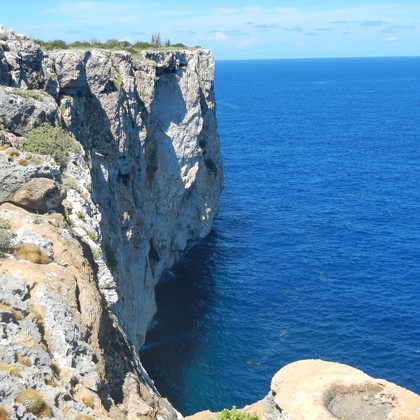 Cliffs and rock faces H1
Cliff on Mona Island, Puerto Rico
13 species
Cliffs and rock faces H1
Cliff on Mona Island, Puerto Rico
13 species
Sheer rock walls, gorges and scree slopes inland, often of limestone, with at most a few ferns, bromeliads and shrubs in the crevices. Walls facing the sea come under rocky shore and limestone cliffs; where the rock disappears into hollows underground, caves and sinkholes begin; where forest covers the rock, limestone karst forest. Characteristic are the mogotes of Viñales in Cuba and the steep mountain walls of the Massif de la Selle in Haiti, where Black-capped Petrel nests in burrows in the face. White-collared Swift and American Black Swift nest on ledges, often behind waterfalls, and Peregrine Falcon, American Kestrel and Red-tailed Hawk use the walls as lookouts.
-
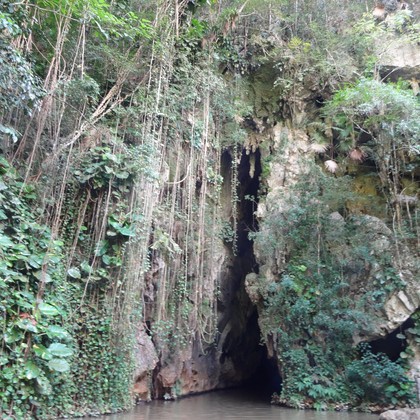 Caves and sinkholes H2
Cueva del Indio, Viñales, Cuba
6 species
Caves and sinkholes H2
Cueva del Indio, Viñales, Cuba
6 species
Caves, hollows and sinkholes, from small overhangs to deep cave systems and collapsed dolines with forest on the floor. Open rock faces in daylight belong to cliffs and rock faces, the wooded karst around them to limestone karst forest. Limestone islands such as Cuba, Jamaica, Puerto Rico and the Bahamas are rich in caves, often with large bat colonies. In Trinidad Oilbird breeds in colonies in dark caves in the Northern Range and flies out at night to look for fruit. Cave Swallow builds its nests in cave mouths, Ashy-faced Owl and American Barn Owl roost and breed in caves and dolines, and White-collared Swift nests in wet caves.
Farmland and plantations I
All land cleared for crops or livestock, from large sugarcane estates to the patchwork of small farms. The subdivision follows the crop and how it is worked: open fields, shaded coffee and cacao, rice fields and fish ponds, pasture with small farms, and orchards and coconut groves. On many islands it has replaced much of the original forest. Its value for birds varies: a bare monoculture offers little, but shade coffee, flooded rice and pasture with trees draw resident birds and winter visitors from North America alike.
-
 Sugarcane and arable fields I1
Aguada, Puerto Rico
53 species
Sugarcane and arable fields I1
Aguada, Puerto Rico
53 species
Large, open plots under a single crop, above all sugarcane, but also tobacco, maize and vegetables. Compared with pasture and small-scale farm mosaic it is large-scale and uniform, without hedges or scattered trees; unlike rice fields and fish ponds it is not flooded. For centuries sugarcane shaped the landscape of Cuba, Hispaniola, Jamaica and Barbados; on several smaller islands cultivation has stopped and the land is growing over with scrub. The cane itself is a dense mass with little food, but along the edges and ditches and after the harvest Western Cattle Egret and Greater Antillean Grackle forage, American Kestrel hunts from posts and wires, and American Barn Owl looks for rats at night.
-
 Coffee and cacao plantations I2
Village in the Blue Mountains, Jamaica
151 species
Coffee and cacao plantations I2
Village in the Blue Mountains, Jamaica
151 species
Coffee or cacao grown beneath a layer of shade trees, often on mountain slopes. It differs from forest in that the understorey is a planted shrub crop and the canopy consists of planted or retained trees such as Inga; it differs from coconut, citrus and fruit plantations in that a crop grows beneath those trees. Coffee is grown in Jamaica's Blue Mountains, upland Puerto Rico, the Cordillera Central of Hispaniola and Cuba's Sierra Maestra; cacao chiefly in the Dominican Republic, Trinidad and Grenada. Shade coffee keeps many forest birds: Black-throated Blue Warbler and American Redstart winter here, Bananaquit visits the flowering shade trees and Cocoa Thrush lives in Trinidad's cacao groves.
-
 Rice fields and fish ponds I3
Rice field in Pinar del Río, Cuba
112 species
Rice fields and fish ponds I3
Rice field in Pinar del Río, Cuba
112 species
Artificially flooded fields and ponds whose water level is set by people: rice that is sown, flooded and drained again, and fish ponds that are emptied from time to time. In this they differ from freshwater marsh with reeds and sedges and from lakes and ponds, where the water follows its own rhythm. Rice is grown on a large scale in Cuba and in the Cibao valley of the Dominican Republic; fish ponds lie in Jamaica and Cuba, among other places. The alternately wet and dry land draws herons, Glossy Ibis and West Indian Whistling Duck; on passage, waders such as Lesser Yellowlegs drop in, and in autumn Bobolink comes for the rice grains.
-
 Pasture and small-scale farm mosaic I4
Pasture, Dominican Republic
220 species
Pasture and small-scale farm mosaic I4
Pasture, Dominican Republic
220 species
Grazing land with scattered trees, living fences and small plots, the patchwork that makes up the countryside on many islands. Compared with sugarcane and arable fields it is small-scale and varied; unlike savanna and open grassland it is shaped by grazing, mowing and planting rather than by fire or soil. In Cuba pastures with royal palms, Roystonea regia, set the scene; on Hispaniola and Jamaica, small farms with bananas, cassava and beans on the slopes. Smooth-billed Ani and Western Cattle Egret follow the cattle, Grey Kingbird and Red-tailed Hawk hunt from posts and lone trees, Eastern Meadowlark sings in Cuban pastures, and on Hispaniola Palmchat nests communally in the royal palms.
-
 Coconut, citrus and fruit plantations I5
Duaba River, Baracoa, Cuba
107 species
Coconut, citrus and fruit plantations I5
Duaba River, Baracoa, Cuba
107 species
Orchards and plantings of coconut palms, citrus, mango and other fruit, with no crop beneath. Unlike coffee and cacao plantations they lack a shrub layer under the trees; unlike coastal woodland the planting is regular and managed, even where coconut palms stand just behind the beach. Coconut groves line many coasts, citrus has been grown above all in Cuba, and bananas were long the main crop of Dominica, St Lucia and St Vincent. Ripe fruit draws birds: Hispaniolan Woodpecker pecks into oranges and is regarded locally as a pest, Scaly-naped Pigeon eats fruit, Bananaquit visits flowers and ripe fruit, and Grey Kingbird keeps watch from the treetops.
Built-up land J
Everything people have built: villages, towns, gardens and parks, and the large infrastructure of harbours, airports and industrial estates. Farmland and plantations come under farmland and plantations. The subdivision separates the green residential setting from the hard, open ground of transport and industry. For birds built-up land is a young habitat in which mainly adaptable and introduced species thrive, though many an endemic species of gardens and palms is at home there as well.
-
 Villages, towns and gardens J1
Fishing village of Corossol, Saint-Barthélemy
265 species
Villages, towns and gardens J1
Fishing village of Corossol, Saint-Barthélemy
265 species
Settlements from hamlet to city with their gardens, yards, parks, cemeteries and avenues. Large open ground of transport and industry comes under harbours, airports and industry; kitchen gardens and orchards beyond the built-up area under farmland and plantations. Royal palms, mangoes, breadfruit trees and flowering ornamental shrubs shape the scene. In the palms of Hispaniola Palmchat builds its communal nests, and Antillean Palm Swift hunts around palm crowns throughout; Bananaquit, Greater Antillean Grackle, Carib Grackle and Grey Kingbird are part of the street scene in many towns. Introduced species such as House Sparrow, Eurasian Collared Dove, Rock Dove and Village Weaver follow people, and Zenaida Dove and Common Ground Dove walk the yards.
-
 Harbours, airports and industry J2
Gustavia harbour, Saint-Barthélemy
37 species
Harbours, airports and industry J2
Gustavia harbour, Saint-Barthélemy
37 species
Harbours, quays, airfields, roads, rubbish tips and industrial estates: hard, open ground with little vegetation. Residential areas and gardens come under villages, towns and gardens; salt pans, even when worked, under saline lagoon and salt pan. In most harbours of the region Brown Pelican sits on the mooring posts, Magnificent Frigatebird hangs over the quay, and Laughing Gull and Royal Tern search for fish and scraps. On the grass beside runways Western Cattle Egret and Killdeer feed, and Antillean Nighthawk hunts there at dusk. Cave Swallow nests under bridges and in culverts, and Rock Dove and House Sparrow find food and nest sites.
Classification: a separate classification for the Caribbean. Land: vegetation types after Areces-Mallea, A.E. et al. (1999), A Guide to Caribbean Vegetation Types (The Nature Conservancy), supplemented with types that birdwatchers distinguish on the islands. Coast and sea: after CMECS (Coastal and Marine Ecological Classification Standard). No existing standard covers the whole Caribbean island arc with sea, coast and land in one hierarchy. The names and descriptions were written for this guide.