All species › Passerines › New World warblers › Arrowhead Warbler
Arrowhead Warbler | Setophaga pharetra
Jamaicazanger | Reinita jamaicana
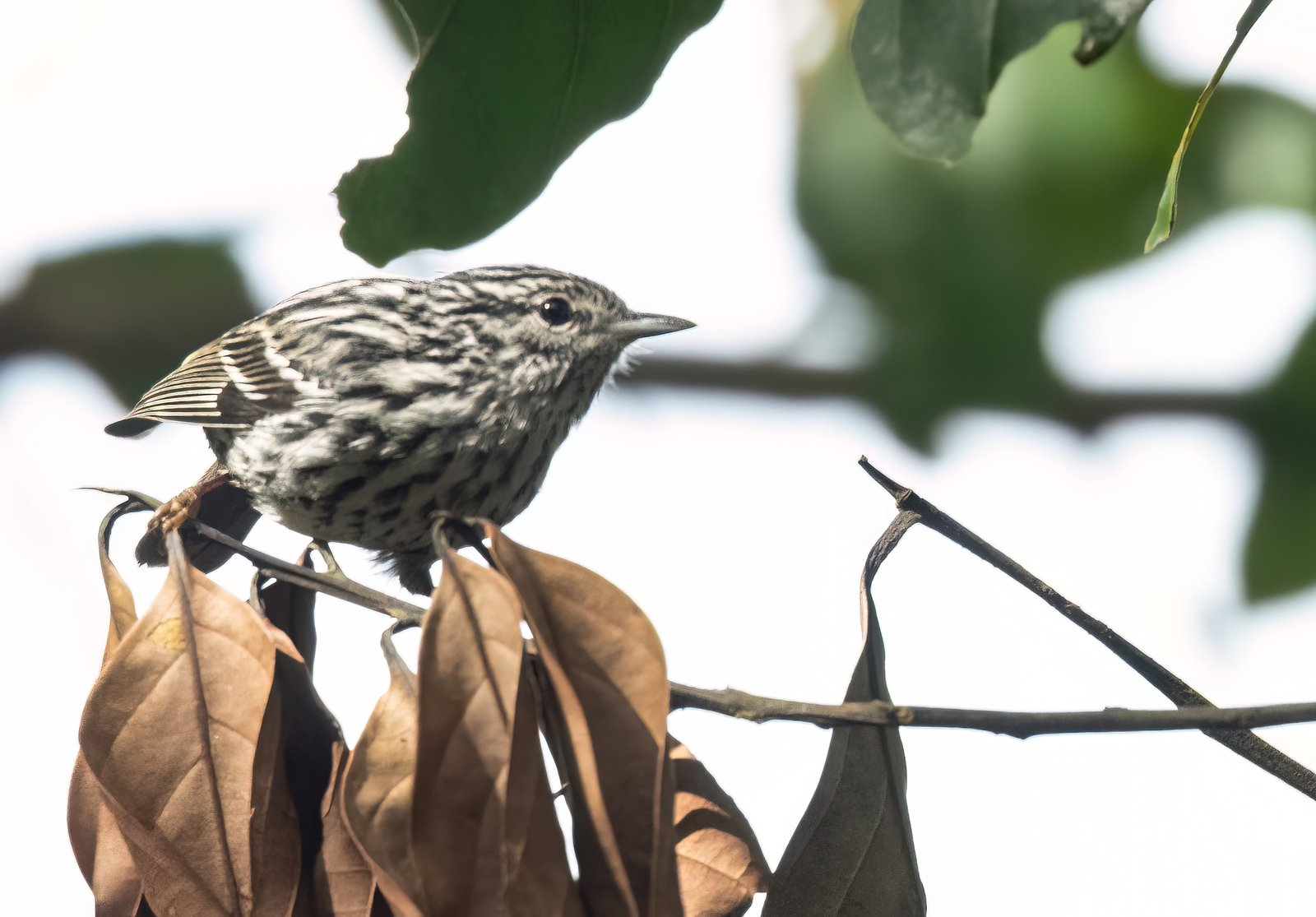
The Arrowhead Warbler is a black-and-white streaked warbler of the humid montane forests of Jamaica. Its name refers to the arrowhead-shaped black spots on the underparts. It is common in suitable forest and often joins mixed flocks of other small forest birds.
Voice
The song is a series of high, squeaky notes, roughly sswee-sswee-swee-swee, often somewhat variable in rhythm. The call is a repeated, high, metallic tic.
Recording: Rick Bowers — CC BY-NC-SA 3.0 · converted to mono · xeno-canto
Identification
12.5–13 cm. Head and upperparts are streaked black and white, with white tips to the wing-coverts forming two wing-bars. The tail is dark with a pale underside. Underparts are whitish, the throat, breast and flanks covered in black arrowhead-shaped spots. The female is slightly duller, with greyer streaks. Juveniles are brownish yellow above with faint yellowish streaks, and pale brownish yellow below with faint dark streaks.
Confusion species
Black-and-white Warbler Mniotilta varia, a common winter visitor, is also streaked black and white, but has a white central crown stripe, creeps along trunks and branches and shows streaks rather than arrowheads on the flanks. Females and young Blackpoll Warblers Setophaga striata, a passage migrant, are olive-green with faint streaks and pale legs. No other resident warbler on Jamaica has this pattern.
Habitat
Humid montane forest and cloud forest at middle and high elevations, also semi-evergreen forest and limestone forest such as in Cockpit Country. Outside the breeding season some birds descend to humid lowland forest. It forages in the understorey and middle levels for insects, often in mixed flocks with todies, vireos and wintering warblers.
Where the bird is most at home, classified by the vegetation types of the Caribbean.




Range and movements
Only on Jamaica, mainly in the Blue and John Crow Mountains, the central highlands and Cockpit Country. The species does not occur outside Jamaica.
- Resident
- dark = core range, pale = thinly spread
How and when to look
Along the roads and trails in the Blue Mountains, for example at Hardwar Gap, and in Cockpit Country. The metallic tic and mixed flocks of small birds are the clues; within them the bird usually shows itself at close range.
Conservation status
Not threatened. The species is common in humid forest; clearance for agriculture, coffee growing and mining reduces its habitat locally.
Scientific name
Setophaga pharetra | (Gosse, 1847)
Gosse described the species in 1847 as Sylvicola pharetra; because it was later moved to another genus, the author and year stand in brackets. The genus Setophaga was introduced in 1827 by Swainson. Setophaga is Greek, from sēs, sētos 'moth' and -phagos '-eating': 'moth-eater'. pharetra is Latin for 'quiver', after the arrow-like black streaks on the plumage. The specimen the first description was based on came from Bluefields Peak, Jamaica.