All species › Gannets and cormorants › Frigatebirds › Ascension Frigatebird
Ascension Frigatebird | Fregata aquila
Ascensionfregatvogel | Rabihorcado de Ascensión
The Ascension Frigatebird breeds only on Ascension, in the middle of the tropical Atlantic. Young birds wander widely over the ocean after fledging; one fitted with a satellite tag was followed to off the coast of Brazil, and the species has twice been recorded in Scotland. For the Caribbean it is a candidate vagrant: there are no documented records, and entries in databases probably stem from confusion with Magnificent Frigatebird or from old labels.
Voice
Silent at sea. At the colony bill-clattering and a harsh, rattling call; displaying males give a trilling, gurgling sound.
Recording: Jim Holmes — CC BY-NC-SA 4.0 · converted to mono · xeno-canto
Identification
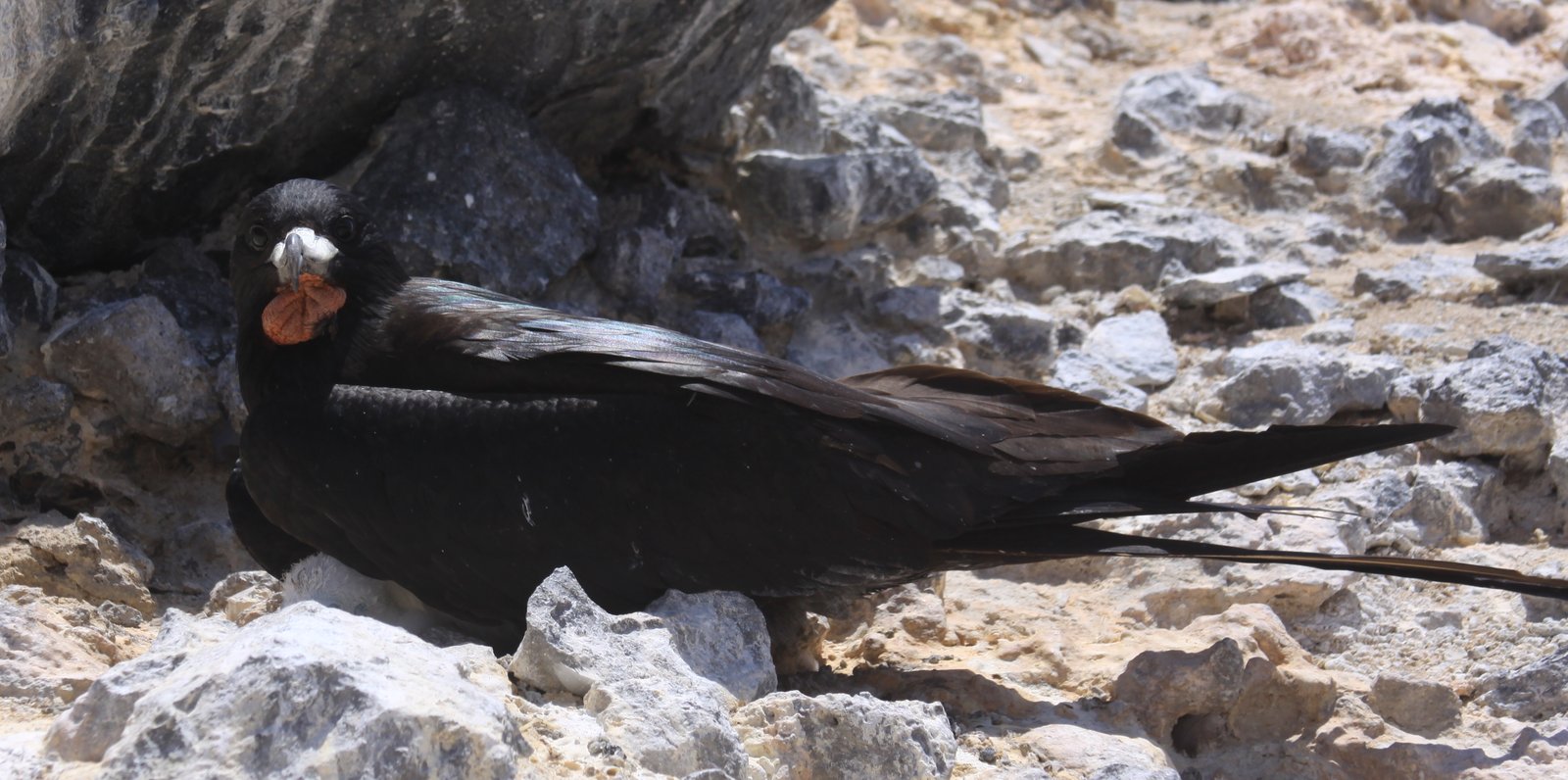
89–96 cm, with a wingspan of about two metres; smaller than Magnificent Frigatebird. Shaped like all frigatebirds: narrow, angled wings, a long, deeply forked tail and a long hooked bill. The male is all black, with a green gloss on head, mantle and scapulars and a red gular pouch. The female is blackish-brown with a rufous-brown hindneck collar and breast band; most females have an all-dark belly, a minority a white patch on the breast. Juveniles have a white head and belly and are barely separable from young Magnificent Frigatebirds.
Confusion species
Magnificent Frigatebird Fregata magnificens is larger; the female has a black head and throat and a large white breast and belly, the male a purple rather than green gloss. An adult female with a dark belly and rufous-brown breast band is unique among frigatebirds. Males and juveniles are practically impossible to identify to species at sea; other rare frigatebirds from outside the region then also come into consideration.
Habitat
Open ocean. It forages up to hundreds of kilometres from the colony, snatching flying fish and young sea turtles from the surface and robbing other seabirds. It nests on bare rock.
Where the bird is most at home, classified by the vegetation types of the Caribbean.

Range and movements
Not reliably recorded in the region. Databases contain a few reports from the Bahamas, Cuba, Puerto Rico, Curaçao and Guadeloupe, but none is known as a documented record; old museum data date from a time when the name Fregata aquila was also used for Magnificent Frigatebird. Outside the region it breeds only on Ascension, for a long time solely on the rock stack of Boatswain Bird Island and, since the eradication of feral cats, again on the main island.
How and when to look
A frigatebird with a dark belly and a brown breast band deserves careful documentation: photographs of head, throat, breast and belly, from below and above. Without photographs a report cannot be assessed.
Conservation status
Vulnerable, owing to the very small breeding population on a single island. After feral cats were eradicated from Ascension in 2004–2006 the species returned to the main island and is increasing; it remains sensitive to catastrophes and food shortages around that one island.
Scientific name
Fregata aquila | (Linnaeus, 1758)
Linnaeus described the species in 1758 as Pelecanus Aquilus; because it was later moved to another genus, the author and year stand in brackets. The genus Fregata was introduced in 1799 by De Lacépède. Fregata derives from the French frégate, 'frigate', a fast warship — for the swift flight and the habit of robbing other seabirds. aquila is Latin for 'eagle' — for the raptor-like way frigatebirds chase other seabirds for their food. The specimen the first description was based on came from Ascension Island.