All species › Waders, gulls and terns › Gulls and terns › Audouin's Gull
Audouin's Gull | Ichthyaetus audouinii
Audouins meeuw | Gaviota de Audouin
Audouin's Gull is a medium-sized gull of the Mediterranean that feeds almost entirely on fish and rarely wanders far from its breeding range. In the Caribbean it has been found on Trinidad and Barbados: an immature on the west coast of Trinidad in the winter of 2016–2017, the first record on this side of the Atlantic, and a bird on Barbados in 2024.
Voice
Usually silent away from the breeding grounds. At colonies a hoarse, low gieeh-ah and short nasal calls, deeper than those of Herring Gulls.
Recording: Sergi Carreras — CC BY-NC-SA 4.0 · converted to mono · xeno-canto
Identification
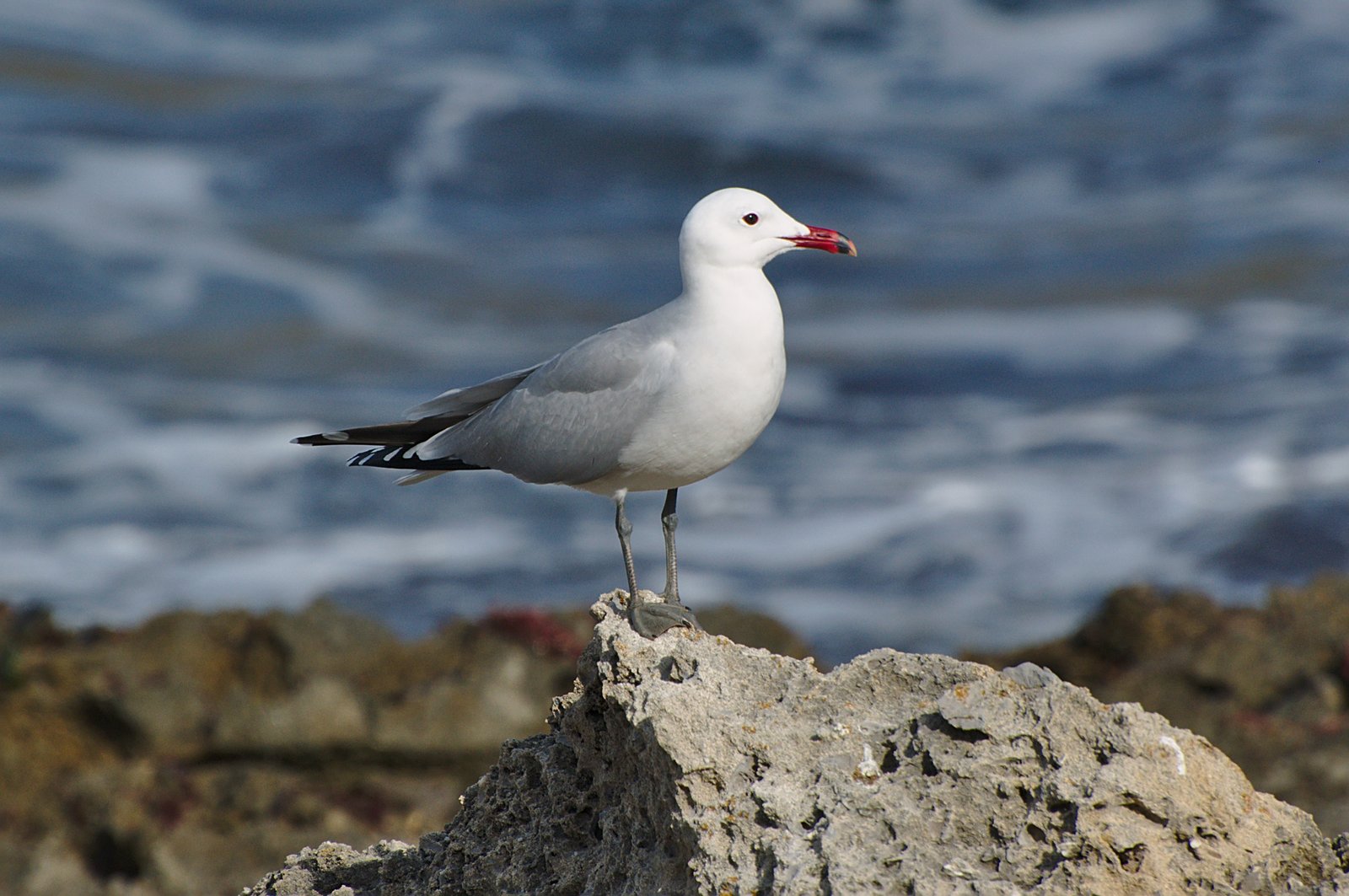
48–52 cm, with fairly long, slender wings and a short, thick bill. Adults have a pale grey mantle, white head and underparts and black wingtips with only small white tips, without large mirrors. The bill is dark red with a black band and a yellow tip and looks dark at a distance; the legs are dark grey-green. The eye is dark. Adult plumage is reached in the fourth year. Juveniles are dark grey-brown with scaly upperparts, a rather plain dark tail and a white rump with a sharp border; the bill is dark. The Trinidad bird was moulting from first-winter to first-summer plumage and became steadily whiter on the head and underparts over those months.
Confusion species
Ring-billed Gull Larus delawarensis has a yellow bill with a black ring and yellow legs; young Ring-billed Gulls are paler and more mottled, with a pale grey mantle and a tail band. Young Lesser Black-backed Gulls Larus fuscus are larger, with a heavier black bill, a more brown-spotted rump and tail base and paler inner primaries. Laughing Gull Leucophaeus atricilla is smaller, with a darker grey mantle and a slender, drooping bill.
Habitat
Coastal waters, sandy beaches and tidal flats. Often fishes in the evening and at night, also far out at sea, and follows fishing boats. On Trinidad the bird frequented a fish landing site on the Gulf of Paria coast.
Where the bird is most at home, classified by the vegetation types of the Caribbean.



Range and movements
Two records: Brickfields, on the west coast of Trinidad, from 10 December 2016, intermittently until early April 2017; later also seen a little further north along the same coast. In addition, Pile Bay in St. Michael, Barbados, from 20 June 2024 until at least October 2024. Outside the region it breeds mainly on the coasts and islands of the western Mediterranean, with the largest colonies in Spain, and winters along the Atlantic coast of north-west and West Africa.
How and when to look
Any gull with a short, dark-looking bill among the Lesser Black-backed and Laughing Gulls at fish landing sites on Trinidad deserves a closer look. Photographs of the rump, tail and wingtips are needed to document a new record.
Conservation status
Vulnerable. The world population is concentrated in a small number of colonies and has declined steeply. Threats include bycatch in longline fisheries, food shortage, and disturbance and predation at colonies.
Scientific name
Ichthyaetus audouinii | (Payraudeau, 1826)
Payraudeau described the species in 1826 as Larus Audouinii; because it was later moved to another genus, the author and year stand in brackets. The genus Ichthyaetus was introduced in 1829 by Kaup. Ichthyaetus is Greek, from ikhthus 'fish' and aetos 'eagle', hence 'fish eagle'. audouinii honours the French naturalist Jean Victoire Audouin (1797–1841). The specimen the first description was based on came from Sardinia and Corsica.