All species › Cranes, rails and allies › Rails and crakes › Azure Gallinule
Azure Gallinule | Porphyrio flavirostris
Azuurpurperhoen | Calamoncillo celeste
The Azure Gallinule is the smallest gallinule, a pale South American marsh bird known in the region only from Trinidad. It lives hidden in tall marsh grass and floating vegetation and is therefore seldom seen. Over much of its range the species moves with the seasons, following the wet season; the birds in Trinidad also seem not to be present all year.
Voice
Usually silent; sometimes a short trill. Little has been documented about its vocal repertoire.
Recording: JAYRSON ARAUJO DE OLIVEIRA — CC BY-NC-SA 4.0 · converted to mono · xeno-canto
Identification
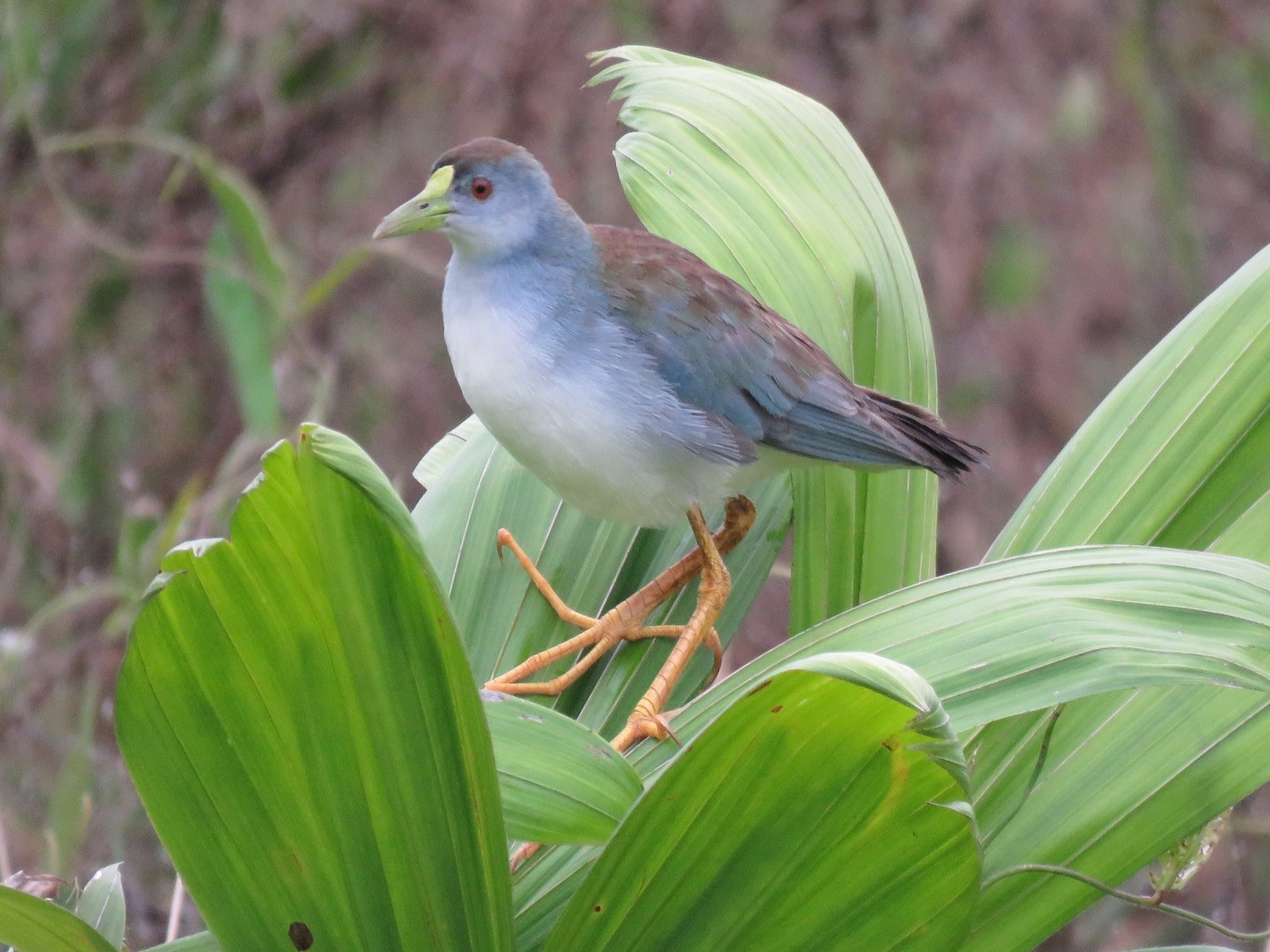
23–26 cm, slender, with long toes. Crown, hindneck and back are pale olive-brown, the back with dark feather centres. The wing coverts are bright azure to greenish blue, visible in a flushed bird. Face, sides of neck and breast are pale blue-grey, belly and undertail white. Bill and frontal shield are pale greenish yellow, the legs yellow. The sexes are alike. Juveniles are browner, with a buffy face and less blue in the wing.
Confusion species
Purple Gallinule Porphyrio martinica is larger and darker, with purple-blue head and underparts, a red bill with a yellow tip and a pale blue shield. Young Purple Gallinules are very like Azure Gallinule, but are larger and have less blue in the wing and a duller, browner breast.
Habitat
Lowland freshwater marshes with fairly deep water and much tall marsh grass and floating plants, wet savanna, seasonal pools and rice fields. It feeds in the vegetation on seeds, insects and other small invertebrates, clambering up grass stems as it does so. The nest is in dense vegetation above the water.
Where the bird is most at home, classified by the vegetation types of the Caribbean.


Range and movements
In the region only in Trinidad, where it is seen scarcely and irregularly in freshwater marshes and rice fields. Whether it breeds there has not been clearly established; most birds are probably arrivals from the South American mainland with the wet season. There are no regular sites in Tobago or on the other islands. Outside the region in northern and central South America east of the Andes, from Colombia, Venezuela and the Guianas to Bolivia, Paraguay and northern Argentina.
- Resident
- dark = core range, pale = thinly spread
How and when to look
Extensive freshwater marshes with tall grass and floating vegetation offer the best chance, such as the Nariva Swamp. The bird sometimes appears briefly at the edge of open water or on floating leaves; a flushed bird stands out by its pale blue wings and dangling yellow legs.
Conservation status
Not threatened; the species has a large range in South America. In Trinidad its occurrence depends on large freshwater marshes, which are under pressure from drainage, fires and conversion to farmland.
Scientific name
Porphyrio flavirostris | (Gmelin, 1789)
Gmelin described the species in 1789 as Fulica flavirostris; because it was later moved to another genus, the author and year stand in brackets. The genus Porphyrio was introduced in 1760 by Brisson. Porphyrio is Latin, from the Greek porphuriōn, the classical authors' name for the swamphen, from porphura 'purple'. flavirostris is Latin, from flavus 'yellow' and rostrum 'bill', after the yellowish-green bill. The specimen the first description was based on came from Cayenne, French Guiana.