All species › Passerines › Tanagers › Barbados Bullfinch
Barbados Bullfinch | Loxigilla barbadensis
Barbadosdikbekje | Semillero de Barbados
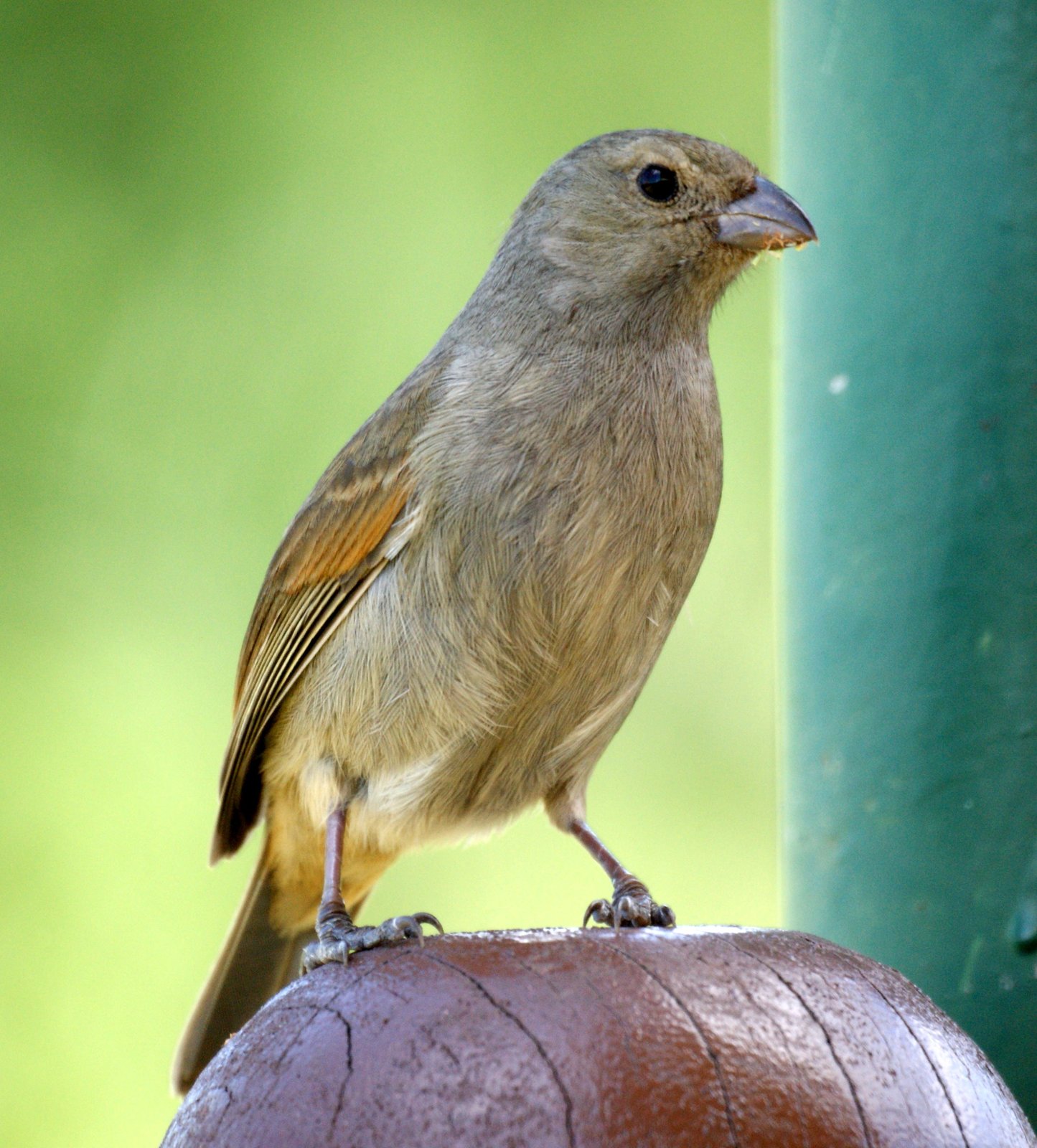
The Barbados Bullfinch is the only endemic bird species of Barbados. It was long treated as a subspecies of Lesser Antillean Bullfinch, but has been regarded as a separate species since 2006; it is the only form in that group in which male and female look alike. In Barbados it is simply called sparrow. The birds are tame and come onto terraces and into restaurants.
Voice
A simple twittering, an occasional harsh, short call and a sharp trill.
Recording: David Darrell-Lambert — CC BY-NC-SA 4.0 · converted to mono · xeno-canto
Identification
14–15 cm, with a thick, conical dark bill. The upperparts are dark olive-grey, the wings mostly brown, the underparts grey and the undertail coverts rufous. The sexes are alike, and birds closely resemble a female Lesser Antillean Bullfinch. There is no black plumage like that of the male of that species.
Confusion species
Black-faced Grassquit Melanospiza bicolor is much smaller, with a slimmer bill; the male has a black face and breast, the female is plain olive-green without a rufous undertail. Lesser Antillean Bullfinch Loxigilla noctis does not occur in Barbados.
Habitat
Almost everywhere on the island: gardens, parks, yards, hotel grounds, thickets, coastal scrub, field margins and the forest in the deep ravines (gullies). It eats seeds, fruit, nectar and insects, as well as anything people leave behind. In experiments, urban birds proved better at problem-solving than rural ones, and in Barbados bullfinches have been described tearing open sugar packets. The nest is a globe with a side entrance in a tree or shrub; the clutch is two or three spotted eggs.
Where the bird is most at home, classified by the vegetation types of the Caribbean.






Range and movements
Only in Barbados, throughout the island. It does not occur outside Barbados.
- Resident
- dark = core range, pale = thinly spread
How and when to look
Hotel and restaurant terraces, gardens and parks in Bridgetown and along the west coast are the best places; the birds often come right onto the tables. In Barbados any bullfinch with rufous undertail coverts is this species.
Conservation status
Not threatened. The species is common and has adapted well to the man-made landscape of Barbados.
Scientific name
Loxigilla barbadensis | Cory, 1886
Cory described the species in 1886 and placed it straight away in the genus where it still stands. The genus Loxigilla was introduced in 1831 by Lesson. Loxigilla is a blend of Loxia (crossbills) and Fringilla (finches). barbadensis is Latin for 'of Barbados', the only island where the species lives. The specimen the first description was based on came from Barbados.