All species › Passerines › New World warblers › Black-throated Blue Warbler
Black-throated Blue Warbler | Setophaga caerulescens
Blauwe zwartkeelzanger | Reinita azulada
The Black-throated Blue Warbler is one of the few North American warblers that winter almost entirely in the Caribbean. Male and female differ so much that they were once described as separate species. In the Greater Antilles it is a regular sight in winter in montane forest and shade coffee.
Voice
The call is a short, dry tchek. The song is a slow, buzzy series of three to five notes, rising at the end: zur zur zur zreee. In spring males already sing on the wintering grounds.
Recording: Jeff Stewart — CC BY-NC-SA 4.0 · converted to mono · xeno-canto
Identification
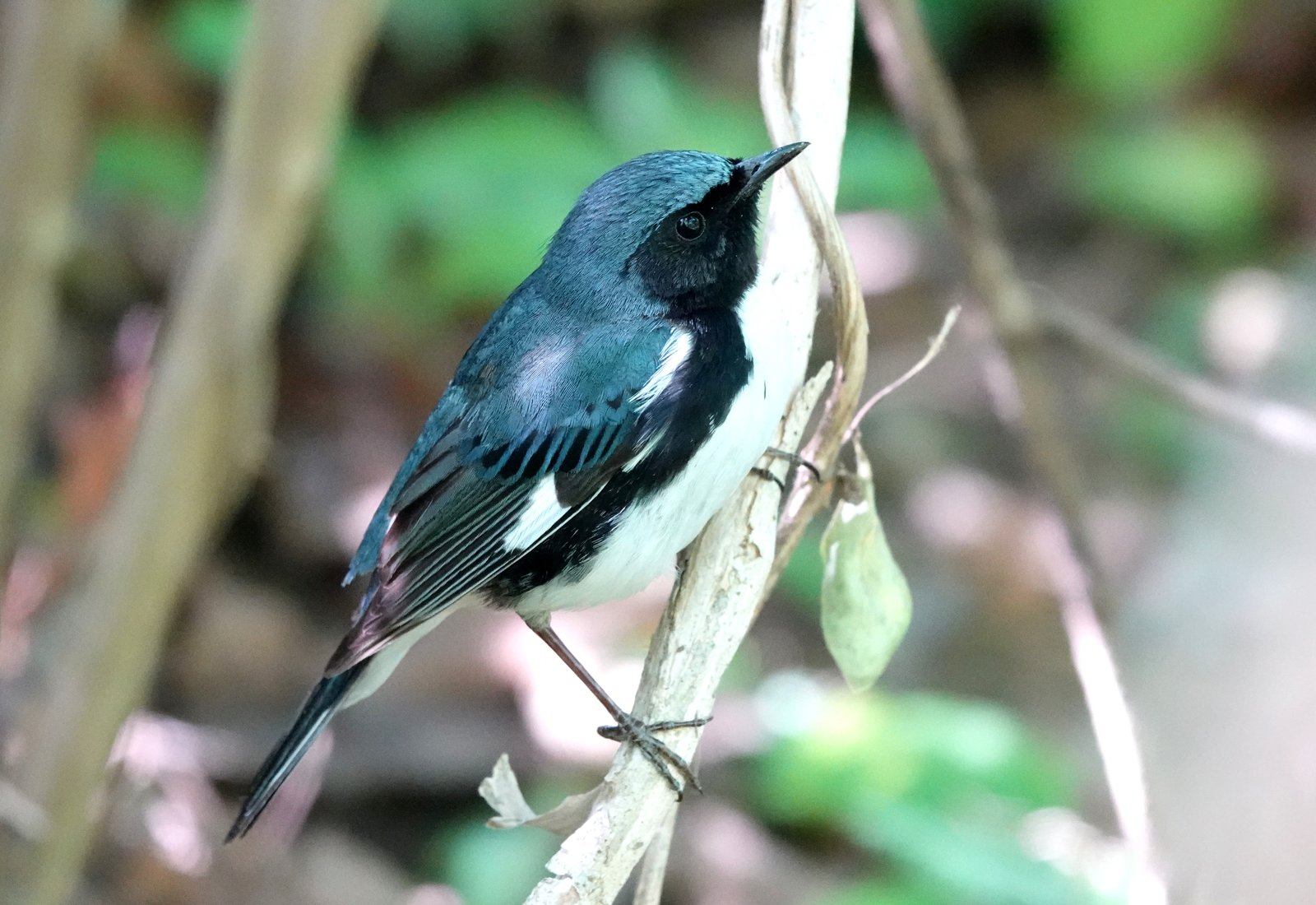
11–13 cm. The male is dark grey-blue above, with a black face, throat and flanks sharply set off against a white belly. The female is plain olive-brown above and pale buff-yellow below, with a thin pale supercilium above a dark cheek. Both sexes have a white patch at the base of the primaries: large in males, small in females and sometimes barely visible in young females. Young males resemble adults, with a greenish wash on the back.
Confusion species
The male has no similar species in the region; Cerulean Warbler Setophaga cerulea is paler blue, with wing bars and a white throat. The female resembles Tennessee Warbler Leiothlypis peregrina and Orange-crowned Warbler Leiothlypis celata, but has a dark cheek below the pale supercilium and usually the white primary patch. Female Ceruleans have distinct wing bars.
Habitat
Moist and semi-deciduous forest, montane rainforest, cloud forest, karst forest and shade-coffee plantations, from the lowlands high into the mountains; less in dry forest. Males often predominate in high, closed forest, females in lower, more open forest and scrub. It searches the middle storey for insects and also takes fruit and nectar.
Where the bird is most at home, classified by the vegetation types of the Caribbean.






Range and movements
A common winter visitor in the Bahamas, Cuba, the Cayman Islands, Jamaica, Hispaniola (Haiti and the Dominican Republic) and Puerto Rico; less common in the Turks and Caicos Islands and the Virgin Islands. Rare in the Lesser Antilles, a vagrant to Trinidad and Tobago and the ABC Islands. Isotope studies showed that birds from the northern breeding range winter mainly in Cuba and Jamaica, and birds from the southern part mainly on Hispaniola and Puerto Rico. Breeds in south-eastern Canada, the north-eastern United States and the Appalachians.
- Resident
- Summer visitor (c. Oct–Mar)
- Winter visitor (c. Apr–Sep)
- Passage (Mar–Apr, Oct–Nov)
- dark = core range, pale = thinly spread
How and when to look
In winter in almost any montane forest in the Greater Antilles, often in mixed flocks. Females are best identified by the white primary patch and the dark cheek; the dry tchek helps to locate them.
Conservation status
Not threatened. The population is stable to slightly increasing. Since the species winters largely in the Greater Antilles, the conservation of montane forest and shade coffee there is important for it.
Scientific name
Setophaga caerulescens | (Gmelin, 1789)
Gmelin described the species in 1789 as Motacilla caerulescens; because it was later moved to another genus, the author and year stand in brackets. The genus Setophaga was introduced in 1827 by Swainson. Setophaga is Greek, from sēs, sētos 'moth' and -phagos '-eating': 'moth-eater'. caerulescens is Latin for 'bluish', after the male's blue upperparts. The specimen the first description was based on came from Hispaniola.