All species › Birds of prey › Hawks, eagles and kites › Broad-winged Hawk
Broad-winged Hawk | Buteo platypterus
Breedvleugelbuizerd | Gavilán aludo
The Broad-winged Hawk is a small, compact buteo. North American breeders migrate in large flocks through Central America to South America and barely touch the Caribbean, but the islands hold five resident subspecies of their own, spread over Cuba, Puerto Rico and the Lesser Antilles to Tobago. In Cuba it is called gavilán bobo, in Puerto Rico guaraguao de bosque.
Voice
A high, thin, drawn-out whistle, roughly pee-teeeee, with a short first note and a long, slightly falling second note. Often heard from birds soaring over forest.
Recording: Denis Dujardin — CC BY-NC-SA 4.0 · converted to mono · xeno-canto
Identification
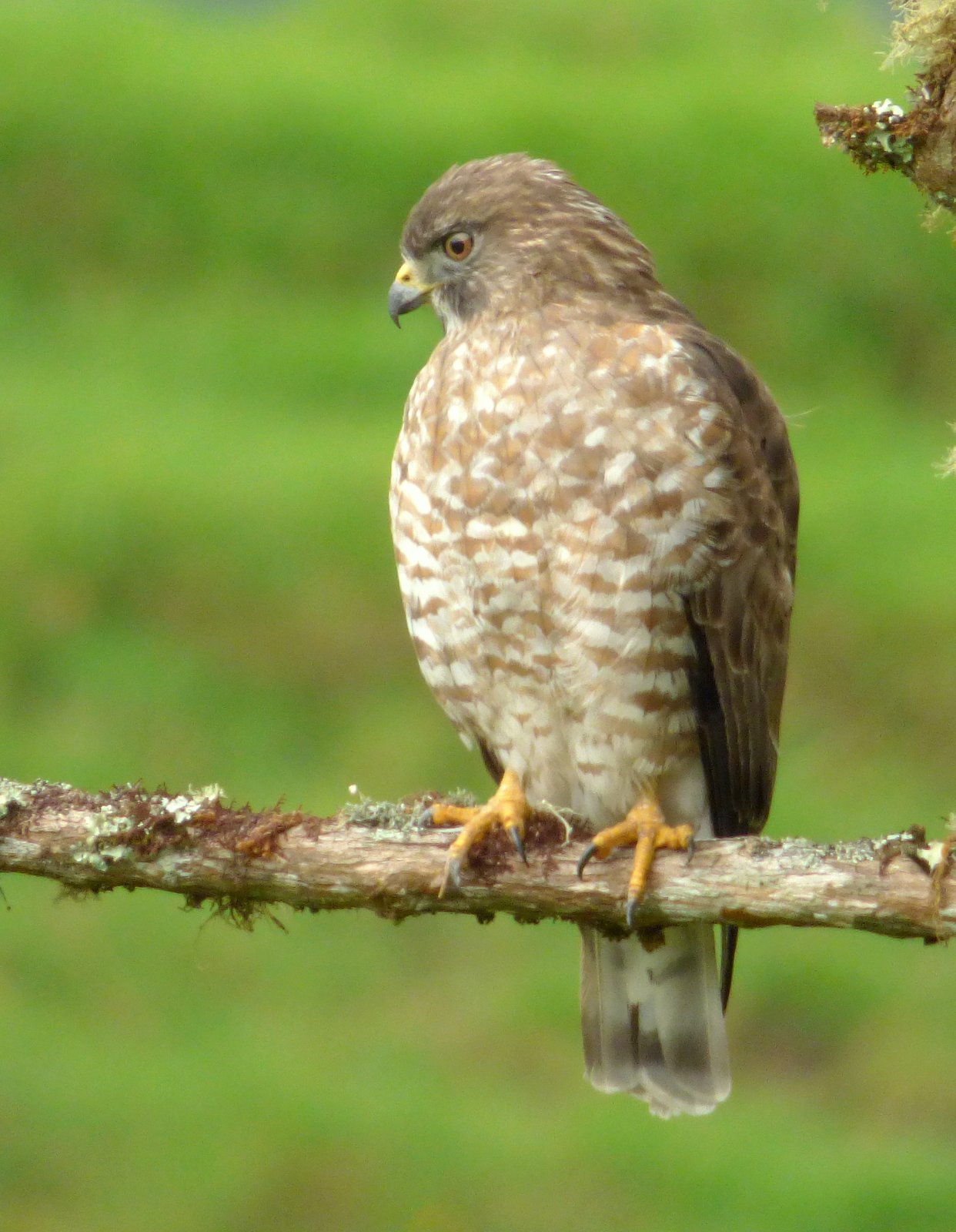
34–44 cm, chunky, with broad, fairly pointed wings and a short tail. Adults are dark grey-brown above with a brown head; the breast is densely barred rufous-brown, the belly paler. The tail is black with a single broad white band and a narrow white tip. In flight the underwings are white with a clear dark trailing edge and dark wingtips. The island forms differ from each other and from the migrants: Puerto Rican birds are darker and browner, Lesser Antillean birds often warmer rufous. Juveniles are white or pale buff below with dark streaks, a dark malar stripe and a brown tail with several narrow bands. A dark morph occurs rarely among migrants.
Confusion species
Red-tailed Hawk Buteo jamaicensis is much larger, with a belly band and, in adults, a rusty-red tail. Sharp-shinned Hawk Accipiter striatus has shorter, rounder wings, a long narrow tail with thin bands and a flap-and-glide flight. Cuban Black Hawk Buteogallus gundlachii and Gundlach's Hawk Astur gundlachi are larger. In Trinidad young birds resemble young Grey-lined Hawks Buteo nitidus.
Habitat
Almost any forest type with some openings: dry and moist broadleaf forest, rainforest and montane forest, pine forest in Cuba, limestone forest, and also shade coffee, plantations and forest edges near villages. It hunts from a perch below the canopy or at a forest edge, taking lizards, frogs, large insects, small mammals and birds. The nest is a stick platform in a tree fork.
Where the bird is most at home, classified by the vegetation types of the Caribbean.






Range and movements
Resident in Cuba (subspecies cubanensis), Puerto Rico (brunnescens), Antigua (insulicola), Dominica, Martinique and Saint Lucia (rivierei), and Saint Vincent, the Grenadines, Grenada and Tobago (antillarum). In Hispaniola, Jamaica, the Bahamas, Trinidad and other islands a scarce passage migrant or winter visitor from North America. Outside the region it breeds in eastern North America and winters from Mexico to Brazil.
- Resident
- Summer visitor (c. Oct–Mar)
- Winter visitor (c. Apr–Sep)
- Passage (Mar–Apr, Oct–Nov)
- dark = core range, pale = thinly spread
How and when to look
In Dominica, Saint Lucia and Grenada the commonest forest raptor; towards midday birds rise over wooded valleys. In Puerto Rico the best chances are in Río Abajo State Forest and Carite Forest, in Cuba in the Sierra de los Órganos and the montane forests of the east.
Conservation status
Not threatened as a species. The Puerto Rican subspecies is very scarce, numbering at most a few hundred birds, and is listed as endangered in the United States because of its small numbers and forest loss; hurricanes can hit the small population hard.
Scientific name
Buteo platypterus | (Vieillot, 1823)
Vieillot described the species in 1823 as Sparvius Platypterus; because it was later moved to another genus, the author and year stand in brackets. The genus Buteo was introduced in 1799 by De Lacépède. Buteo is the Latin word for a buzzard. platypterus is Greek, from platus 'broad' and pteron 'wing', after the broad wings. The specimen the first description was based on came from Schuylkill River, Pennsylvania (USA).