All species › Waders, gulls and terns › Gulls and terns › Brown Noddy
Brown Noddy | Anous stolidus
Noddy | Tiñosa común
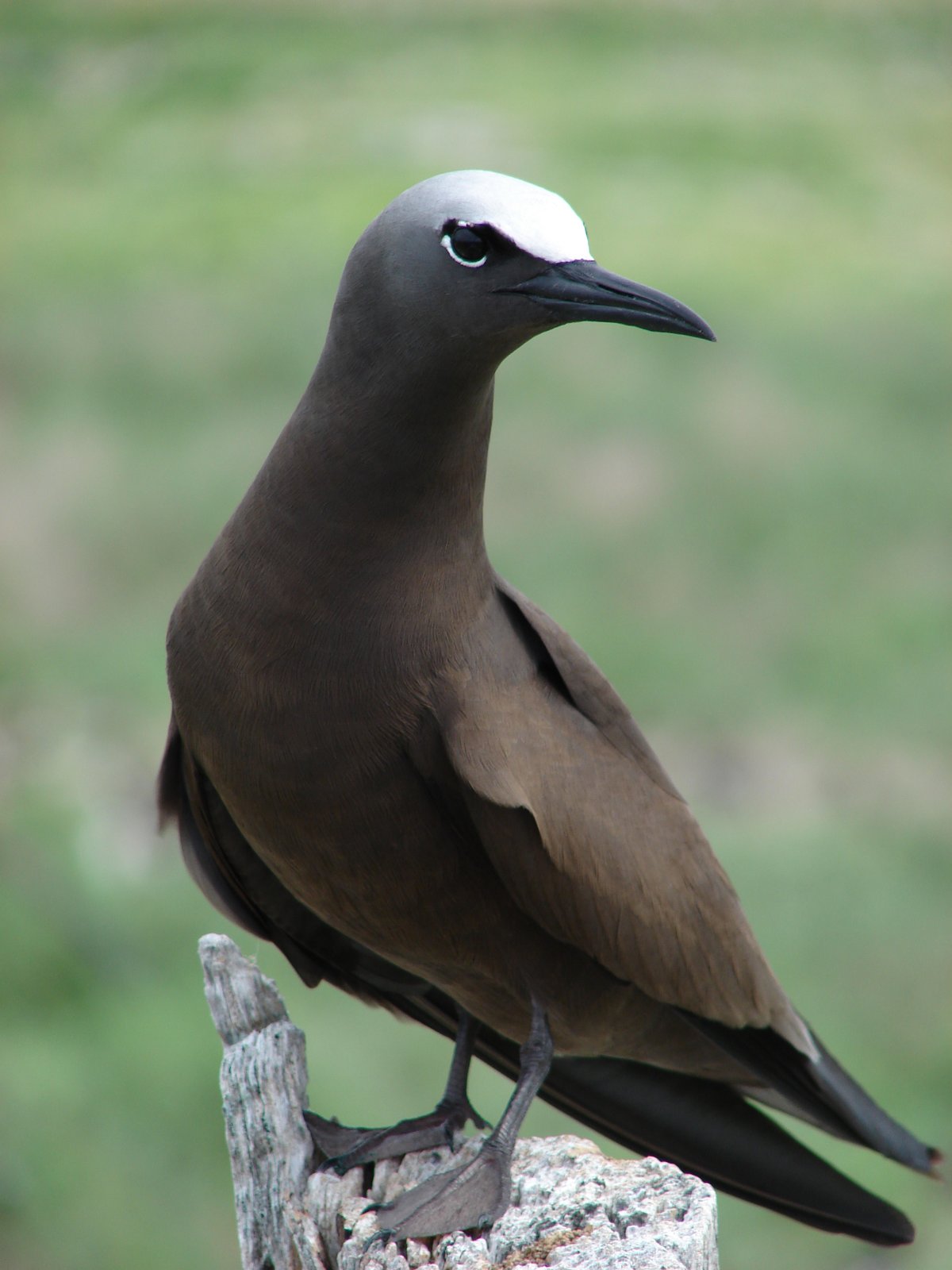
The Brown Noddy is a dark brown tern with a pale crown and wedge-shaped tail that breeds in almost every seabird colony in the Caribbean. It feeds just above the water, picking small fish and squid from the surface, often where tuna and other predatory fish drive shoals upwards. Outside the breeding season it wanders over the open sea.
Voice
At the colony a low, raw, crow-like karrk plus growling and rattling sounds; mostly silent at sea.
Recording: Alexander Schlatmann — CC BY-NC-SA 4.0 · converted to mono · xeno-canto
Identification
38–45 cm, uniform dark chocolate-brown, with a whitish-grey crown that blends gradually into the brown nape, a narrow white crescent below the eye and a black line between eye and bill. The bill is black and fairly stout, the legs dark. The long tail is wedge-shaped with a small notch at the tip, not forked. In flight the underwing coverts are paler brown than the flight feathers. The sexes are alike. Juveniles have a browner, barely pale crown and pale fringes to the wing coverts.
Confusion species
Black Noddy Anous minutus is smaller and blacker, with a longer, thinner bill, a more sharply defined bright white cap reaching the nape and a shorter tail. Juvenile Sooty Terns Onychoprion fuscatus are also dark brown, but have white spots on the back and wings, a pale belly and undertail and a forked tail.
Habitat
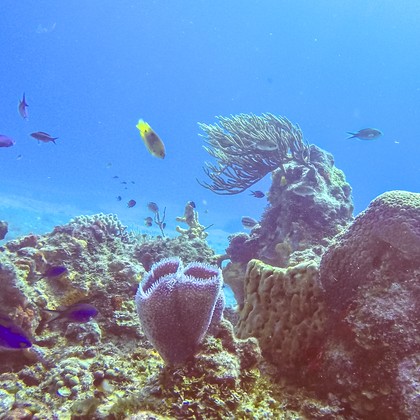
Open sea and coastal waters, especially over reefs and where shoals of predatory fish are hunting. It breeds in colonies on rocky islets, coral cays and cliffs, on ledges and in crevices, on bushes or on the ground; the nest is a flat platform of twigs and seaweed. It rests on buoys, posts, driftwood and boats.
Where the bird is most at home, classified by the vegetation types of the Caribbean.




Range and movements
Breeds widely throughout the region on offshore islets and cliffs: in the Bahamas and the Turks and Caicos Islands, on cays off Cuba and Jamaica (including the Pedro and Morant Cays), around Puerto Rico and the Virgin Islands, on many small islands of the Lesser Antilles south to the Grenadines, around Aruba, off Tobago and around San Andrés. Elsewhere in the region mainly seen offshore. Beyond the region in all tropical oceans; in the Atlantic also on the Dry Tortugas, off Brazil and in the Gulf of Guinea.
- Resident
- Summer visitor (c. Oct–Mar)
- Passage (Mar–Apr, Oct–Nov)
- dark = core range, pale = thinly spread
How and when to look
Boat trips to colony islets in the breeding season, or headlands where birds feed low over the water, give the best chances. At the colony birds are often fairly tame, and the nodding and bowing of courtship can be watched closely.
Conservation status
Not threatened. The world population is large. In the Caribbean eggs are still taken at some colonies, and rats, cats and disturbance by visitors affect breeding success on small cays.
Scientific name
Anous stolidus | (Linnaeus, 1758)
Linnaeus described the species in 1758 as Sterna stolida; because it was later moved to another genus, the author and year stand in brackets. The genus Anous was introduced in 1826 by Stephens. Anous is Greek for 'stupid, silly' — for the tameness with which noddies allowed sailors to approach and catch them. stolidus is Latin for 'stupid, dull' — for the birds' tameness, which made them easy to catch at sea. The specimen the first description was based on came from West Indies.