All species › Hummingbirds and swifts › Hummingbirds › Brown Violetear
Brown Violetear | Colibri delphinae
Bruine violetoorkolibrie | Colibrí pardo
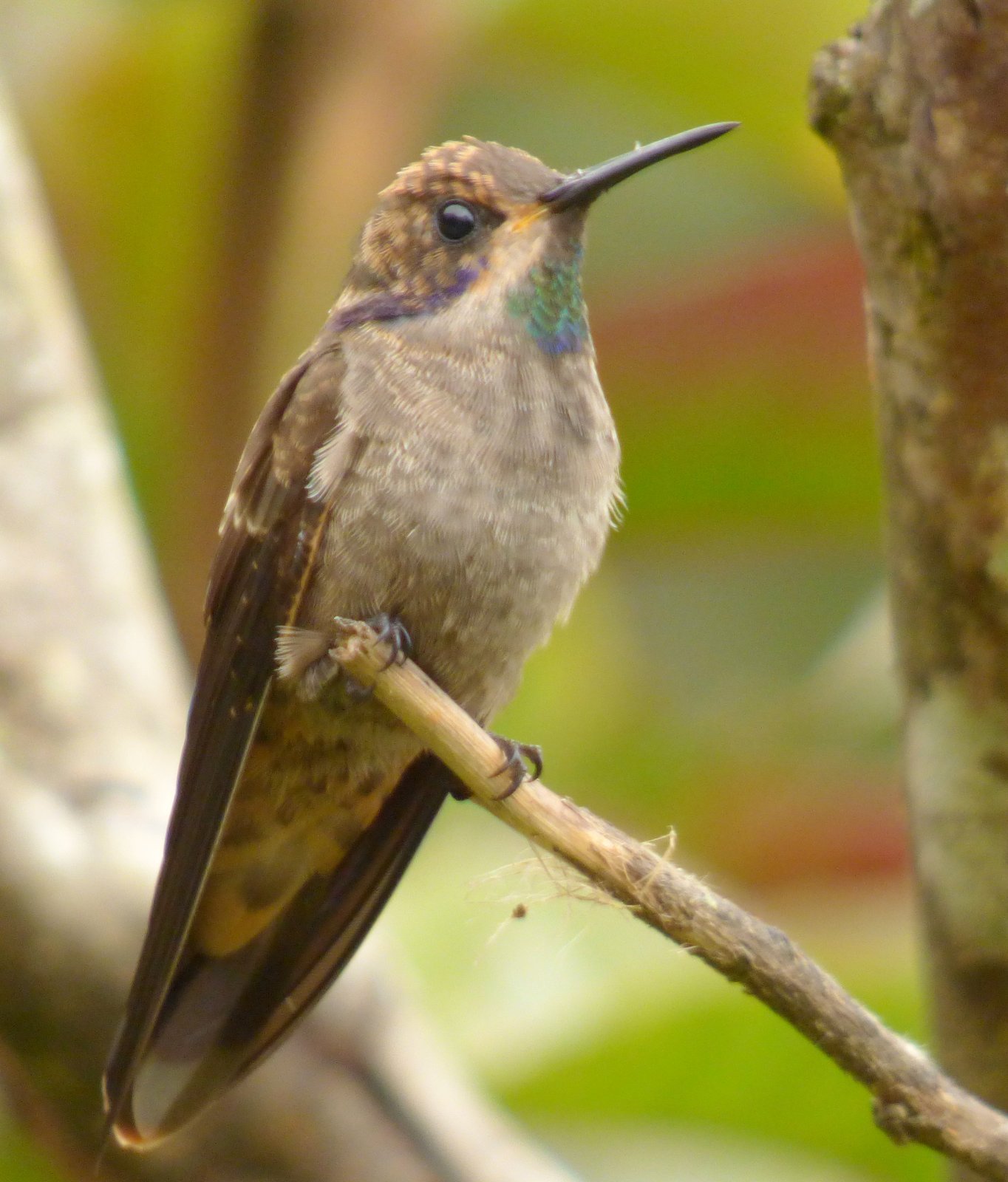
The Brown Violetear is a medium-sized, mainly brown hummingbird of montane forests with an isolated population in Trinidad. Despite its dull plumage it is aggressive, spending much time chasing other hummingbirds from flowers and feeders. Outside the breeding season birds wander to lower forest edges.
Voice
Males sing in loose groups from high, exposed branches, giving a loud, endlessly repeated series of sharp notes, chip-chip-chip.
Recording: Juan Freile — CC BY-NC-SA 4.0 · converted to mono · xeno-canto
Identification
11–12 cm, with a short, nearly straight black bill. The plumage is grey-brown, with a rufous rump and greyish underparts. A violet patch runs back and down from the eye; below it lies a pale malar stripe, and a glittering green and blue stripe runs down the centre of the throat. The female has a smaller throat patch. Juveniles have rufous fringes to the upperparts and little or no violet behind the eye.
Confusion species
No other hummingbird in Trinidad is as uniformly brown while having a short, straight bill. The hermits, such as Rufous-breasted Hermit Glaucis hirsutus, have long, curved bills and keep to the understorey. Female Black-throated Mango Anthracothorax nigricollis has a curved bill and white underparts with a black central stripe.
Habitat
The canopy and edges of humid montane forest, cloud forest and coffee and cacao plantations in the higher parts of the Northern Range; outside the breeding season also lower, at forest edges and in gardens with flowering trees and shrubs. It takes nectar and catches insects in flight.
Where the bird is most at home, classified by the vegetation types of the Caribbean.




Range and movements
Within the region only in Trinidad, scarce and irregular in the Northern Range; numbers vary from year to year. There is just a single report from Tobago. Outside the region from Central America through the Andes to Bolivia, on the tepuis of southern Venezuela and the Guianas, with an isolated population in Bahia, Brazil.
- Resident
- dark = core range, pale = thinly spread
How and when to look
The Asa Wright Nature Centre is the most reliable site; in some years a bird stays for weeks at the feeders on the veranda. Elsewhere in the Northern Range at flowering trees along the higher roads. The violet ear patch shows only in good light; the brown plumage and short bill are the first clue.
Conservation status
Not threatened. Widespread in the montane forests of Central and South America; scarce in Trinidad.
Scientific name
Colibri delphinae | (Lesson, 1839)
Lesson described the species in 1839 as Ornismya Delphinae; because it was later moved to another genus, the author and year stand in brackets. The genus Colibri was introduced in 1824 by Spix. Colibri is the Spanish and French name for a hummingbird, supposedly based on a Carib word. delphinae refers to Delphine d'Albémar, the tragic heroine of Madame de Staël's novel Delphine (1802). The specimen the first description was based on came from Bogotá, Colombia (designated later).