All species › Passerines › Tyrant flycatchers › Cattle Tyrant
Cattle Tyrant | Machetornis rixosa
Veetiran | Picabuey
The Cattle Tyrant is a flycatcher that spends most of its time on the ground. It walks and runs on long legs through short grass and often perches on the backs of cattle, horses, donkeys and goats, taking the insects they flush. It is a bird of open country in South America and eastern Panama; in the Caribbean it occurs regularly only on the ABC Islands.
Voice
High, thin calls, such as a repeated tsee or tseep, and at dawn a rapid series of high squeaky notes. It calls less than most large flycatchers.
Recording: Glauko Corrêa da Silva — CC BY-NC-SA 4.0 · converted to mono · xeno-canto
Identification
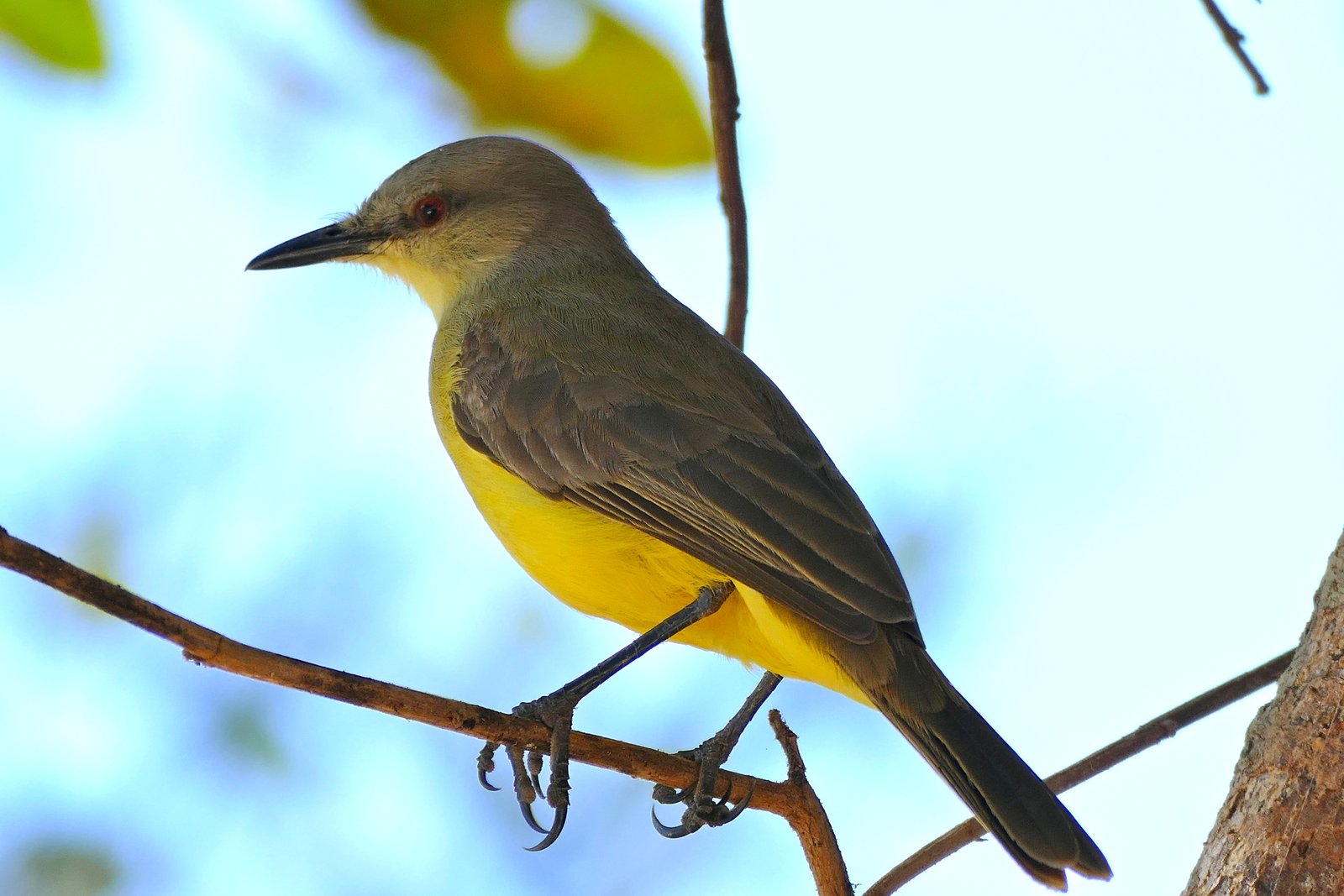
19–20 cm, slim, with long black legs and a fairly short, straight bill. The head is grey with a narrow dark eyestripe and a usually concealed orange-red crown patch; the iris is reddish. Back and wings are olive-brown, the tail dark brown with a pale buffy tip. Throat and underparts are yellow; in the northern subspecies flavigularis, the one closest to the ABC Islands, the throat is yellow too. The sexes are alike; juveniles lack the crown patch.
Confusion species
Tropical Kingbird Tyrannus melancholicus is similar in colour but has a heavier bill, short legs and a notched tail; it hunts from a high perch and rarely lands on the ground. Its habit of walking on the ground and its long legs separate the Cattle Tyrant from every other yellow-bellied flycatcher in this guide.
Habitat
Cattle pasture, savanna, open yards, parks, golf courses, lawns and open ground with scattered trees and shrubs; on Aruba also open patches in dry cactus scrub near villages and farms. It forages walking on the ground or from an animal's back, mainly taking insects flushed by grazing livestock. The nest is placed in a cavity or among palm fronds, sometimes in the old nest of another bird.
Where the bird is most at home, classified by the vegetation types of the Caribbean.




Range and movements
On Aruba now a resident of open country; on Curaçao much scarcer and irregular. A few wandering birds have been recorded on Trinidad. Outside the region in eastern Panama, northern Colombia and Venezuela and, in a second area, in eastern and central South America to Argentina.
- Resident
- dark = core range, pale = thinly spread
How and when to look
On Aruba best looked for in pastures, yards with goats or donkeys and grassy areas at golf courses and hotels. It stands out as the only yellow flycatcher that runs about on the ground or rides on an animal's back.
Conservation status
Not threatened. Across much of its range the species benefits from deforestation and the spread of pasture, and it is expanding in northern South America.
Scientific name
Machetornis rixosa | (Vieillot, 1819)
Vieillot described the species in 1819 as Tyrannus rixosus; because it was later moved to another genus, the author and year stand in brackets. The genus Machetornis was introduced in 1841 by Gray. Machetornis is Greek, from makhētēs 'fighter' and ornis 'bird', after its combative behaviour and habit of taking over other species' nests. rixosa is from Latin rixosus 'quarrelsome', after its combative behaviour. The specimen the first description was based on came from Paraguay.