All species › Passerines › Waxwings › Cedar Waxwing
Cedar Waxwing | Bombycilla cedrorum
Cederpestvogel | Ampelis americano
The Cedar Waxwing is a wandering berry-eater from North America that reaches the Caribbean in varying numbers in winter. In some years flocks appear in the Bahamas and the Greater Antilles, in others hardly any. The birds arrive late in the winter and often stay into May.
Voice
A very high, thin, buzzy whistle, sreee or seee, often given by the whole flock at once and in flight. The sound is so high that it is often missed.
Recording: Rory Nefdt — CC BY-NC-SA 4.0 · converted to mono · xeno-canto
Identification
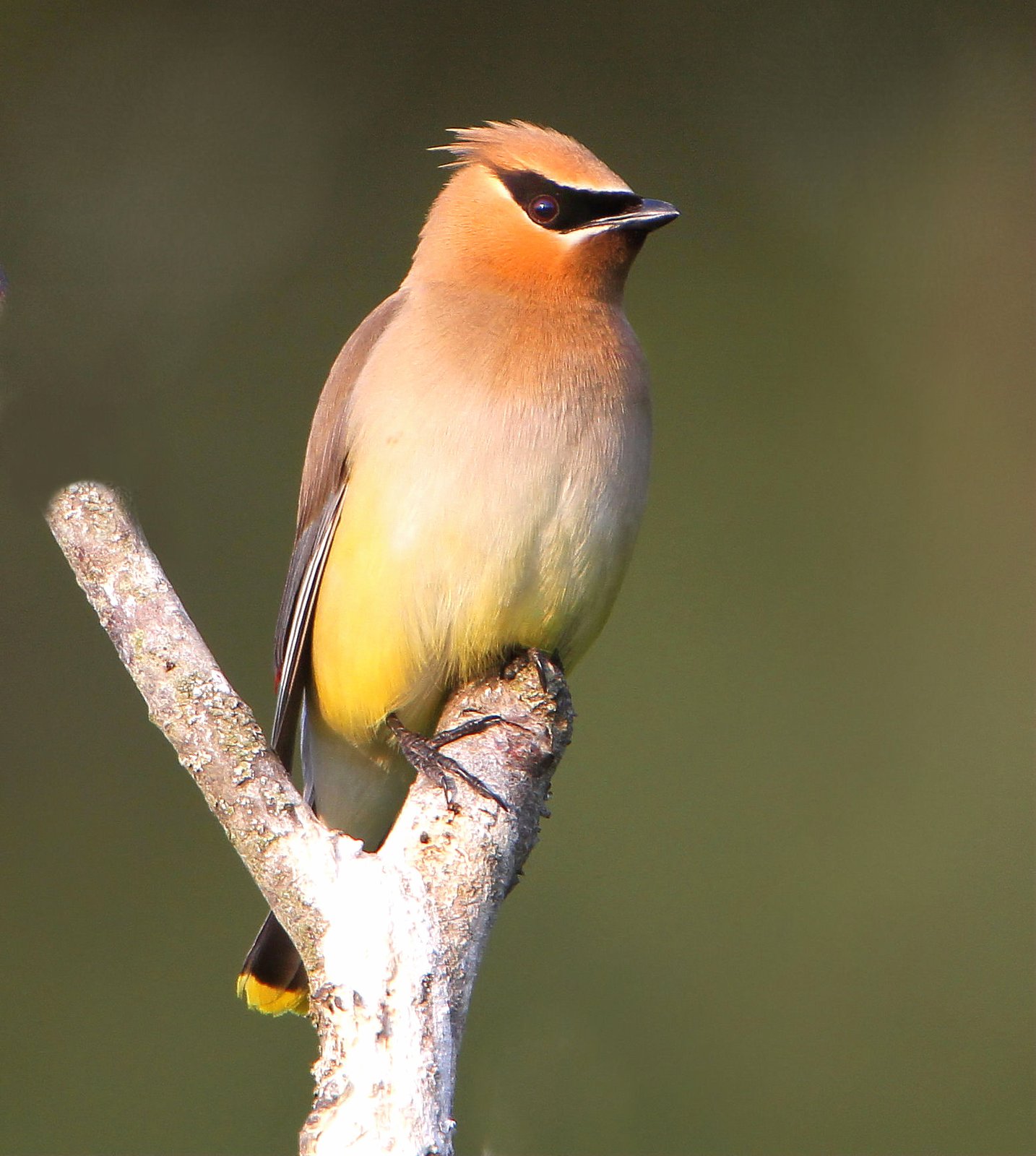
15–18 cm, sleek, with a soft crest and a short tail. Head, breast and mantle warm grey-brown, greyer towards the rump and wings. A black mask with a thin white border runs through the eye; the chin is black. Belly pale yellow, undertail coverts white. The tail is grey with a yellow terminal band, which can be orange in birds that have eaten certain berries. Adults have red, waxy tips to the secondaries. Juveniles are greyer, with faint streaking below and little or no red in the wing. In flight it shows triangular wings and a starling-like silhouette.
Confusion species
No other waxwing occurs in the region. On Hispaniola a flock in flight might recall Palmchat Dulus dominicus, but that species lacks a crest and mask and is heavily streaked below. The mask, crest and yellow tail band are otherwise distinctive.
Habitat
Anywhere with berries and fruit: edges of broadleaf and pine forest, fruit plantations, parks and gardens with fruiting trees and shrubs. In winter it eats almost only berries, swallowed whole, and also catches insects in flight. It roams in flocks and stays as long as food lasts.
Where the bird is most at home, classified by the vegetation types of the Caribbean.





Range and movements
Irregular winter visitor to the Bahamas, Cuba, the Cayman Islands and Jamaica, fairly common in some winters and absent in others. Rare on Hispaniola, Puerto Rico and the Virgin Islands; exceptional further south in the Lesser Antilles. It breeds in southern Canada and the northern and central United States and winters from the United States to Central America and north-western South America.
- Resident
- Winter visitor (c. Apr–Sep)
- Passage (Mar–Apr, Oct–Nov)
- dark = core range, pale = thinly spread
How and when to look
Best searched for in late winter and spring at fruiting trees in parks and gardens in Cuba and the Bahamas. The high call is often the first clue; flocks like to sit close together at the top of a bare tree.
Conservation status
Not threatened. The population is large and stable to increasing. In the Caribbean, numbers depend strongly on the berry crop in North America.
Scientific name
Bombycilla cedrorum | Vieillot, 1808
Vieillot described the species in 1808 and placed it straight away in the genus where it still stands. He introduced the genus Bombycilla in that same work. Bombycilla is Vieillot's coined Latin for 'silktail', a rendering of the German Seidenschwanz, from bombyx 'silk' and -cilla, which he mistakenly took to mean 'tail'. cedrorum is Latin for 'of the cedars', after the berries of eastern red cedar that the bird readily eats. The specimen the first description was based on came from eastern North America.