All species › Waders, gulls and terns › Plovers and lapwings › Common Ringed Plover
Common Ringed Plover | Charadrius hiaticula
Bontbekplevier | Chorlitejo grande
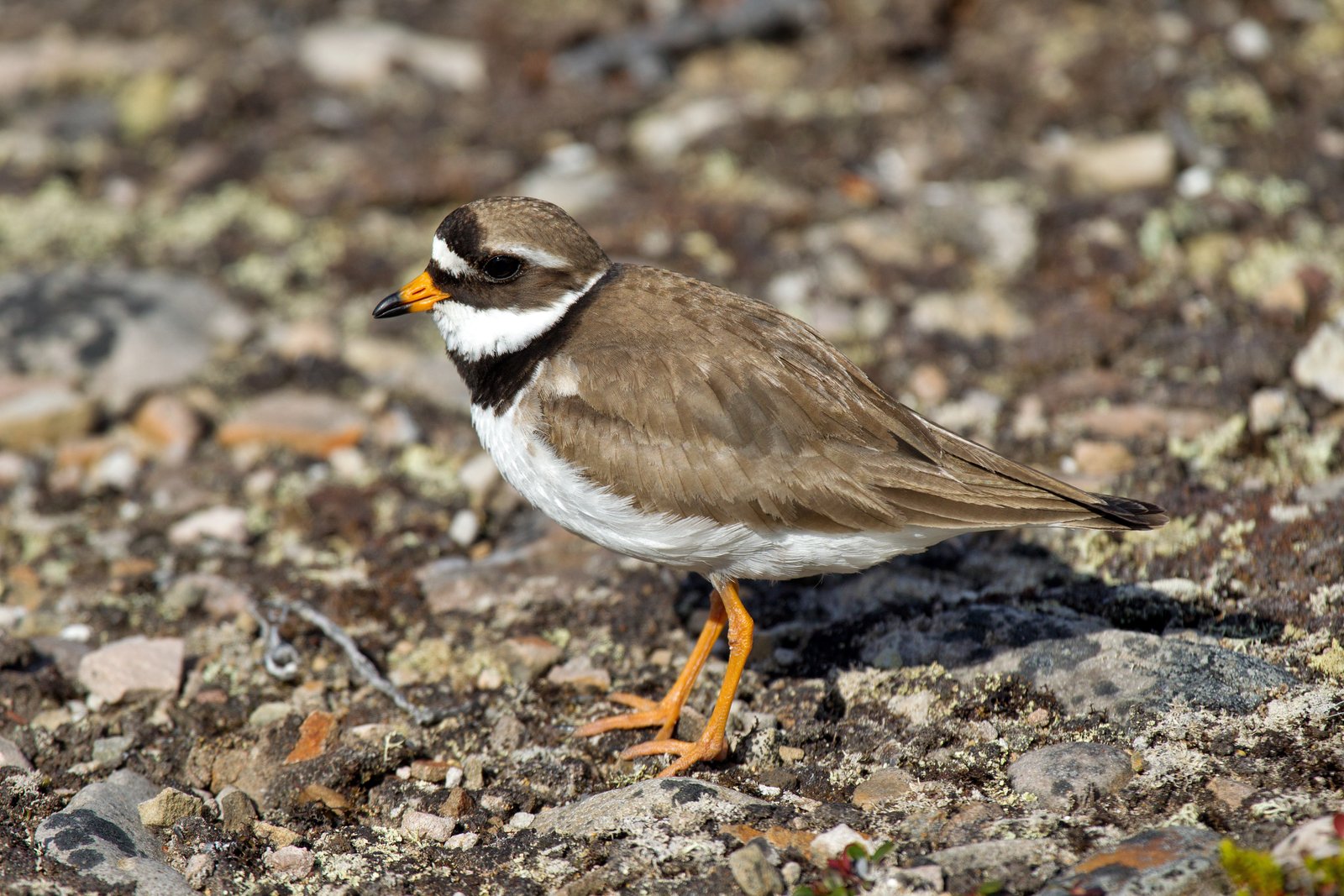
The Common Ringed Plover is the Eurasian sister species of Semipalmated Plover and closely resembles it. It breeds from Arctic Canada and Greenland far into Siberia and winters mainly in Europe and Africa. In the Caribbean it is a very rare vagrant that can only be picked out among the far more numerous Semipalmated Plovers with a good view.
Voice
A soft, mellow, rising too-ip, fuller and less sharp than the chu-wee of Semipalmated Plover. In the field the call is one of the most reliable features.
Recording: Vandousselaere Patrick — CC BY-NC-SA 4.0 · converted to mono · xeno-canto
Identification
18–20 cm, on average slightly larger and stockier than Semipalmated Plover. Brown upperparts, white underparts and a black (brown in juveniles) breast band that is often broader in adults. In breeding plumage an orange bill with a black tip and orange legs; outside the breeding season and in juveniles a darker bill. Key details: a clear white supercilium behind the eye, often also in winter plumage; no or a barely visible yellow eye-ring; and webbing only between the outer and middle toes, hardly between the middle and inner. In flight a white wing bar.
Confusion species
Semipalmated Plover Charadrius semipalmatus is the only real confusion risk: it has webbing between all three front toes, a narrower breast band, a shorter bill, a more obvious yellow eye-ring and a less distinct white stripe behind the eye. Piping Plover Charadrius melodus is much paler and sandier, with an incomplete breast band.
Habitat
Sandy beaches, mudbanks, tidal flats and the edges of salt pans and lagoons, usually in the company of other small plovers and sandpipers. It feeds with short runs and sudden stops.
Where the bird is most at home, classified by the vegetation types of the Caribbean.



Range and movements
Records are known from Barbados and Guadeloupe among others, and from a few other islands of the Lesser Antilles; the species is also on the official list of Trinidad and Tobago. Most islands have no records, and because of its similarity to Semipalmated Plover it probably often goes unnoticed. Beyond the region it breeds in north-east Canada, Greenland, Iceland and northern Europe and Asia, and winters in western Europe, Africa and south-west Asia.
How and when to look
A small plover with a broad breast band and a clear white supercilium among Semipalmated Plovers on a beach or salt pan in the Lesser Antilles deserves a second look. Call and toes are decisive; photographs of the feet are of great value for a rarity record.
Conservation status
Not globally threatened. In the Caribbean a very rare vagrant with no regular presence.
Scientific name
Charadrius hiaticula | Linnaeus, 1758
Linnaeus described the species in 1758 and placed it straight away in the genus where it still stands. He introduced the genus Charadrius in that same work. Charadrius is Late Latin, from Ancient Greek kharadrios, a plain-coloured nocturnal bird of ravines and river valleys, from kharadra 'ravine'. hiaticula is late Medieval Latin for a plover. The specimen the first description was based on came from Sweden.