All species › Passerines › Tyrant flycatchers › Crested Doradito
Crested Doradito | Pseudocolopteryx sclateri
Kuifdoradito | Doradito copetón
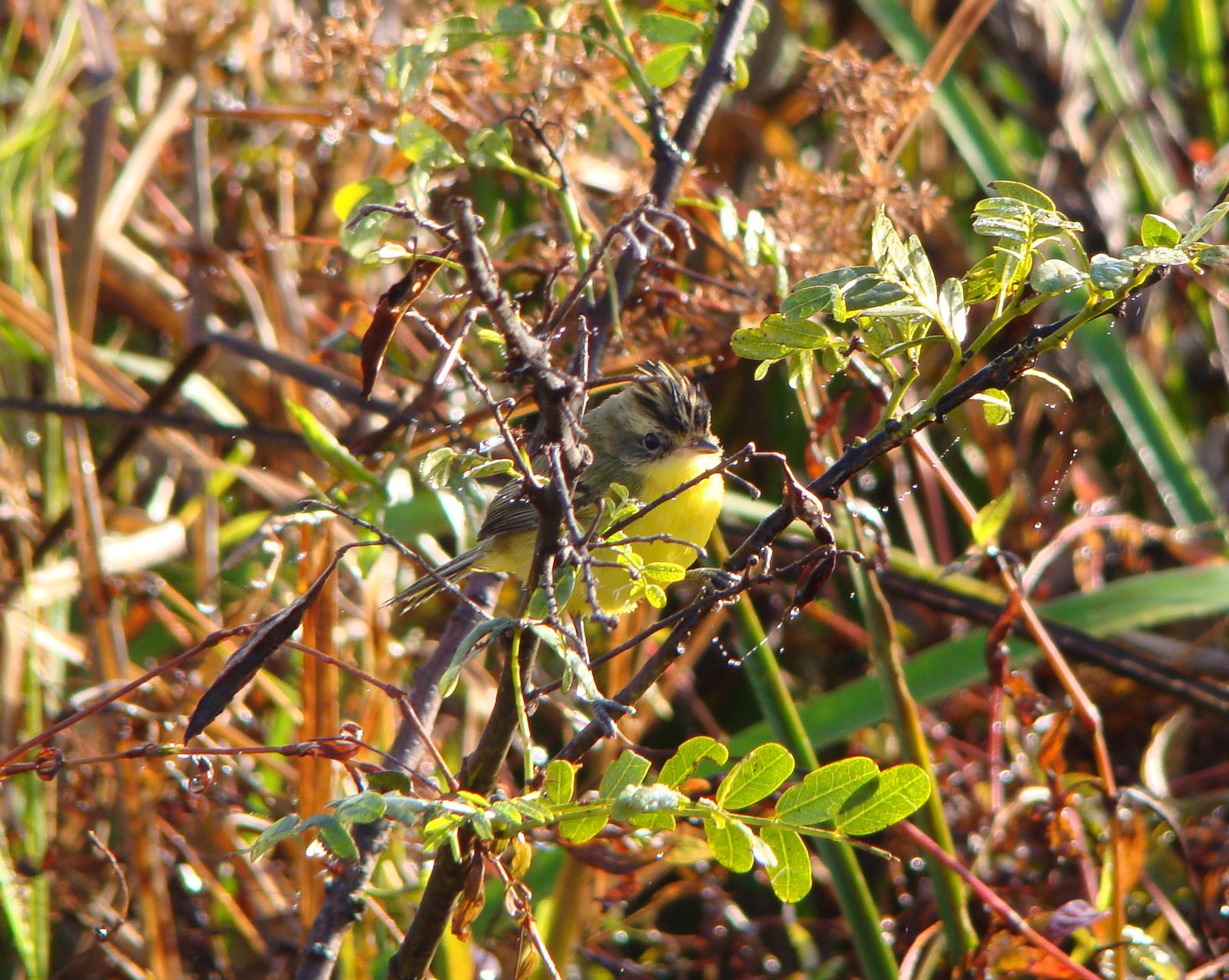
The Crested Doradito is a small, yellow flycatcher of reed beds and marshes in South America. Its range is fragmented, from Venezuela and Guyana to Argentina and Uruguay. In the Caribbean it has been recorded as a vagrant on Trinidad.
Voice
In the south of the range the song is described as a very high, liquid wic-wic-wic; the call is a mellow wik wik.
Recording: GABRIEL LEITE — CC BY-NC-SA 4.0 · converted to mono · xeno-canto
Identification
10–11 cm, small and thin-billed. Both sexes have a shaggy crest. The male has a blackish crown and crest, olive upperparts, dark wings with pale edgings and bright yellow underparts. The female is duller, with a less dark crown and paler yellow underparts. Iris dark brown, legs black.
Confusion species
Saffron Finch Sicalis flaveola and Grassland Yellow Finch Sicalis luteola are also yellow but have a conical finch bill. Masked Yellowthroat Geothlypis aequinoctialis shares the same rank vegetation but lacks a crest; the male has a black mask. American Yellow Warbler Setophaga aestiva has no crest and a plain yellow head.
Habitat
Reed beds, marshes and tall grass near water, up to about 500 m. It forages in pairs or small family groups for insects and spiders, gleaned from the vegetation, often while clinging to reed stems.
Where the bird is most at home, classified by the vegetation types of the Caribbean.


Range and movements
Vagrant on Trinidad; does not breed in the region. The nearest range is in Venezuela and Guyana; further populations are scattered through Bolivia, Brazil, Paraguay, Uruguay and Argentina. The species was formerly thought to be migratory but is now regarded as resident.
How and when to look
A small yellow bird with a shaggy dark crest in the marshes or rice fields of Trinidad deserves careful comparison with warblers and yellow finches. The thin bill and the crest are decisive. Records are worth documenting.
Conservation status
Not threatened globally, with a stable population, though local and scarce. In the Caribbean a vagrant.
Scientific name
Pseudocolopteryx sclateri | (Oustalet, J-FÉ, 1892)
Oustalet, J-FÉ described the species in 1892 as Anaeretes sclateri; because it was later moved to another genus, the author and year stand in brackets. The genus Pseudocolopteryx was introduced in 1905 by Lillo. Pseudocolopteryx is Greek, from pseudos 'false' and the genus Colopteryx (kolos 'stunted', pterux 'wing'): 'false Colopteryx'. sclateri honours the British zoologist Philip Lutley Sclater (1829–1913). The specimen the first description was based on came from Buenos Aires province, Argentina (originally given in error as 'Chile').