All species › Passerines › New World blackbirds › Crested Oropendola
Crested Oropendola | Psarocolius decumanus
Kuiforopendola | Oropéndola crestada
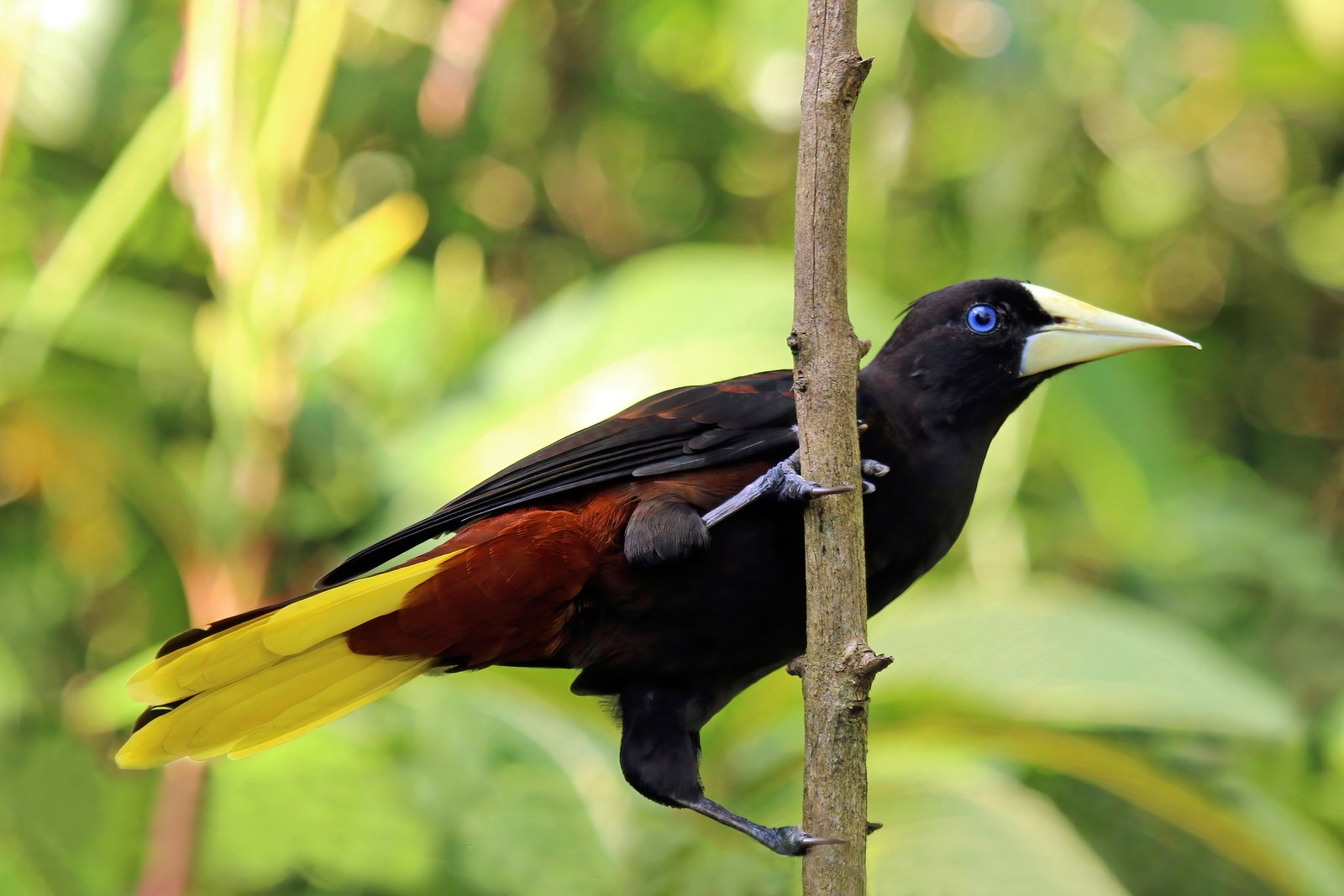
The Crested Oropendola is a large black blackbird with a yellow tail and an ivory bill that breeds in colonies of long hanging nests. In the Caribbean it occurs only on Trinidad and Tobago, where it is common and known locally as the cornbird. Males are much larger than females.
Voice
During the bowing display, in which the male tips forward with raised tail and flapping wings, it gives a liquid, gurgling series of notes ending in a loud, explosive final note. The call is a harsh chak. The wings also make an audible rushing sound in flight.
Recording: JAYRSON ARAUJO DE OLIVEIRA — CC BY-NC-SA 4.0 · converted to mono · xeno-canto
Identification
Male about 47 cm, female about 37 cm. The plumage is glossy black, with a chestnut rump and undertail. The central tail feathers are black, the rest bright yellow, so the tail looks largely yellow in flight and from below. The bill is long, pointed and ivory-white to pale yellow, with a swollen base continuing as a shield onto the forehead. The eye is pale blue. The male has a narrow crest of a few long feathers on the hindcrown, often hardly visible. The female is smaller and duller, brownish black, with a small crest. Juveniles are duller still, with a brownish eye and a darker bill.
Confusion species
Yellow-rumped Cacique Cacicus cela is much smaller, with a yellow rump, a yellow wing patch and a yellow tail base with a black tail tip. Giant Cowbird Molothrus oryzivorus, often found at oropendola colonies, is all black with a black bill and black tail. Carib Grackle Quiscalus lugubris is smaller, with a black bill and a yellow eye.
Habitat
Forest edges, open and secondary forest, clearings with tall isolated trees, cacao and coffee plantations, gardens and villages, from the lowlands into the hills. It eats fruit, nectar and insects, often in groups in the canopy. The colonies, on Trinidad of up to about 40 nests, hang in tall isolated trees, often over a clearing or road; the nests are long woven pouches suspended from the tips of branches.
Where the bird is most at home, classified by the vegetation types of the Caribbean.






Range and movements
Resident on Trinidad and Tobago, including Little Tobago, and common in wooded and semi-open country, especially in the Northern Range of Trinidad and the Main Ridge forest of Tobago. Elsewhere in the region at most a very rare vagrant. Outside the region from Costa Rica and Panama through almost all of tropical South America to northern Argentina.
- Resident
- dark = core range, pale = thinly spread
How and when to look
The colony at the Asa Wright Nature Centre in the Arima Valley is a well-known place to watch the display at close range; on Tobago the birds are common along the roads through the Main Ridge forest. Colonies can be spotted from afar by the hanging nests and the constant coming and going.
Conservation status
Not threatened. The species is widespread and common and adapts well to forest edges, plantations and gardens. Giant Cowbirds parasitise its nests.
Scientific name
Psarocolius decumanus | (Pallas, 1769)
Pallas described the species in 1769 as Xanthornus decumanus; because it was later moved to another genus, the author and year stand in brackets. The genus Psarocolius was introduced in 1827 by Wagler. Psarocolius is Greek, from psar 'starling' and koloios 'jackdaw', for these large, starling-like birds. decumanus is Latin for 'large, huge' (literally 'of the tenth', like the biggest wave), after the bird's size. The specimen the first description was based on came from Suriname.