All species › Birds of prey › Hawks, eagles and kites › Double-toothed Kite
Double-toothed Kite | Harpagus bidentatus
Tandwouw | Gavilán bidentado
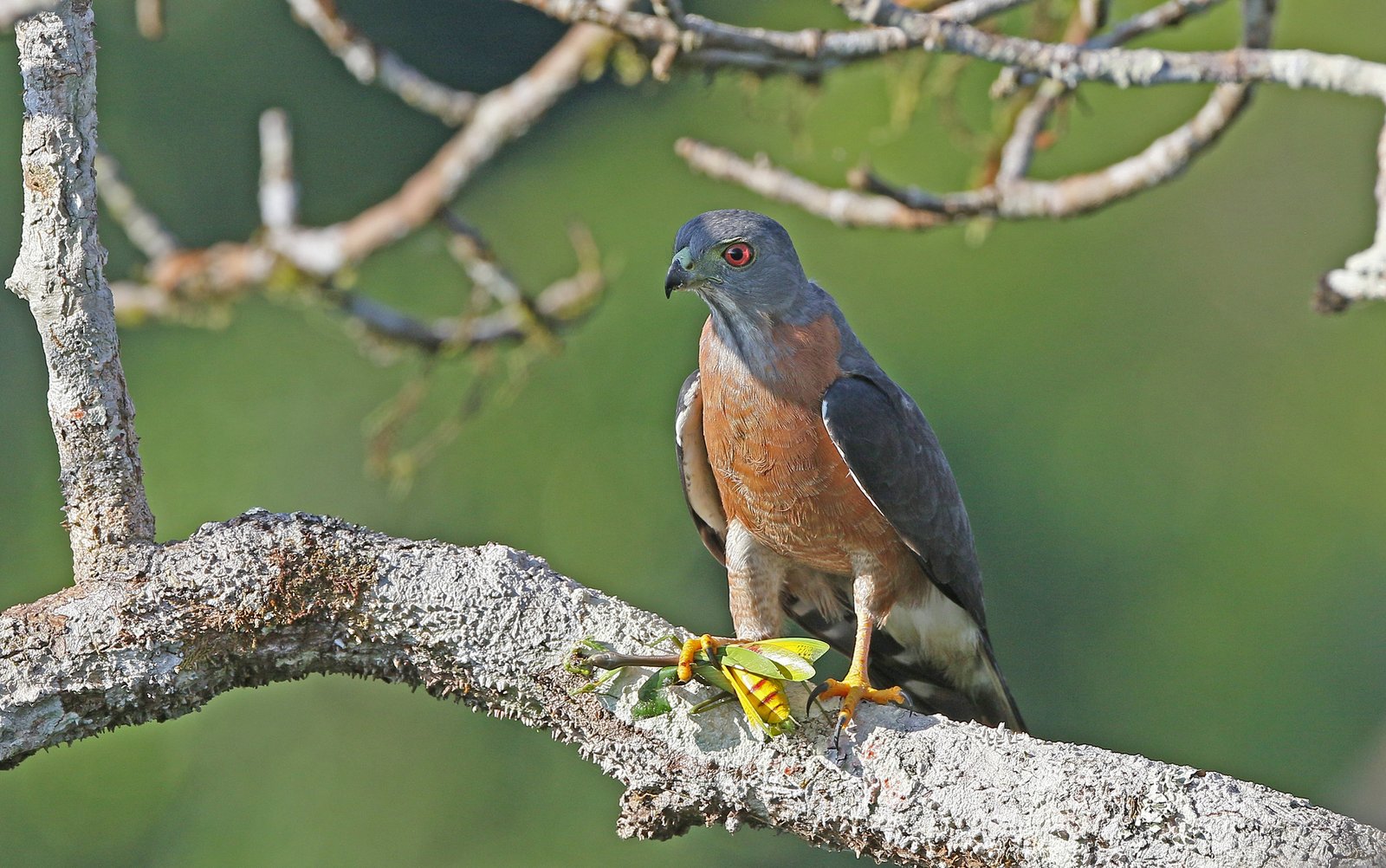
The Double-toothed Kite is a small forest raptor that in build and colour looks more like a hawk than a kite. It is named after the two notches on the edge of the upper mandible. In the Caribbean it occurs only on Trinidad. It regularly follows troops of monkeys to catch the insects and lizards they flush.
Voice
A high, thin whistled tsee-weep or see-weeeep; in disputes a series tsip-tsip-tsip-tsip ending in a long wheeeooip.
Recording: Fernando Igor de Godoy — CC BY-NC-SA 4.0 · converted to mono · xeno-canto
Identification
29–35 cm, compact, with fairly short, rounded wings and a medium-length tail. Adults have a dark grey head, a white throat with a dark central stripe, slate-grey upperparts and a rufous breast and belly with grey barring. The tail is blackish with three narrow pale bands. The eye is orange, the legs yellow. When soaring, the fluffy white undertail coverts are visible, protruding on either side of the tail. Immatures are brown above and white to buff below with dark streaks; the throat stripe is already present.
Confusion species
Broad-winged Hawk Buteo platypterus is larger and heavier, has no dark throat stripe and a tail with broad white bands. Grey-lined Hawk Buteo nitidus is barred grey and white below, without rufous, and has a tail with broad white bands. Plumbeous Kite Ictinia plumbea has long, pointed wings with a rufous patch on the primaries.
Habitat
Mature moist broadleaf forest and rainforest in the lowlands and mountains, also older secondary forest and forest edges. It hunts from the middle and upper storeys for large insects, lizards and frogs, often following howler and capuchin monkeys. The nest is a small cup of twigs high in a tree.
Where the bird is most at home, classified by the vegetation types of the Caribbean.



Range and movements
Resident on Trinidad, mainly in the forested Northern Range and the larger forest tracts in the centre and south of the island. Not on Tobago. Outside the region from Mexico through Central America to western Ecuador, and in northern and Amazonian South America to Bolivia and Brazil.
- Resident
- dark = core range, pale = thinly spread
How and when to look
In mid-morning, when thermals build, the Double-toothed Kite circles over the forest of the Northern Range, for example in the Arima Valley. The white undertail coverts are then the best feature. Inside the forest it is worth looking for a perched bird around troops of monkeys.
Conservation status
Not threatened. The species depends on mature forest and disappears where this is cleared.
Scientific name
Harpagus bidentatus | (Latham, 1790)
Latham described the species in 1790 as Falco bidentatus; because it was later moved to another genus, the author and year stand in brackets. The genus Harpagus was introduced in 1824 by Vigors. Harpagus comes from Greek harpagos 'grappling hook' or harpax 'robber', after the hooked bill and grasping habits. bidentatus is Latin for 'two-toothed', after the two tooth-like projections on the edge of the upper mandible. The specimen the first description was based on came from Cayenne, French Guiana.