All species › Passerines › Tyrant flycatchers › Eastern Kingbird
Eastern Kingbird | Tyrannus tyrannus
Koningstiran | Pitirre americano
The Eastern Kingbird breeds across much of North America and winters in the Amazon basin. On its way there it migrates in flocks through the western Caribbean, where it may turn up in autumn in Cuba, the Bahamas, Jamaica, the Cayman Islands and San Andrés. Outside the breeding season it behaves differently than on its breeding grounds: instead of hunting alone from a post, it forages in flocks on fruit.
Voice
Usually silent on migration. Calls include a sharp, sputtering dzeet and a dry, electric-sounding chatter, kitter-kitter-kitter.
Recording: Stanislas Wroza — CC BY-NC-SA 4.0 · converted to mono · xeno-canto
Identification
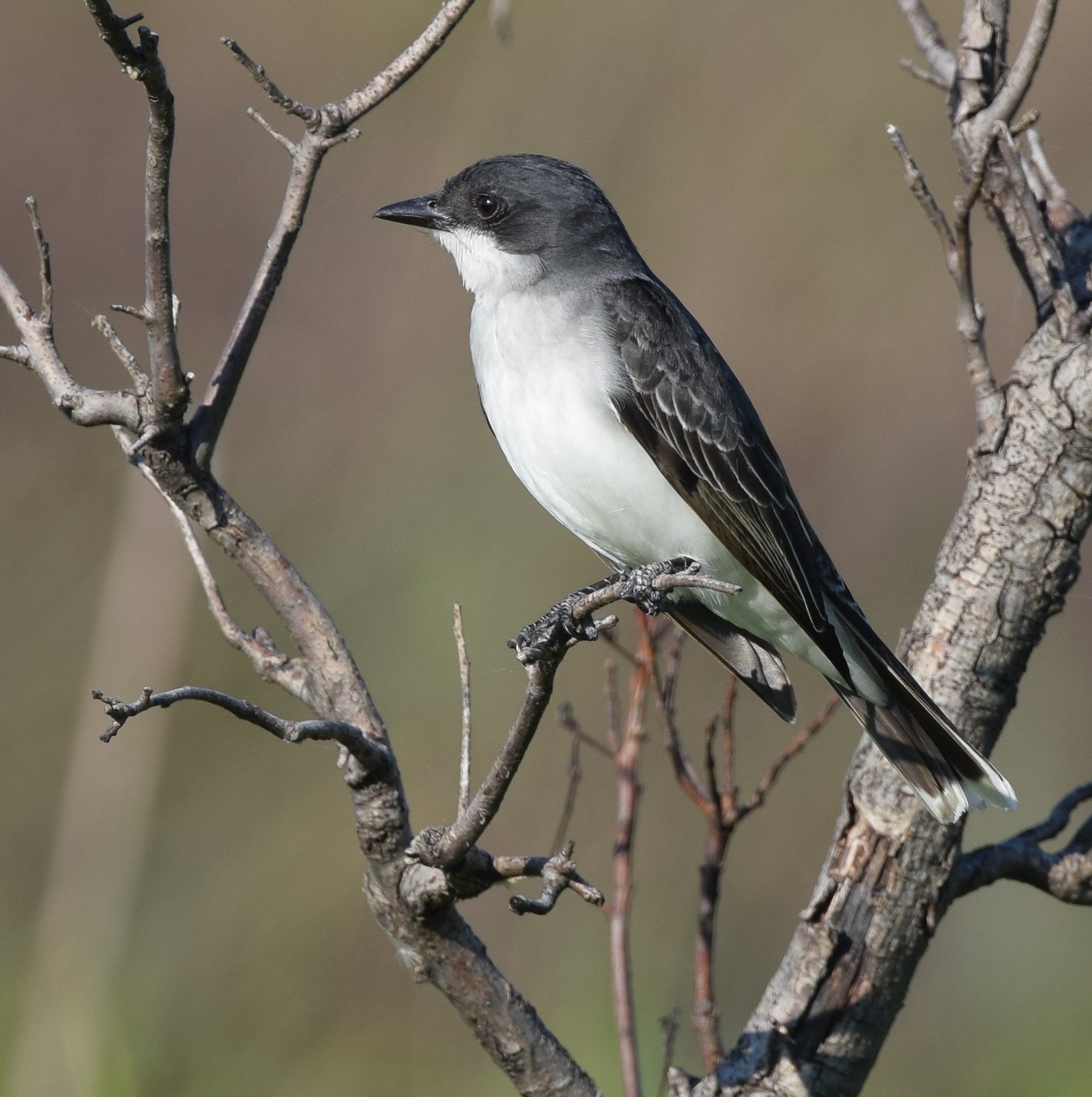
19–23 cm, more compact and smaller-billed than the Caribbean kingbirds. The head is blackish, darker than the slate-grey back and wings. The wing coverts are edged pale. Underparts white, the breast lightly washed grey. The black tail is square-ended with a white terminal band. A red crown patch is almost always concealed. Juveniles are browner above, with a narrower, dingy white tail tip. The sexes are alike.
Confusion species
Loggerhead Kingbird Tyrannus caudifasciatus is larger and heavier-billed, with an olive-brown back and a greyer, less sharply defined tail band. Grey Kingbird Tyrannus dominicensis is pale grey above with a black eye mask and lacks the white tail tip. Fork-tailed Flycatcher Tyrannus savana in the south also has a black cap and white underparts, but a pale grey back and, in adults, a very long forked tail.
Habitat
On migration in open country with trees and shrubs: pasture, forest edges, coastal vegetation, gardens and golf courses. Flocks often rest in treetops and then feed heavily on fruit and berries; it also catches flying insects from an open perch.
Where the bird is most at home, classified by the vegetation types of the Caribbean.





Range and movements
Regular passage migrant in Cuba, the Bahamas, Jamaica, the Cayman Islands and San Andrés, more numerous in autumn than in spring. Rare on Hispaniola, Puerto Rico, the Virgin Islands and in the Lesser Antilles; a scarce passage migrant on the ABC Islands and in Trinidad and Tobago. Breeds from Canada to the southern United States and winters in western South America, mainly in Amazonia.
- Summer visitor (c. Oct–Mar)
- Winter visitor (c. Apr–Sep)
- Passage (Mar–Apr, Oct–Nov)
- dark = core range, pale = thinly spread
How and when to look
The best chance is in September and October in Cuba and the western islands, when small flocks sit in the tops of fruiting trees or on wires beside open ground. The white tail tip shows from a long distance in flight.
Conservation status
Not threatened. The species is widespread and numerous, although numbers in parts of its North American breeding range have declined over the long term.
Scientific name
Tyrannus tyrannus | (Linnaeus, 1758)
Linnaeus described the species in 1758 as Lanius tyrannus; because it was later moved to another genus, the author and year stand in brackets. The genus Tyrannus was introduced in 1799 by De Lacépède. Tyrannus is Latin (from Greek turannos) for 'tyrant, despot', after the aggressive way these birds drive off even raptors. tyrannus is Latin for 'tyrant', after the ferocity with which the bird defends its territory against much larger birds. The specimen the first description was based on came from North America (later restricted to South Carolina).