All species › Waders, gulls and terns › Sandpipers and snipes › Eurasian Whimbrel
Eurasian Whimbrel | Numenius phaeopus
Regenwulp | Zarapito trinador
Eurasian Whimbrel in the narrow sense is the whimbrel of Europe, Asia and Africa. Since Hudsonian Whimbrel has been treated as a separate species, this Old World species is a very rare vagrant in the Caribbean. Birds that stray across the Atlantic reach the region mainly in the east, and among Hudsonian Whimbrels they only stand out to those who check the rump.
Voice
A rapid series of clear whistles, pi-pi-pi-pi-pi-pi-pi, like that of Hudsonian Whimbrel; the call is therefore no help in identification.
Recording: Paul Kelly — CC BY-NC-SA 4.0 · converted to mono · xeno-canto
Identification
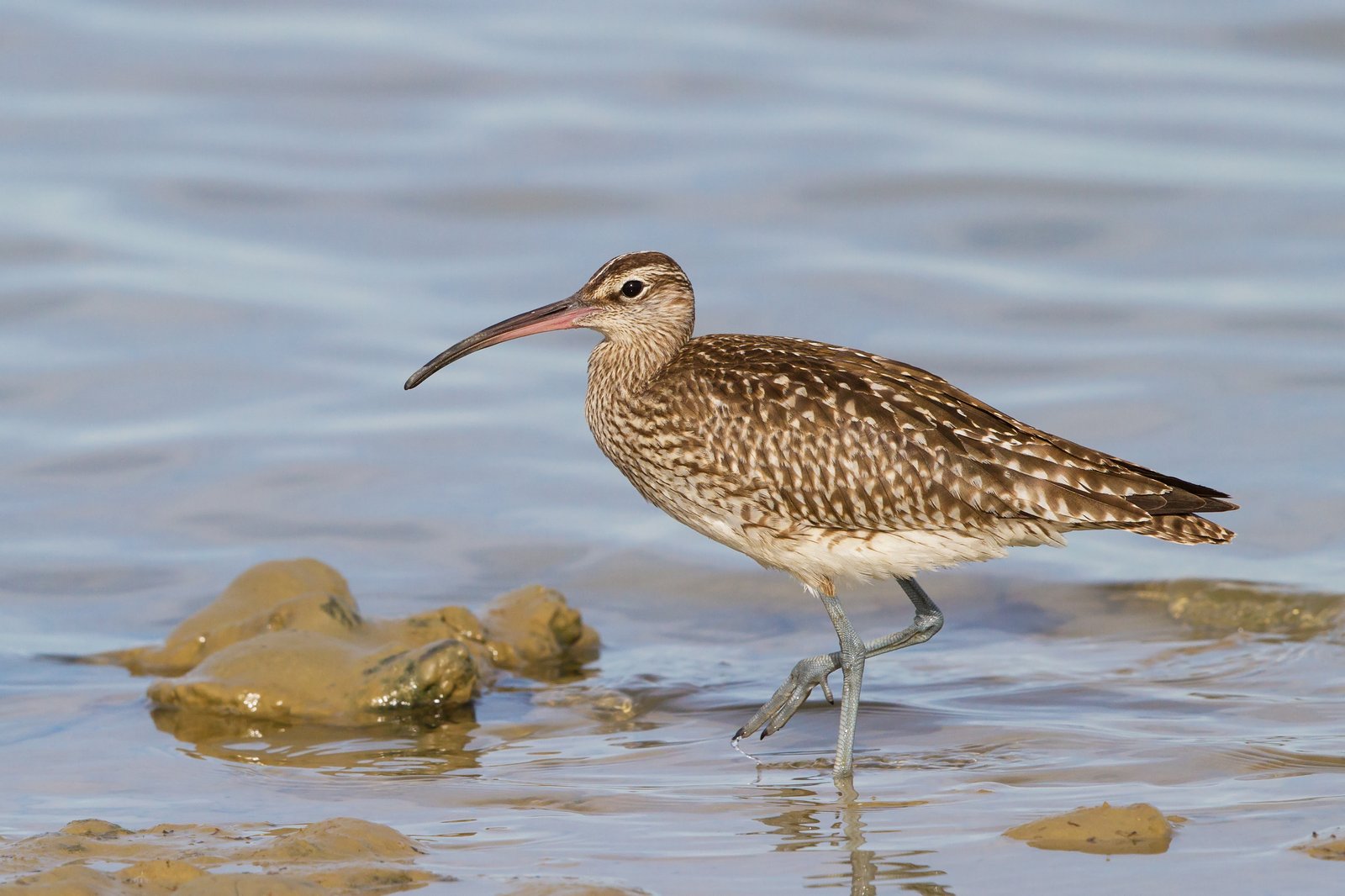
37–47 cm. Grey-brown, with a long bill that curves down in its outer part, two dark crown stripes with a pale central stripe, a pale supercilium and a dark eye-stripe. Neck and breast finely streaked, belly paler. In flight a white wedge shows on the lower back and rump, and the underwing and axillaries are largely white with dark barring. On average somewhat colder grey-brown and more contrasting than Hudsonian Whimbrel. The sexes are alike.
Confusion species
Hudsonian Whimbrel Numenius hudsonicus has a uniformly brown lower back and rump and a cinnamon-barred underwing; at rest the two species differ little. Marbled Godwit Limosa fedoa is cinnamon, with a straight or slightly upturned, two-toned bill.
Habitat
The same coastal habitats as Hudsonian Whimbrel: rocky shores, mudflats, salt ponds and mangrove edges. Vagrants often join small groups of Hudsonian Whimbrels and feed mainly on crabs and other crustaceans.
Where the bird is most at home, classified by the vegetation types of the Caribbean.




Range and movements
Records are few and mostly from the east of the region, where transatlantic vagrants first make landfall. Its occurrence in the region has not been well summarised, partly because records in databases are often entered under Whimbrel in the broad sense. Outside the region it breeds in Iceland, northern Europe and northern Asia and winters along the coasts of Africa, southern Asia and Australasia.
How and when to look
Groups of whimbrels in the Lesser Antilles are worth checking in flight: a bird with a white lower back and rump deserves documenting. A photograph of the bird flying away is the best evidence.
Conservation status
Not threatened globally. In the Caribbean a very rare vagrant with no regular presence.
Scientific name
Numenius phaeopus | (Linnaeus, 1758)
Linnaeus described the species in 1758 as Scolopax Phaeopus; because it was later moved to another genus, the author and year stand in brackets. The genus Numenius was introduced in 1760 by Brisson. Numenius is Greek, from neos 'new' and mēnē 'moon', after the bill that recalls a crescent moon; noumēnios is the name of a bird in Hesychius. phaeopus is the Medieval Latin name for this bird, from Greek phaios 'dusky' and pous 'foot'. The specimen the first description was based on came from Sweden.