All species › Passerines › Tyrant flycatchers › Fuscous Flycatcher
Fuscous Flycatcher | Cnemotriccus fuscatus
Vinktiran | Mosquero parduzco
The Fuscous Flycatcher is an inconspicuous brown flycatcher of the lower storey of forest and thickets in tropical South America. In Trinidad and Tobago it lives in the shade of dense undergrowth, where it is heard more often than seen. The species varies strongly in voice and appearance across its range, and some subspecies may be split as separate species.
Voice
Varies strongly between regions. Birds of northern South America give strong, somewhat reedy calls and, mainly at dawn, a short series of clear notes. An unknown flycatcher calling from dense thickets in Trinidad and Tobago is often this species.
Recording: JAYRSON ARAUJO DE OLIVEIRA — CC BY-NC-SA 4.0 · converted to mono · xeno-canto
Identification
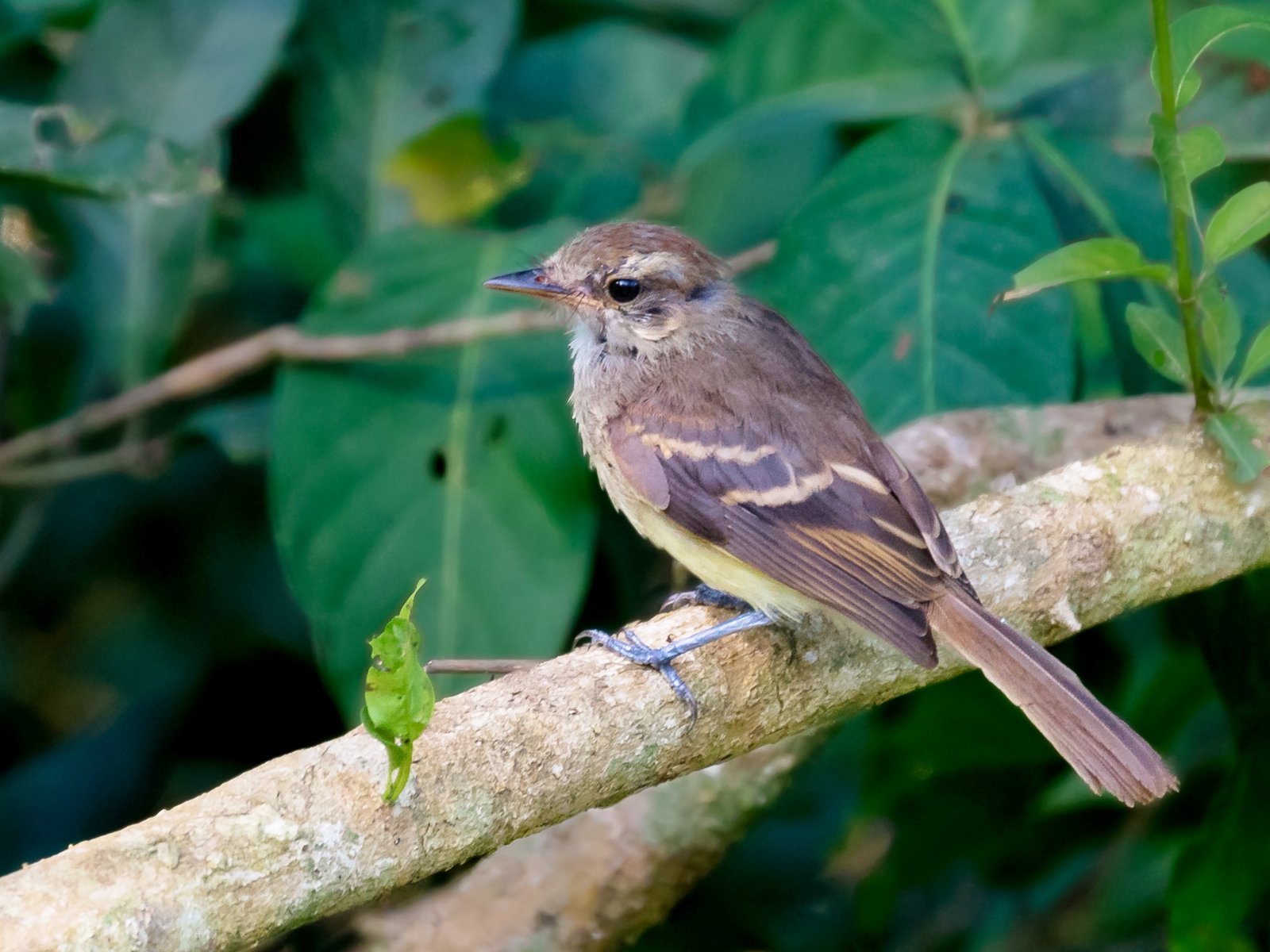
13.5–15 cm, slim and long-tailed, with a thin, fairly long bill: the upper mandible black, the base of the lower mandible dull pinkish. Crown and upperparts are warm brown with a rufous tinge. A whitish supercilium contrasts with dusky lores and eye-stripe. The wings are dark with two distinct buffy-brown wing bars. The throat is whitish, the breast olive-grey to grey-brown, the belly pale yellow. The sexes are alike.
Confusion species
Euler's Flycatcher Lathrotriccus euleri is slightly smaller and shorter-tailed, more olive-brown, with a whitish eye-ring instead of a supercilium and a yellower belly. Tropical Pewee Contopus cinereus is greyer, longer-winged and lacks a supercilium, and perches higher and more in the open. The northern Empidonax species are very rare in the south of the region and more olive.
Habitat
Dense, shady thickets and the lower storey of moist and dry forest, secondary woodland, forest edges and streamside growth, from sea level into the hills. It catches insects with short sallies from a low, sheltered perch and sits motionless for long periods. The nest is an open cup in a tree cavity, a crevice or among aerial roots.
Where the bird is most at home, classified by the vegetation types of the Caribbean.



Range and movements
Within the region a fairly common but inconspicuous resident in Trinidad and Tobago, on Tobago among other places in the Main Ridge forest. Absent elsewhere in the region. Outside the region throughout almost all of tropical and subtropical South America east of the Andes, from Colombia and Venezuela to Bolivia, Paraguay, Argentina and Uruguay.
- Resident
- Winter visitor (c. Apr–Sep)
- Passage (Mar–Apr, Oct–Nov)
- dark = core range, pale = thinly spread
How and when to look
Best found by listening along forest trails with dense undergrowth early in the morning. The bird often sits low and still in the shade; the supercilium and buffy wing bars confirm the identification.
Conservation status
Not threatened. The species has a very large range and also occurs in secondary woodland and thickets.
Scientific name
Cnemotriccus fuscatus | (Wied-Neuwied, 1831)
Wied-Neuwied described the species in 1831 as M[uscipeta] fuscata; because it was later moved to another genus, the author and year stand in brackets. The genus Cnemotriccus was introduced in 1927 by Hellmayr. Cnemotriccus is Greek, from knēmos 'mountain slope' and trikkos, an unidentified small bird, after the hilly coastal woodland of south-eastern Brazil where it was described. fuscatus is Latin for 'darkened', from fuscus 'dark', after the dull brown plumage. The specimen the first description was based on came from unknown; probably Rio de Janeiro, Brazil.