All species › Pelicans, herons and ibises › Herons and bitterns › Great Egret
Great Egret | Ardea alba
Grote zilverreiger | Garceta grande
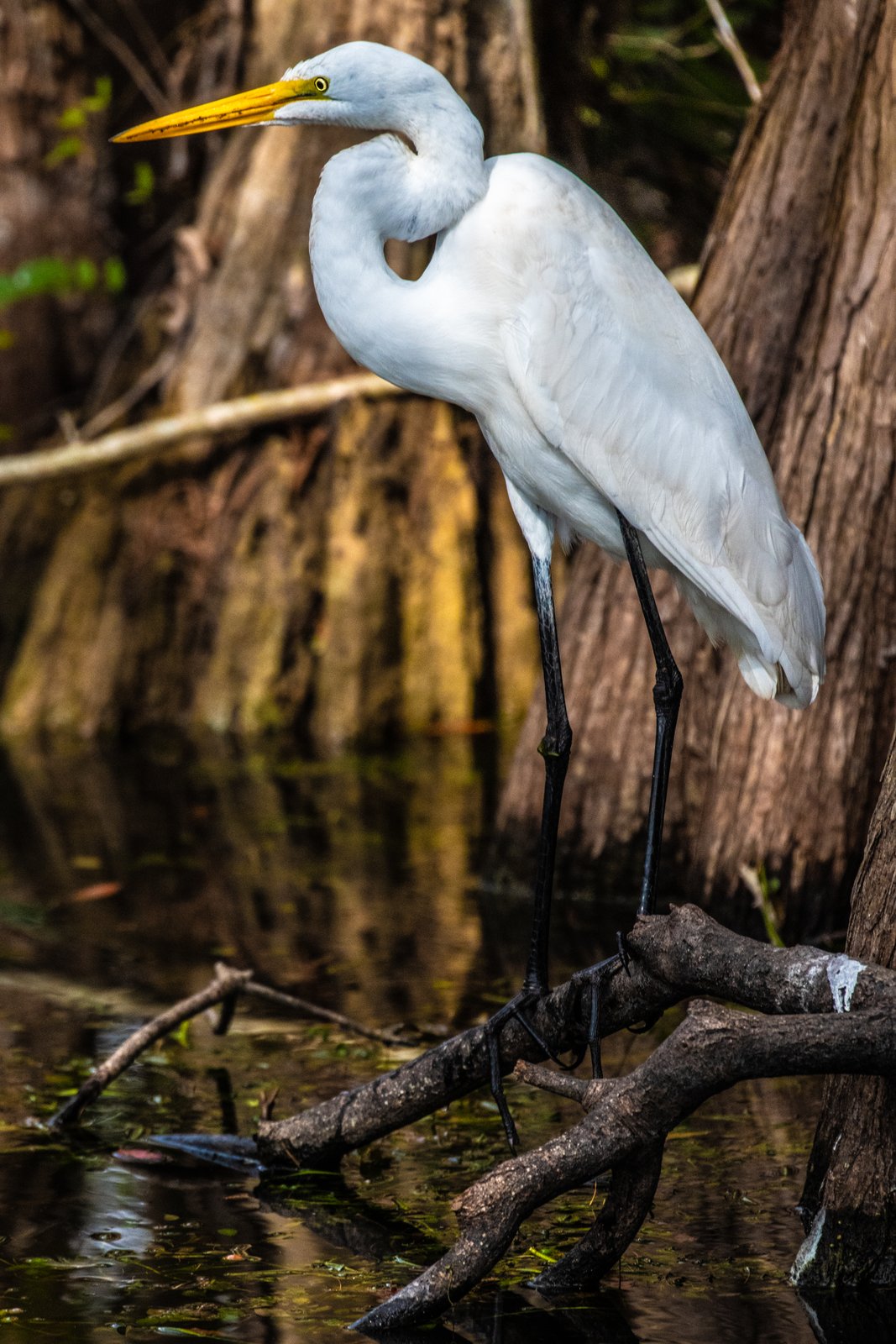
The Great Egret is the largest white egret in the region, a bird over a metre long with a long, thin neck held in a deep S-curve at rest. It hunts by stalking slowly or standing motionless in shallow water. Around 1900 the species was heavily persecuted in the Americas for the plumes of its breeding dress, which were used on women's hats.
Voice
Usually silent. When disturbed a low, hoarse, rattling kraak; at colonies various cackling and croaking sounds.
Recording: Manuel Grosselet — CC BY-NC-SA 4.0 · converted to mono · xeno-canto
Identification
94–104 cm, slender, with a long neck and long black legs with black feet. The plumage is entirely white. The bill is yellow and fairly heavy; the gape line extends behind the eye. In the breeding season long, lacy plumes grow on the back and reach beyond the tail, the bare lores turn bright green and the bill may become partly dark. The sexes are alike; juveniles resemble non-breeding adults. In flight the neck is withdrawn and the legs project well beyond the tail; the wingbeats are slow and deep.
Confusion species
Snowy Egret Egretta thula and Little Egret Egretta garzetta are much smaller, with a thin black bill and yellow feet. Young Little Blue Herons Egretta caerulea are white but smaller, with a greyish, dark-tipped bill and greenish legs. Western Cattle Egret Ardea ibis is small and stocky, with a short yellow bill and short neck. The white form of Great Blue Heron Ardea herodias is larger and heavier, with pale legs and a stouter bill.
Habitat
Freshwater marshes, shallow lagoons and salt pans, mangroves, the edges of lakes and ponds, rice fields, flooded grassland and tidal mudflats. It eats mainly fish, also frogs, crabs, large insects and sometimes small reptiles. It roosts and breeds in colonies, often with other herons, in mangroves or in trees and bushes over water; the nest is a platform of sticks.
Where the bird is most at home, classified by the vegetation types of the Caribbean.






Range and movements
Resident and breeding in the Bahamas, Cuba, Jamaica, Hispaniola (Haiti and the Dominican Republic), Puerto Rico, the ABC Islands and Trinidad, and also present in the Turks and Caicos Islands, the Cayman Islands, the Virgin Islands, Tobago, San Andrés and the islands of the Lesser Antilles, where it occurs mainly as a non-breeding visitor. Migrants from North America arrive in the northern winter. Outside the region in the Americas from southern Canada to Argentina and Chile, and also in Africa, southern and eastern Asia, Australia and parts of Europe.
- Resident
- Summer visitor (c. Oct–Mar)
- Winter visitor (c. Apr–Sep)
- Passage (Mar–Apr, Oct–Nov)
- dark = core range, pale = thinly spread
How and when to look
Large wetlands with shallow open water, such as the Zapata Peninsula in Cuba, the salt pans of Bonaire and the marshes around the Gulf of Paria in Trinidad, hold the largest numbers. At a distance it is best picked out among the other white egrets by its neck length, yellow bill and black feet.
Conservation status
Not threatened. Populations have recovered from the plume trade around 1900. Locally, the draining of wetlands, mangrove clearance and disturbance of breeding colonies are threats.
Scientific name
Ardea alba | Linnaeus, 1758
Linnaeus described the species in 1758 and placed it straight away in the genus where it still stands. He introduced the genus Ardea in that same work. Ardea is the Latin word for 'heron'. alba is Latin for 'white'. The specimen the first description was based on came from Europe.