All species › Passerines › Cardinals › Indigo Bunting
Indigo Bunting | Passerina cyanea
Indigogors | Azulillo índigo
The Indigo Bunting is a small cardinal that breeds along forest edges and in brushy ground in eastern North America. Much of the population winters in Central America, but in the western Caribbean it is one of the commonest migrants of open country in winter. In Cuba it is called azulejo. In 2012 a probable breeding record, the first for the West Indies, was documented in Cuba.
Voice
The call is a sharp, dry spit; in flight a high, buzzy zeeep. The song consists of paired high notes, roughly sweet-sweet chew-chew sweet-sweet, and may be heard in spring before departure.
Recording: Rory Nefdt — CC BY-NC-SA 4.0 · converted to mono · xeno-canto
Identification
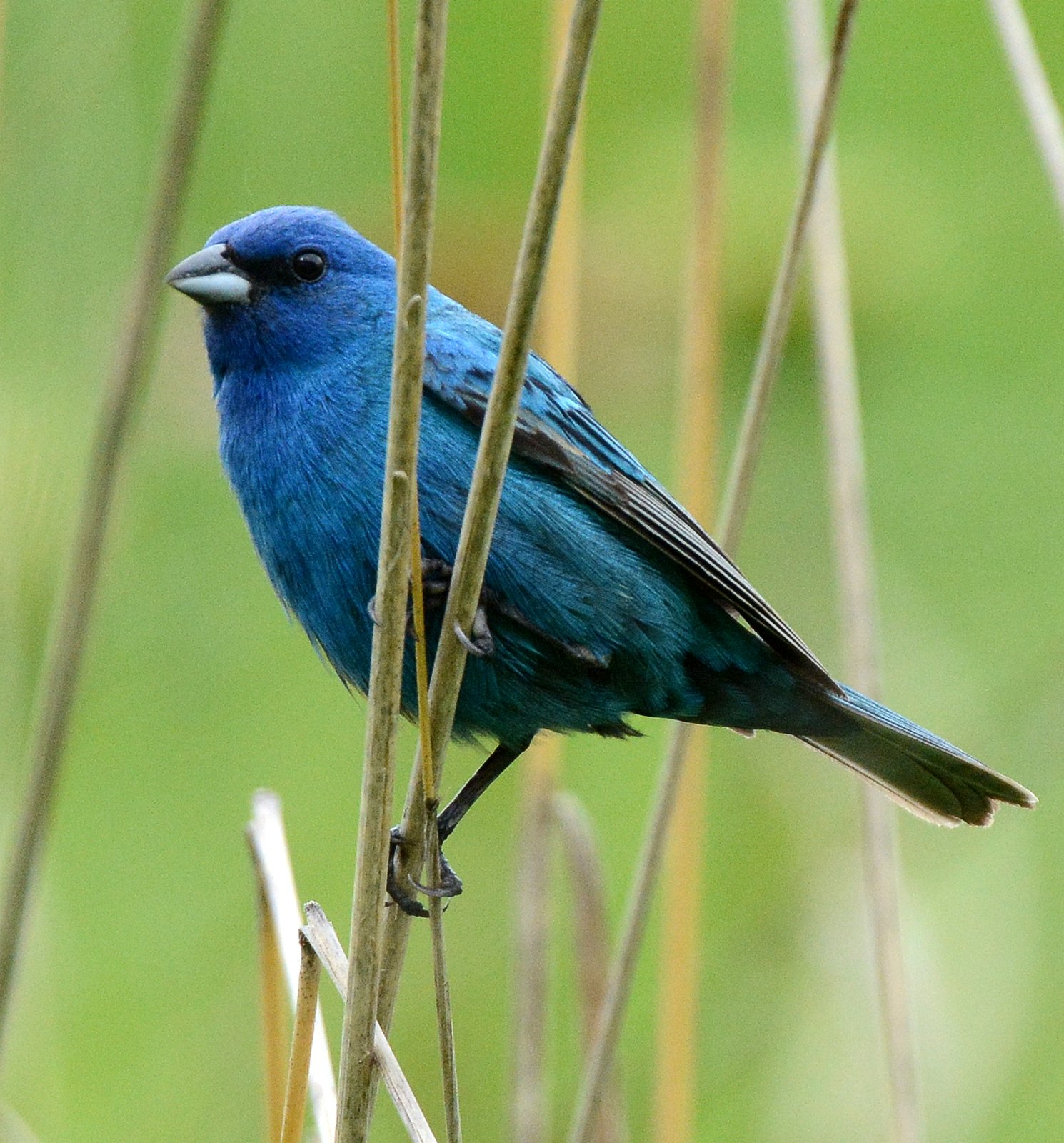
11.5–13 cm, with a short conical bill. The breeding male is entirely deep indigo blue, slightly darker on the head, with blackish flight feathers and tail. In winter the male is largely brown with scattered blue feathers, mainly on wings, tail and rump; in spring it gradually turns blue. The female is plain warm brown with a paler throat, faint streaks on the breast, indistinct wing bars and often a blue tinge to tail and shoulder. Juveniles resemble the female and are slightly more clearly streaked.
Confusion species
Blue Grosbeak Passerina caerulea is larger, with a much heavier bill and two broad cinnamon-brown wing bars, also in females. Male Blue-black Grassquit Volatinia jacarina is glossy blue-black rather than bright blue, with a more pointed bill. Female Painted Bunting Passerina ciris is green, not brown. Female Yellow-faced Grassquits Tiaris olivaceus are olive without breast streaks.
Habitat
Open and semi-open country with grass and shrubs: savanna, pasture, rough field margins, sugar cane, roadsides, coastal scrub and the edges of dry forest, also large gardens. In winter it eats mainly grass seeds, often in flocks that feed low in the grass and flush together when disturbed.
Where the bird is most at home, classified by the vegetation types of the Caribbean.






Range and movements
A common winter visitor in the Bahamas, Cuba, the Cayman Islands and Jamaica and a regular visitor to San Andrés and the Turks and Caicos Islands. Less numerous on Hispaniola, scarce to rare on Puerto Rico and the Virgin Islands, and a rare visitor or vagrant in the Lesser Antilles, the ABC Islands and Trinidad and Tobago. Breeds from south-eastern Canada to the southern and south-western United States; winters from southern Florida and Mexico through Central America to northern South America and in the West Indies.
- Resident
- Summer visitor (c. Oct–Mar)
- Winter visitor (c. Apr–Sep)
- Passage (Mar–Apr, Oct–Nov)
- dark = core range, pale = thinly spread
How and when to look
In winter in almost any rough grassland with seeding grasses on Cuba and Jamaica, often together with grassquits. The best times are early morning and late March to April, when the males turn blue and sometimes sing.
Conservation status
Not threatened. In the breeding range the species benefits from forest edges and disturbed ground. In Cuba it is trapped for the cage-bird trade.
Scientific name
Passerina cyanea | (Linnaeus, 1766)
Linnaeus described the species in 1766 as Tanagra cyanea; because it was later moved to another genus, the author and year stand in brackets. The genus Passerina was introduced in 1816 by Vieillot. Passerina comes from the Latin passerinus 'sparrow-like', from passer 'sparrow'. cyanea is Latin for 'blue', for the deep blue breeding plumage of the male. The specimen the first description was based on came from South Carolina.