All species › Passerines › Crows and jays › Jamaican Crow
Jamaican Crow | Corvus jamaicensis
Jamaicaanse kraai | Cuervo jamaicano
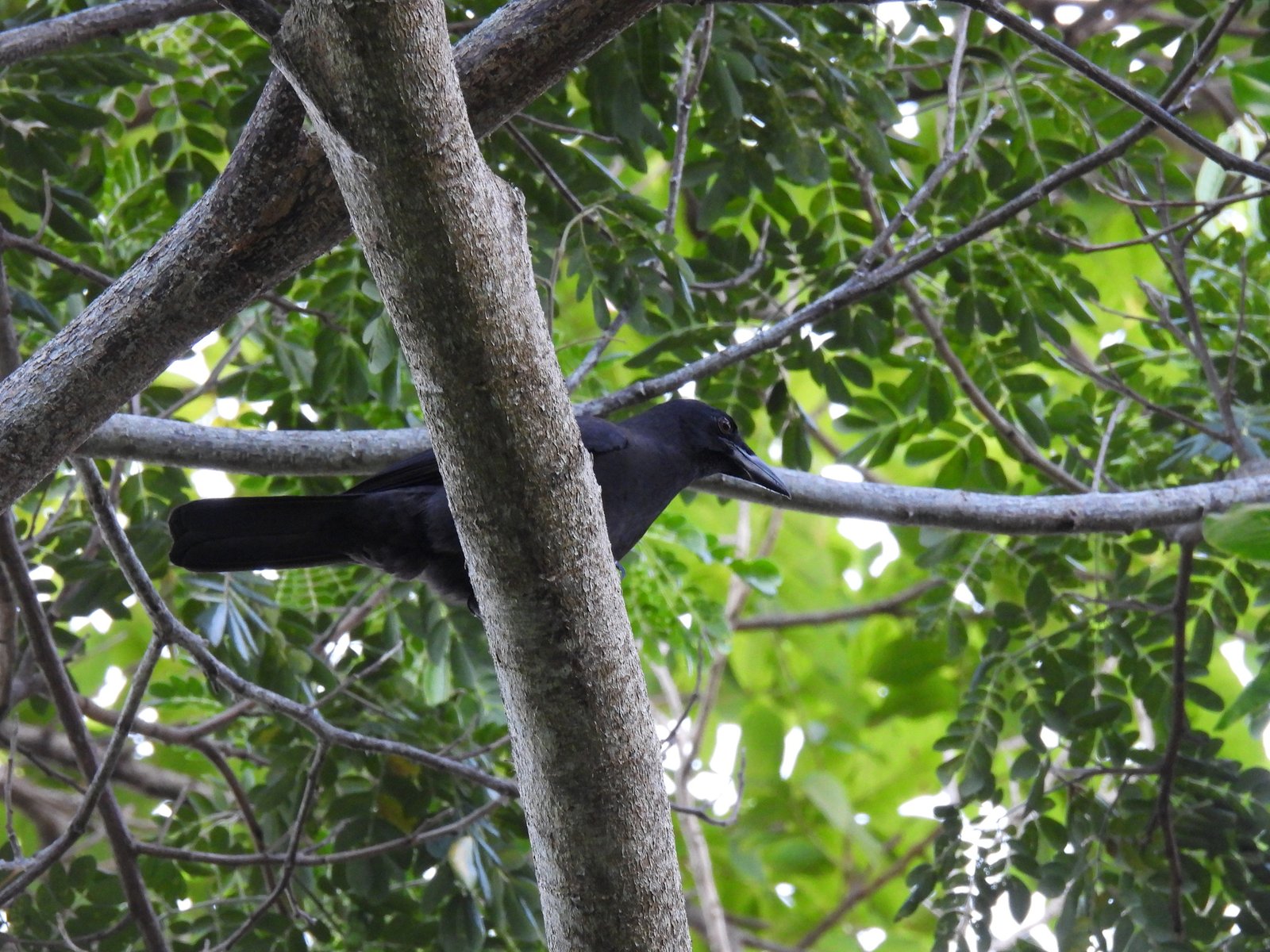
The Jamaican Crow is the only crow on Jamaica and occurs nowhere else. It is a fairly small, dull crow of the wooded hills and mountains, noticed mainly through its jabbering and bubbling calls, which have earned it the local name jabbering crow. It lives in pairs or small groups and eats a lot of fruit.
Voice
A series of jabbering, bubbling and cackling sounds, often kept up at length, interspersed with a slow, harsh craa-aa and musical, gurgling notes. It sounds unlike any North American crow.
Recording: Ross Gallardy — CC BY-NC-SA 4.0 · converted to mono · xeno-canto
Identification
35–38 cm, with a deep, sharply tapering, slate-grey bill. The plumage is uniformly sooty grey to blackish, lacking the gloss of the other Caribbean crows. There is a patch of bare dark grey skin behind the eye and a smaller one at the base of the bill. The nasal bristles are sparse, leaving the nostrils exposed. The iris is grey-brown to red-brown, possibly varying with age. Legs black. The sexes are alike.
Confusion species
There is no other crow on Jamaica. Greater Antillean Grackle Quiscalus niger is much smaller and glossy black, with a slender bill, a yellow iris and a keeled tail. Turkey Vulture Cathartes aura is larger in flight, with a bare red head and long wings held in a V.
Habitat
Wet forest on limestone and in the hills, forest edges and a mosaic of woodland with clearings, small-scale farming and larger gardens. Mainly in the hills and mountains, descending lower in the dry season. It takes fruit in the canopy, probes under bark and in leaf litter for invertebrates and lizards, and robs the nests of other birds of eggs and young. The nest is placed high in a tree.
Where the bird is most at home, classified by the vegetation types of the Caribbean.





Range and movements
Only on Jamaica, mainly in the wooded hills and mountains of the west and centre of the island, with Cockpit Country as the main stronghold; scarcer in the east. It does not occur outside Jamaica.
- Resident
- dark = core range, pale = thinly spread
How and when to look
Best looked for in Cockpit Country and other wooded limestone hills in western and central Jamaica, in the morning, when groups move noisily through the canopy. The jabbering calls usually give the birds away before they are seen.
Conservation status
Near Threatened. The range is small, and the forest the species depends on is shrinking through clearance and bauxite mining.
Scientific name
Corvus jamaicensis | Gmelin, 1788
Gmelin described the species in 1788 and placed it straight away in the genus where it still stands. The genus Corvus was introduced in 1758 by Linnaeus. Corvus is the Latin word for 'raven'. jamaicensis means 'of Jamaica', the island to which this crow is restricted. The specimen the first description was based on came from Jamaica.