All species › Passerines › New World blackbirds › Jamaican Oriole
Jamaican Oriole | Icterus leucopteryx
Witvleugeltroepiaal | Turpial de Jamaica
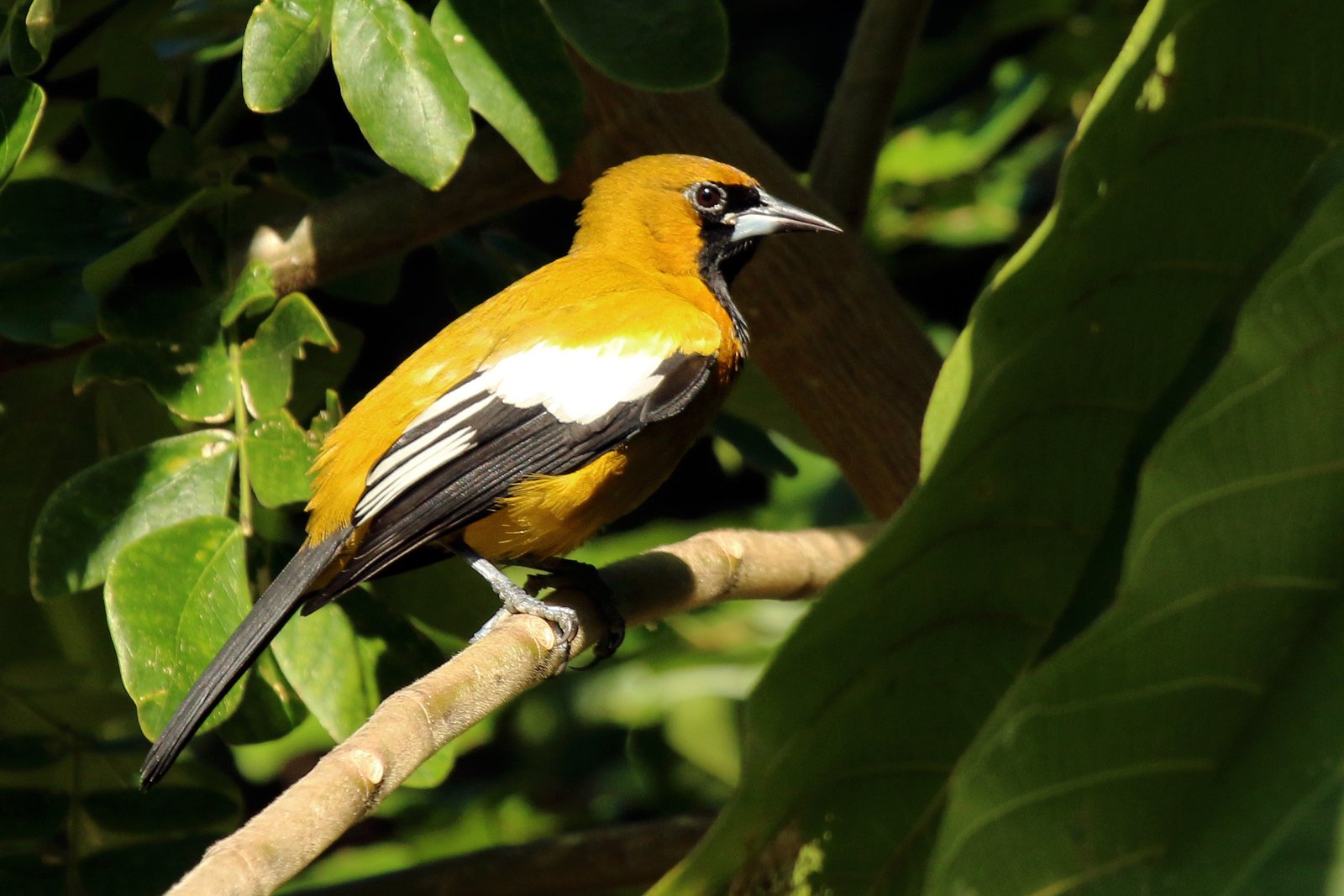
The Jamaican Oriole is a yellow-green oriole with a black mask and a white wing patch, living on Jamaica and the Colombian island of San Andrés. A third subspecies, bairdi of Grand Cayman, is extinct. It forages in a way unusual for orioles, prising off bark and searching bromeliads for insects. In Jamaica it is traditionally called Auntie Katie.
Voice
The song is a clear, whistled yoo-cheet or cheet-yoo, and repeated variants such as tee-tee-woo. Also a harsh chuck.
Recording: Bobby Wilcox — CC BY-NC-SA 4.0 · converted to mono · xeno-canto
Identification
20–22 cm, with a fairly long tail and a stout, pointed bill. The nominate form of Jamaica is olive-yellow above and yellow below, with a black mask, black throat and black tail. The wings are black with a large white patch across the coverts. The form lawrencii of San Andrés is brighter yellow-green, with lemon-yellow underparts. The female resembles the male but is slightly duller. Immatures are greener and duller.
Confusion species
Baltimore Oriole Icterus galbula and Orchard Oriole Icterus spurius winter on Jamaica and San Andrés; females and young of those species are smaller, lack the black mask and have two narrow white wing bars instead of a white patch. Jamaican Blackbird Nesopsar nigerrimus is all black.
Habitat
Forest of all types except mangroves, open woodland, plantations and gardens, from the lowlands into the mountains. It forages in pairs or family groups, stripping bark from branches, searching bromeliads and eating insects and other arthropods, supplemented by fruit and nectar.
Where the bird is most at home, classified by the vegetation types of the Caribbean.






Range and movements
Resident throughout Jamaica at all elevations, and on San Andrés, with the subspecies lawrencii. The subspecies bairdi occurred on Grand Cayman and is extinct. The species does not occur outside these islands.
- Resident
- dark = core range, pale = thinly spread
How and when to look
On Jamaica it is common in gardens, parks and forest edges, including in Kingston. The whistled yoo-cheet often reveals its presence; feeding birds work along branches and bromeliads.
Conservation status
Not threatened; both remaining subspecies are common and stable. The Grand Cayman subspecies disappeared in the twentieth century.
Scientific name
Icterus leucopteryx | (Wagler, 1827)
Wagler described the species in 1827 as Ps[arocolius] Leucopteryx; because it was later moved to another genus, the author and year stand in brackets. The genus Icterus was introduced in 1760 by Brisson. Icterus is from Ancient Greek ikteros, a yellow bird usually taken to be the golden oriole, the sight of which was thought to cure jaundice. leucopteryx is Greek, from leukos 'white' and pterux 'wing', after the white wing patch. The specimen the first description was based on came from Saint Andrew, Jamaica.