All species › Passerines › Waxbills › Java Sparrow
Java Sparrow | Padda oryzivora
Rijstvogel | Capuchino arrocero de Java
The Java Sparrow is the largest estrildid finch, roughly the size of a House Sparrow, and comes from Java, Bali and Bawean in Indonesia. As a cage bird it is found worldwide, whereas the wild population in its native range has declined sharply. In the Caribbean only Puerto Rico holds a small, local population, mainly in and around San Juan.
Voice
A short, clear chip or tchee, often in flight. The song is a series of rapidly repeated clicking and bell-like notes running into a trill.
Recording: Sam Hambly — CC BY 4.0 · Converted to mp3, mono, full length · iNaturalist
Identification
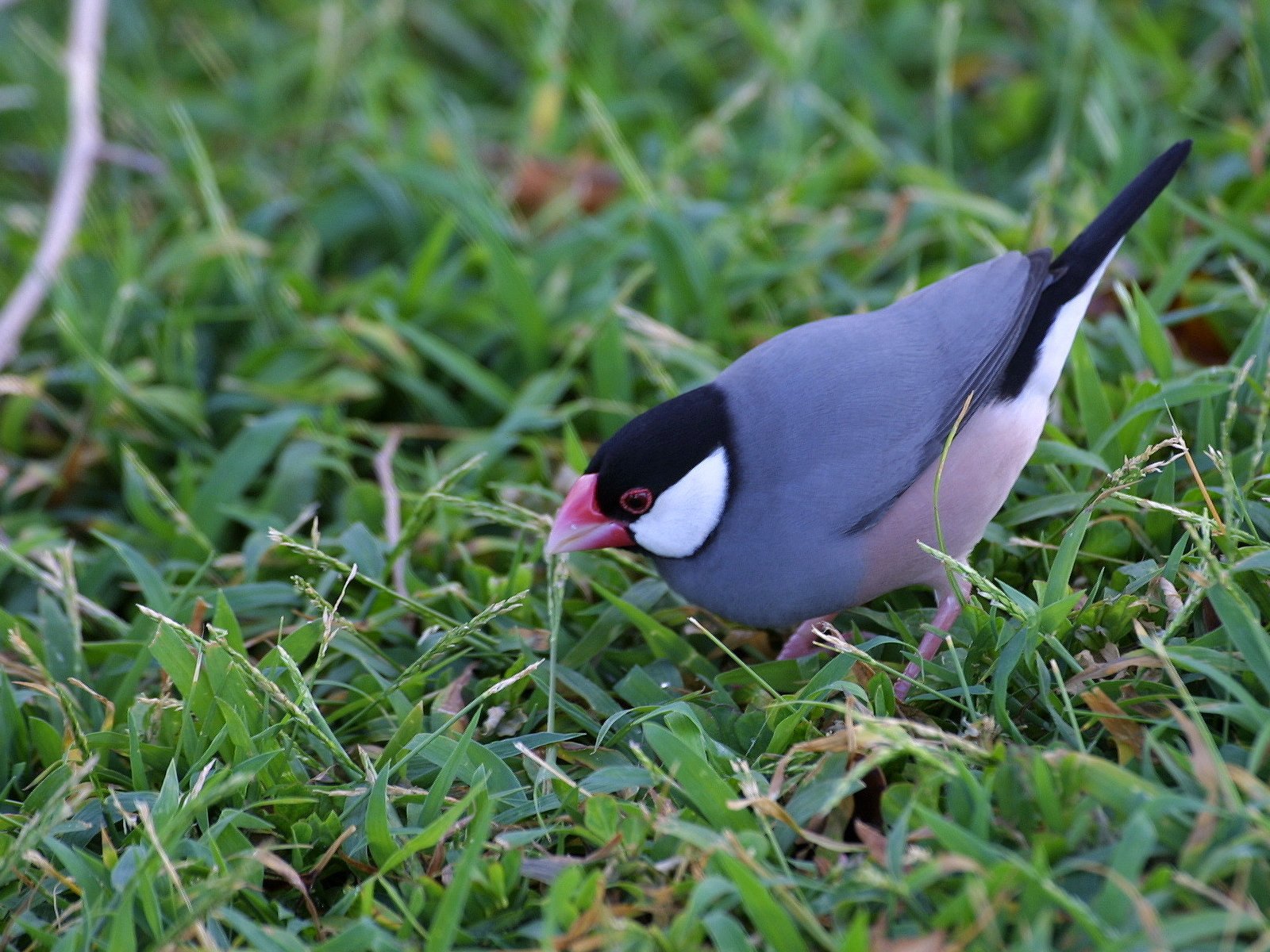
15–17 cm, sturdy, with a heavy red conical bill and a red eye-ring. Head and throat are black, with a large white cheek patch. Back, wings and breast are blue-grey, the belly pinkish grey and the undertail coverts white. The tail is black and the legs pink. The sexes are alike. Juveniles are grey-brown above and pale brown below, with an indistinctly marked head and a dark bill with a pink base. Escaped cage birds may be white or pied colour forms.
Confusion species
An adult cannot be confused with any other species in the region. Juveniles recall a female House Sparrow Passer domesticus, but are plainer and greyer, without streaks on the back, with a pale cheek and a thicker bill with a pink base. The munias, such as Scaly-breasted Munia Lonchura punctulata, are much smaller.
Habitat
On Puerto Rico in urban and suburban areas: parks, gardens, lawns, verges and waste ground, and in surrounding farmland. In the native range open grassland and cultivation, especially rice fields. It eats grain and other seeds, often from the ground. It nests in holes and crevices in trees and buildings, under eaves or in the crowns of palms.
Where the bird is most at home, classified by the vegetation types of the Caribbean.




Range and movements
Locally established on Puerto Rico, mainly in the San Juan metropolitan area. Occasional records have been reported from Jamaica, and elsewhere in the region all records concern single escapes. Native to Java, Bali and Bawean. Introduced in many places, including Hawaii and parts of South-east Asia.
- Resident
- dark = core range, pale = thinly spread
How and when to look
Best found in parks and on grassy areas in and around San Juan, often in small groups searching the ground for seeds. The large white cheek and red bill are visible even at a distance.
Conservation status
Globally threatened. The wild population in Indonesia has declined sharply due to trapping for the cage-bird trade, control as a pest in rice fields and habitat loss. The Puerto Rican population is small and local; the number of reports in recent years is lower than around 2006.
Scientific name
Padda oryzivora | (Linnaeus, 1758) (GBIF: Lonchura oryzivora)
Linnaeus described the species in 1758 as Loxia oryzivora; because it was later moved to another genus, the author and year stand in brackets. The genus Padda was introduced in 1850 by Reichenbach. Padda was already used by George Edwards in 1743 as an English name for the Java sparrow, probably from Malay padi 'rice (in the husk)'. oryzivora is Latin, from oryza 'rice' and -vorus '-eating': 'rice-eater', after its reputation as a pest of rice fields. The specimen the first description was based on came from Java.